The Drawer Marked Empty
Una historia gratuita en inglés de nivel B2 para estudiantes, para leer en línea en 7 idiomas, con opción de escucharla en la app gratuita Storyteller.
A shop assistant writes one careless word on an insurance form, and a visiting valuer gently asks her to look again.
¡Ese fue el avance! Escucha la historia completa en la app gratuita Storyteller. Descargar la app
El audio no está disponible en este momento.
Edin had worked in the stamp and coin shop for nine months before she finally admitted that she disliked one drawer. It was the bottom one of the long oak counter, the only one with a lock. Nobody had ever found the key.
Edin llevaba nueve meses trabajando en la tienda de sellos y monedas antes de admitir por fin que no le gustaba un cajón. Era el de abajo del largo mostrador de roble, el único con cerradura. Nadie había encontrado nunca la llave.
The owner, a quiet man who had moved to the coast in the spring, had left her a binder of instructions. Page forty said only, "Do not worry about the locked drawer. It is not important."
El dueño, un hombre callado que se había mudado a la costa en primavera, le había dejado una carpeta con instrucciones. La página cuarenta solo decía: «No se preocupe por el cajón cerrado. No es importante».
For months she had obeyed him. She sold albums of postage stamps to schoolchildren, polished silver coins for retired engineers, and learned to tell a real misprint from a smudge. The drawer sat below her knees like a small, stubborn animal.
Durante meses lo obedeció. Vendió álbumes de sellos postales a escolares, pulió monedas de plata para ingenieros jubilados y aprendió a distinguir un verdadero error de impresión de una mancha. El cajón estaba debajo de sus rodillas como un animal pequeño y obstinado.
Then the insurance company sent a form. Every item in the shop had to be listed, counted, and valued before the end of the month.
Entonces la compañía de seguros mandó un formulario. Cada artículo de la tienda debía ser listado, contado y valorado antes de fin de mes.
"Everything?" Edin asked the empty shop, and the shop did not answer.
«¿Todo?», le preguntó Edin a la tienda vacía, y la tienda no respondió.
She worked for three evenings, with the sign turned to closed. She counted the albums, weighed the loose coins, and photographed the glass cases. When she reached the last line of the form, which was headed "Contents of locked storage," she hesitated.
Trabajó durante tres tardes, con el letrero girado a «cerrado». Contó los álbumes, pesó las monedas sueltas y fotografió las vitrinas. Cuando llegó a la última línea del formulario, que llevaba el título «Contenido del almacenamiento con llave», dudó.
She knocked on the drawer with one knuckle. It sounded hollow, or at least she decided that it did. She wanted to go home, and the owner had called it unimportant, so she wrote one word in the box. Empty.
Golpeó el cajón con un nudillo. Sonó hueco, o al menos decidió que así sonaba. Quería irse a casa, y el dueño lo había llamado sin importancia, así que escribió una palabra en la casilla. Vacío.
Two days later Cato came into the shop. He was a thin man in a faded grey jacket, with a magnifying glass on a cord around his neck. He introduced himself as a valuer sent by the insurance company to check her figures.
Dos días después entró Cato en la tienda. Era un hombre delgado con una chaqueta gris desteñida y una lupa colgada de un cordón al cuello. Se presentó como un tasador enviado por la compañía de seguros para verificar sus cifras.
"I will not take long," he said. "Most of these visits are a formality."
«No tardaré mucho», dijo. «La mayoría de estas visitas son una formalidad».
"I hope so," said Edin. "I did everything carefully."
«Eso espero», dijo Edin. «Lo hice todo con cuidado».
He moved through the shop with a patient, slightly sleepy manner, opening cases and reading labels. Now and then he made a small note in a book with a green cover. Edin pretended to rearrange the pens on the counter, though she had arranged them twice already.
Se movió por la tienda con un aire paciente y algo soñoliento, abriendo vitrinas y leyendo etiquetas. De vez en cuando hacía una pequeña anotación en un cuaderno de tapa verde. Edin fingía reacomodar los bolígrafos sobre el mostrador, aunque ya los había acomodado dos veces.
After an hour he stopped beside the oak counter and rested his hand on top of it. Then he stood very still, as if he were listening to something far away.
Después de una hora se detuvo junto al mostrador de roble y apoyó la mano encima. Luego se quedó muy quieto, como si escuchara algo muy lejano.
"Is there a problem?" she asked.
«¿Hay algún problema?», preguntó ella.
"Not at all. I only noticed that your bottom drawer is locked." He tilted his head. "The form says it is empty."
«Para nada. Solo noté que su cajón de abajo está cerrado con llave». Ladeó la cabeza. «El formulario dice que está vacío».
"It is. The owner told me it was not important."
«Lo está. El dueño me dijo que no era importante».
"People say that about many things." Cato crouched down, with a small groan, and tapped the front of the drawer the way she had done. Then he slid his fingers underneath and tipped the whole counter very slightly towards himself.
«La gente dice eso de muchas cosas». Cato se agachó, con un pequeño gemido, y golpeó el frente del cajón como ella había hecho. Luego deslizó los dedos por debajo e inclinó todo el mostrador muy ligeramente hacia sí.
Something shifted inside the drawer with a soft, heavy sound.
Algo se movió dentro del cajón con un sonido suave y pesado.
Edin felt her stomach drop. "That might be the wood moving," she said weakly.
A Edin se le encogió el estómago. «Puede ser la madera moviéndose», dijo débilmente.
"Wood does not usually clink," said Cato. He was not unkind about it. He simply stayed where he was, on one knee, waiting for her to decide what kind of person she wanted to be.
«La madera no suele tintinear», dijo Cato. No lo dijo con crueldad. Simplemente se quedó donde estaba, sobre una rodilla, esperando a que ella decidiera qué clase de persona quería ser.
"I should have asked," she said at last. "I wrote that it was empty because I did not want to be the one to open it. That was a mistake, and I knew it was one while I was writing."
«Debí preguntar», dijo ella por fin. «Escribí que estaba vacío porque no quería ser quien lo abriera. Fue un error, y sabía que lo era mientras lo escribía».
"Then it is a mistake you have already half corrected," said Cato.
«Entonces es un error que ya ha corregido a medias», dijo Cato.
She laughed in spite of herself. "How do you open a drawer without a key?"
Rio a pesar de sí misma. «¿Cómo se abre un cajón sin llave?».
"Gently, if possible." He took a thin strip of metal from his jacket pocket. "I carry this for old cabinets. It has never been used on anything I was not asked to open. May I?"
«Con delicadeza, de ser posible». Sacó una tira delgada de metal del bolsillo de la chaqueta. «La llevo para armarios viejos. Nunca se ha usado en nada que no me hayan pedido abrir. ¿Me permite?».
"Please. It is my signature on the form, so it is my problem."
«Por favor. Es mi firma la que está en el formulario, así que es mi problema».
It took him almost ten minutes. Edin held the lamp and tried not to breathe too loudly. When the lock finally gave way, it did so with a small, dry click, like a tongue against teeth.
Le tomó casi diez minutos. Edin sostuvo la lámpara e intentó no respirar demasiado fuerte. Cuando por fin cedió la cerradura, lo hizo con un clic pequeño y seco, como una lengua contra los dientes.
The drawer slid out slowly. Inside lay a flat tray of faded blue velvet, and on the velvet rested forty or fifty coins, each one set in its own hollow. Beside them was a bundle of stamps wrapped in thin paper, tied with a piece of string that had gone brittle with age.
El cajón se deslizó lentamente. Dentro había una bandeja plana de terciopelo azul desteñido, y sobre el terciopelo descansaban cuarenta o cincuenta monedas, cada una en su propio hueco. A su lado había un fajo de sellos envueltos en papel fino, atado con un cordel que se había vuelto quebradizo con los años.
Neither of them spoke for a while.
Ninguno de los dos habló durante un rato.
"These are not ordinary," Cato said finally. He lifted the magnifying glass and bent over the tray. "This is a coin from a mint that closed more than a century ago. And this one, here, has a flaw in the lettering. Collectors search for that kind of flaw for years."
«Estas no son comunes», dijo Cato finalmente. Levantó la lupa y se inclinó sobre la bandeja. «Esta es una moneda de una casa de moneda que cerró hace más de un siglo. Y esta, aquí, tiene un defecto en las letras. Los coleccionistas buscan ese tipo de defecto durante años».
"The owner never mentioned any of it."
«El dueño nunca mencionó nada de esto».
"Perhaps he had forgotten. Perhaps he did not know. A drawer can be locked by one person and inherited by another, and the reason can disappear along the way." Cato straightened up slowly. "What matters is that if there had been a fire last winter, you would have been paid for an empty drawer."
«Quizás lo había olvidado. Quizás no lo sabía. Un cajón puede ser cerrado por una persona y heredado por otra, y el motivo puede desaparecer por el camino». Cato se enderezó lentamente. «Lo que importa es que, si el invierno pasado hubiera habido un incendio, le habrían pagado por un cajón vacío».
Edin sat down on the stool behind the counter. "So my honest mistake could have cost the owner a small fortune."
Edin se sentó en el taburete detrás del mostrador. «Así que mi error honesto podría haberle costado una pequeña fortuna al dueño».
"It could have. But it didn't, because the figures were checked before anything happened." He closed his green notebook. "That is the entire purpose of my job. Nobody expects people to be perfect. We only hope they will be corrected in time."
«Podría. Pero no fue así, porque las cifras se verificaron antes de que pasara nada». Cerró su cuaderno verde. «Ese es todo el propósito de mi trabajo. Nadie espera que la gente sea perfecta. Solo esperamos que sea corregida a tiempo».
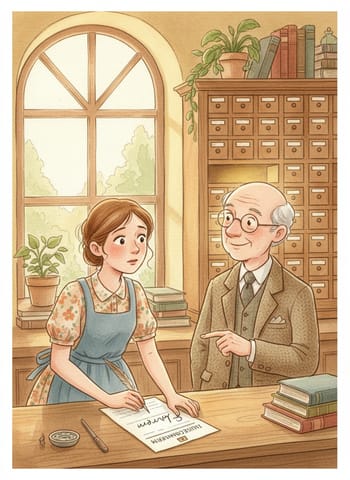
She took a pen and drew a line through the word on the form. Her handwriting was shakier than usual. Beneath it she wrote a new description, listing the coins by number, and she left a blank space for the value.
Ella tomó un bolígrafo y tachó la palabra del formulario. Su letra estaba más temblorosa que de costumbre. Debajo escribió una descripción nueva, listando las monedas por número, y dejó un espacio en blanco para el valor.
"How long will the valuation take?" she asked.
«¿Cuánto tardará la tasación?», preguntó.
"A week, perhaps two. I will need to weigh each piece and compare it with the records." He looked around the shop with new interest. "You may want to move these somewhere safer. And you might want to tell the owner before the news reaches him by post."
«Una semana, quizás dos. Tendré que pesar cada pieza y compararla con los registros». Miró la tienda con nuevo interés. «Quizás quiera mover esto a un lugar más seguro. Y quizás quiera avisar al dueño antes de que la noticia le llegue por correo».
"He will be astonished."
«Se va a asombrar».
"Or he will say that he always knew." Cato smiled. "Men who leave their treasures in a locked drawer often prefer to be mysterious about it."
«O dirá que siempre lo supo». Cato sonrió. «Los hombres que dejan sus tesoros en un cajón cerrado suelen preferir ser misteriosos al respecto».
Edin picked up the telephone, then put it down again. She was not sure yet what she would say. It seemed wrong to hurry that call, and wrong to delay it as well.
Edin levantó el teléfono, y luego lo volvió a dejar. Todavía no estaba segura de qué diría. Le parecía mal apurar esa llamada, y mal retrasarla también.
Instead she brought two cups of water from the back room and set one beside the velvet tray. For a few minutes they sat together in the lamplight and looked at the little coins. Each one waited patiently in its own hollow, as it had waited for years.
En cambio trajo dos vasos de agua de la trastienda y puso uno junto a la bandeja de terciopelo. Durante unos minutos se sentaron juntos a la luz de la lámpara y miraron las pequeñas monedas. Cada una esperaba pacientemente en su hueco, como había esperado durante años.
"Mr. Cato," she said eventually, "if the owner wanted the drawer found, would he hide the key somewhere obvious, or where no one would look?"
«Señor Cato», dijo ella al cabo de un rato, «si el dueño hubiera querido que se encontrara el cajón, ¿escondería la llave en un lugar obvio, o donde nadie buscaría?».
He turned the magnifying glass over in his hands. "That," he said, "is a very good question. Which answer would you prefer to believe?"
Él dio vueltas a la lupa entre las manos. «Esa», dijo, «es una muy buena pregunta. ¿Qué respuesta prefiere creer?».