The Drawer Marked Empty
Uma história gratuita em inglês de nível B2 para estudantes, para ler online em 7 idiomas, com opção de ouvir no app gratuito Storyteller.
A shop assistant writes one careless word on an insurance form, and a visiting valuer gently asks her to look again.
Essa foi a prévia! Ouça a história completa no app gratuito Storyteller. Baixar o app
O áudio não está disponível no momento.
Edin had worked in the stamp and coin shop for nine months before she finally admitted that she disliked one drawer. It was the bottom one of the long oak counter, the only one with a lock. Nobody had ever found the key.
Edin trabalhava na loja de selos e moedas havia nove meses quando finalmente admitiu que não gostava de uma das gavetas. Era a de baixo do longo balcão de carvalho, a única com fechadura. Ninguém jamais encontrara a chave.
The owner, a quiet man who had moved to the coast in the spring, had left her a binder of instructions. Page forty said only, "Do not worry about the locked drawer. It is not important."
O dono, um homem calado que se mudara para o litoral na primavera, deixara para ela um fichário de instruções. A página quarenta dizia apenas: "Não se preocupe com a gaveta trancada. Ela não é importante."
For months she had obeyed him. She sold albums of postage stamps to schoolchildren, polished silver coins for retired engineers, and learned to tell a real misprint from a smudge. The drawer sat below her knees like a small, stubborn animal.
Durante meses ela o obedecera. Vendera álbuns de selos postais para crianças da escola, polira moedas de prata para engenheiros aposentados e aprendera a distinguir um erro de impressão verdadeiro de uma mancha. A gaveta ficava abaixo dos joelhos dela como um animalzinho teimoso.
Then the insurance company sent a form. Every item in the shop had to be listed, counted, and valued before the end of the month.
Então a seguradora mandou um formulário. Cada item da loja precisava ser listado, contado e avaliado até o fim do mês.
"Everything?" Edin asked the empty shop, and the shop did not answer.
"Tudo?", perguntou Edin à loja vazia, e a loja não respondeu.
She worked for three evenings, with the sign turned to closed. She counted the albums, weighed the loose coins, and photographed the glass cases. When she reached the last line of the form, which was headed "Contents of locked storage," she hesitated.
Ela trabalhou três noites, com a placa virada para "fechado". Contou os álbuns, pesou as moedas soltas e fotografou as vitrines de vidro. Quando chegou à última linha do formulário, intitulada "Conteúdo de armazenamento trancado", hesitou.
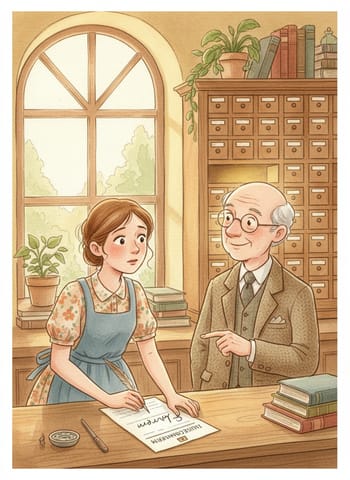
She knocked on the drawer with one knuckle. It sounded hollow, or at least she decided that it did. She wanted to go home, and the owner had called it unimportant, so she wrote one word in the box. Empty.
Bateu na gaveta com um nó de dedo. Soou oca, ou pelo menos ela decidiu que soou. Queria ir para casa, e o dono dissera que a gaveta não era importante, então escreveu uma palavra no campo. Vazia.
Two days later Cato came into the shop. He was a thin man in a faded grey jacket, with a magnifying glass on a cord around his neck. He introduced himself as a valuer sent by the insurance company to check her figures.
Dois dias depois, Cato entrou na loja. Era um homem magro, de jaqueta cinza desbotada, com uma lupa pendurada no pescoço por um cordão. Apresentou-se como um avaliador enviado pela seguradora para conferir os números dela.
"I will not take long," he said. "Most of these visits are a formality."
"Não vou demorar", disse ele. "A maioria dessas visitas é só formalidade."
"I hope so," said Edin. "I did everything carefully."
"Espero que sim", disse Edin. "Fiz tudo com cuidado."
He moved through the shop with a patient, slightly sleepy manner, opening cases and reading labels. Now and then he made a small note in a book with a green cover. Edin pretended to rearrange the pens on the counter, though she had arranged them twice already.
Ele percorreu a loja com um jeito paciente e meio sonolento, abrindo vitrines e lendo etiquetas. De vez em quando fazia uma pequena anotação num caderno de capa verde. Edin fingia reorganizar as canetas sobre o balcão, embora já as tivesse arrumado duas vezes.
After an hour he stopped beside the oak counter and rested his hand on top of it. Then he stood very still, as if he were listening to something far away.
Depois de uma hora, ele parou ao lado do balcão de carvalho e apoiou a mão em cima dele. Então ficou muito imóvel, como se escutasse algo muito distante.
"Is there a problem?" she asked.
"Algum problema?", perguntou ela.
"Not at all. I only noticed that your bottom drawer is locked." He tilted his head. "The form says it is empty."
"De modo algum. Só reparei que a sua gaveta de baixo está trancada." Ele inclinou a cabeça. "O formulário diz que está vazia."
"It is. The owner told me it was not important."
"Está. O dono disse que não era importante."
"People say that about many things." Cato crouched down, with a small groan, and tapped the front of the drawer the way she had done. Then he slid his fingers underneath and tipped the whole counter very slightly towards himself.
"As pessoas dizem isso de muitas coisas." Cato se agachou, com um pequeno gemido, e bateu na frente da gaveta como ela havia feito. Depois deslizou os dedos por baixo e inclinou o balcão inteiro, bem de leve, na direção dele.
Something shifted inside the drawer with a soft, heavy sound.
Algo se deslocou dentro da gaveta com um som suave e pesado.
Edin felt her stomach drop. "That might be the wood moving," she said weakly.
Edin sentiu o estômago despencar. "Pode ser a madeira se movendo", disse ela, fraca.
"Wood does not usually clink," said Cato. He was not unkind about it. He simply stayed where he was, on one knee, waiting for her to decide what kind of person she wanted to be.
"Madeira geralmente não tilinta", disse Cato. Ele não foi indelicado ao dizer isso. Simplesmente ficou onde estava, sobre um joelho, esperando que ela decidisse que tipo de pessoa queria ser.
"I should have asked," she said at last. "I wrote that it was empty because I did not want to be the one to open it. That was a mistake, and I knew it was one while I was writing."
"Eu devia ter perguntado", disse ela por fim. "Escrevi que estava vazia porque não queria ser a pessoa a abri-la. Foi um erro, e eu sabia que era um erro enquanto escrevia."
"Then it is a mistake you have already half corrected," said Cato.
"Então é um erro que você já corrigiu pela metade", disse Cato.
She laughed in spite of herself. "How do you open a drawer without a key?"
Ela riu, apesar de si mesma. "Como se abre uma gaveta sem chave?"
"Gently, if possible." He took a thin strip of metal from his jacket pocket. "I carry this for old cabinets. It has never been used on anything I was not asked to open. May I?"
"Com delicadeza, se possível." Ele tirou do bolso da jaqueta uma fina tira de metal. "Eu a carrego para armários antigos. Nunca foi usada em nada que eu não tivesse sido pedido para abrir. Posso?"
"Please. It is my signature on the form, so it is my problem."
"Por favor. A assinatura no formulário é minha, então o problema é meu."
It took him almost ten minutes. Edin held the lamp and tried not to breathe too loudly. When the lock finally gave way, it did so with a small, dry click, like a tongue against teeth.
Levou quase dez minutos. Edin segurou a lâmpada e tentou não respirar alto demais. Quando a fechadura por fim cedeu, fez um clique pequeno e seco, como uma língua batendo nos dentes.
The drawer slid out slowly. Inside lay a flat tray of faded blue velvet, and on the velvet rested forty or fifty coins, each one set in its own hollow. Beside them was a bundle of stamps wrapped in thin paper, tied with a piece of string that had gone brittle with age.
A gaveta deslizou devagar. Dentro havia uma bandeja plana de veludo azul desbotado e, sobre o veludo, repousavam quarenta ou cinquenta moedas, cada uma encaixada em seu próprio nicho. Ao lado delas, um maço de selos embrulhado em papel fino, amarrado com um barbante que ficara quebradiço com os anos.
Neither of them spoke for a while.
Nenhum dos dois falou por um tempo.
"These are not ordinary," Cato said finally. He lifted the magnifying glass and bent over the tray. "This is a coin from a mint that closed more than a century ago. And this one, here, has a flaw in the lettering. Collectors search for that kind of flaw for years."
"Estas não são comuns", disse Cato por fim. Ergueu a lupa e se debruçou sobre a bandeja. "Esta é uma moeda de uma casa da moeda que fechou há mais de um século. E esta aqui tem um defeito nas letras. Colecionadores procuram esse tipo de defeito durante anos."
"The owner never mentioned any of it."
"O dono nunca mencionou nada disso."
"Perhaps he had forgotten. Perhaps he did not know. A drawer can be locked by one person and inherited by another, and the reason can disappear along the way." Cato straightened up slowly. "What matters is that if there had been a fire last winter, you would have been paid for an empty drawer."
"Talvez tivesse esquecido. Talvez não soubesse. Uma gaveta pode ser trancada por uma pessoa e herdada por outra, e o motivo pode desaparecer pelo caminho." Cato se endireitou devagar. "O que importa é que, se tivesse havido um incêndio no inverno passado, você teria sido paga por uma gaveta vazia."
Edin sat down on the stool behind the counter. "So my honest mistake could have cost the owner a small fortune."
Edin sentou no banquinho atrás do balcão. "Então o meu erro honesto poderia ter custado uma pequena fortuna ao dono."
"It could have. But it didn't, because the figures were checked before anything happened." He closed his green notebook. "That is the entire purpose of my job. Nobody expects people to be perfect. We only hope they will be corrected in time."
"Poderia. Mas não custou, porque os números foram conferidos antes de qualquer coisa acontecer." Ele fechou o caderno verde. "Esse é todo o propósito do meu trabalho. Ninguém espera que as pessoas sejam perfeitas. Só esperamos que sejam corrigidas a tempo."
She took a pen and drew a line through the word on the form. Her handwriting was shakier than usual. Beneath it she wrote a new description, listing the coins by number, and she left a blank space for the value.
Ela pegou uma caneta e riscou a palavra no formulário. A letra estava mais trêmula do que de costume. Embaixo, escreveu uma nova descrição, listando as moedas por número, e deixou um espaço em branco para o valor.
"How long will the valuation take?" she asked.
"Quanto tempo vai levar a avaliação?", perguntou ela.
"A week, perhaps two. I will need to weigh each piece and compare it with the records." He looked around the shop with new interest. "You may want to move these somewhere safer. And you might want to tell the owner before the news reaches him by post."
"Uma semana, talvez duas. Preciso pesar cada peça e compará-la com os registros." Ele olhou para a loja com um novo interesse. "Talvez seja bom guardar isto em algum lugar mais seguro. E talvez você queira avisar o dono antes que a notícia chegue a ele pelo correio."
"He will be astonished."
"Ele vai ficar atônito."
"Or he will say that he always knew." Cato smiled. "Men who leave their treasures in a locked drawer often prefer to be mysterious about it."
"Ou vai dizer que sempre soube." Cato sorriu. "Homens que deixam seus tesouros numa gaveta trancada muitas vezes preferem ser misteriosos a respeito."
Edin picked up the telephone, then put it down again. She was not sure yet what she would say. It seemed wrong to hurry that call, and wrong to delay it as well.
Edin pegou o telefone, depois o pôs de volta. Ainda não sabia o que diria. Parecia errado apressar aquela ligação, e errado adiá-la também.
Instead she brought two cups of water from the back room and set one beside the velvet tray. For a few minutes they sat together in the lamplight and looked at the little coins. Each one waited patiently in its own hollow, as it had waited for years.
Em vez disso, trouxe dois copos de água da sala dos fundos e colocou um ao lado da bandeja de veludo. Por alguns minutos, sentaram-se juntos à luz da lâmpada e ficaram olhando as pequenas moedas. Cada uma esperava pacientemente em seu nicho, como esperava havia anos.
"Mr. Cato," she said eventually, "if the owner wanted the drawer found, would he hide the key somewhere obvious, or where no one would look?"
"Sr. Cato", disse ela por fim, "se o dono quisesse que a gaveta fosse encontrada, esconderia a chave em algum lugar óbvio ou onde ninguém procuraria?"
He turned the magnifying glass over in his hands. "That," he said, "is a very good question. Which answer would you prefer to believe?"
Ele virou a lupa nas mãos. "Essa", disse, "é uma pergunta muito boa. Qual resposta você prefere acreditar?"