The Compass Cup
Una historia gratuita en inglés de nivel B1 para estudiantes, para leer en línea en 7 idiomas, con opción de escucharla en la app gratuita Storyteller.
Two volunteers carry a dented smart trophy down a mountain and must pick between a fast route and a slow one.
¡Ese fue el avance! Escucha la historia completa en la app gratuita Storyteller. Descargar la app
El audio no está disponible en este momento.
The trophy sits on the gatepost at the start of the Kestrel Ridge trail, and it hums.
El trofeo está sobre el poste de la entrada del sendero de Kestrel Ridge, y zumba.
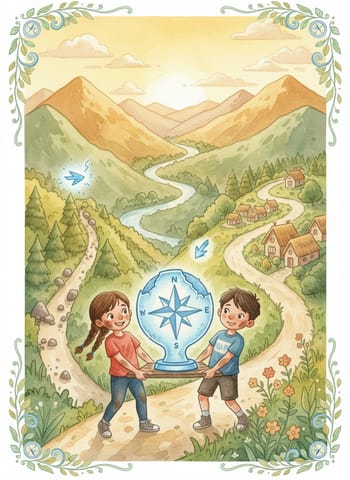
Orson hears it first. He is checking the tyre pressure on his bike, and the sound makes him look up. The Compass Cup is a silver cup the size of a watering can. It has a thin screen on its front. A dent as big as a fist spoils its left side.
Orson lo oye primero. Está revisando la presión de los neumáticos de su bicicleta, y el sonido le hace levantar la vista. La Copa Brújula es una copa de plata del tamaño de una regadera. Tiene una pantalla delgada en el frente. Una abolladura del tamaño de un puño estropea su lado izquierdo.
"It never hummed before," he says.
«Antes nunca zumbaba», dice.
"Last year it never had a dent before," says Bela. She is tying a number card to her handlebars. "A drone dropped it on the finish line. Remember?"
«El año pasado tampoco tenía una abolladura», dice Bela. Está atando un número a su manubrio. «Un dron la dejó caer en la línea de meta. ¿Recuerdas?».
"I remember. I was holding the drone controls."
«Lo recuerdo. Yo tenía los controles del dron».
Bela grins and does not argue.
Bela sonríe y no discute.
The Compass Cup is not an ordinary prize. Hundreds of small sensors stand along the Kestrel trails, in posts and rocks and trees. They measure the surface, the speed of the riders, and the position of every bike. Every few seconds the cup collects the numbers. Then it draws the best line down the mountain. The winner of the race takes it home. Everyone else just wants to see it light up.
La Copa Brújula no es un premio común. Cientos de pequeños sensores se alzan a lo largo de los senderos de Kestrel, en postes, rocas y árboles. Miden la superficie, la velocidad de los ciclistas y la posición de cada bicicleta. Cada pocos segundos la copa recoge los números. Luego dibuja la mejor línea para bajar la montaña. El ganador de la carrera se la lleva a casa. Todos los demás solo quieren verla encenderse.
Today Orson and Bela have a different job. The race starts at noon. The cup must be at the finish hut before the prizes begin. The van that normally carries it has a flat tyre. The only people free to go are two volunteers on mountain bikes.
Hoy Orson y Bela tienen un trabajo diferente. La carrera empieza al mediodía. La copa debe estar en la cabaña de meta antes de que comience la entrega de premios. La camioneta que normalmente la lleva tiene un neumático pinchado. Las únicas personas libres para ir son dos voluntarios en bicicletas de montaña.
"Forty minutes," says Bela. "Then the crowd is waiting."
«Cuarenta minutos», dice Bela. «Después la multitud estará esperando».
"Then we leave now."
«Entonces salimos ahora».
Bela lifts the cup from the gatepost and puts it in her backpack. The screen glows a pale blue. A map appears, with two lines crossing a green mountain, and under each line is a small label.
Bela levanta la copa del poste y la guarda en su mochila. La pantalla brilla con un azul pálido. Aparece un mapa, con dos líneas que cruzan una montaña verde, y bajo cada línea hay una pequeña etiqueta.
CLIFF LINE. NINE MINUTES. SAFETY 96.
LÍNEA DEL ACANTILADO. NUEVE MINUTOS. SEGURIDAD 96.
MEADOW LINE. FIFTEEN MINUTES. SAFETY 96.
LÍNEA DE LA PRADERA. QUINCE MINUTOS. SEGURIDAD 96.
"Two good options," says Orson. "I like the Cliff Line."
«Dos buenas opciones», dice Orson. «Me gusta la Línea del Acantilado».
"Of course you do. It has the big jumps."
«Claro que te gusta. Tiene los saltos grandes».
"It is six minutes faster. We can practise the ceremony."
«Es seis minutos más rápida. Podemos practicar la ceremonia».
"We do not need to practise a ceremony. We need to carry a dented trophy without breaking it."
«No necesitamos practicar una ceremonia. Necesitamos llevar un trofeo abollado sin romperlo».
They look at the map. The two lines glow with the same safety number, as if the cup cannot decide. A tiny message appears under the labels: DECIDE, PLEASE.
Miran el mapa. Las dos líneas brillan con el mismo número de seguridad, como si la copa no pudiera decidirse. Un mensaje diminuto aparece bajo las etiquetas: DECIDAN, POR FAVOR.
Orson laughs. "It is asking us."
Orson ríe. «Nos está preguntando».
"It is not asking. It is broken." Bela frowns and turns the cup in her hands. "The dent has damaged something inside. Before the drone, it always picked one line."
«No está preguntando. Está rota». Bela frunce el ceño y gira la copa en sus manos. «La abolladura dañó algo por dentro. Antes del dron, siempre elegía una línea».
"So we choose. Fast, or slow."
«Entonces elegimos nosotros. Rápido, o lento».
"Fast is a risk," says Bela.
«Rápido es un riesgo», dice Bela.
"Slow is boring."
«Lento es aburrido».
Neither of them moves. Behind them, the first racers arrive at the gate. A woman with a clipboard waves them back. Orson has wanted to ride the Cliff Line all summer, and he knows that Bela knows it.
Ninguno de los dos se mueve. Detrás de ellos, los primeros corredores llegan a la entrada. Una mujer con una tablilla les hace señas para que retrocedan. Orson ha querido recorrer la Línea del Acantilado todo el verano, y sabe que Bela lo sabe.
Bela takes a breath. "Give me ten seconds," she says. "I want to show you something."
Bela respira hondo. «Dame diez segundos», dice. «Quiero mostrarte algo».
She sets the cup on the ground and lifts the front wheel of her bike. Then she lets it drop onto the gravel. The cup shivers a little, and the blue light on its screen flickers. The map disappears for a second and comes back with the lines in the wrong places.
Deja la copa en el suelo y levanta la rueda delantera de su bicicleta. Luego la deja caer sobre la grava. La copa se estremece un poco, y la luz azul de su pantalla parpadea. El mapa desaparece por un segundo y vuelve con las líneas en lugares equivocados.
"That is a tiny bump," she says. "The Cliff Line has fourteen jumps. If the cup shakes like this fourteen times, the map will be gone. So will the chip inside it."
«Eso es un golpecito diminuto», dice. «La Línea del Acantilado tiene catorce saltos. Si la copa se sacude así catorce veces, el mapa desaparecerá. Y el chip que lleva dentro también».
Orson stares at the screen. For a moment he says nothing. Then he nods slowly.
Orson mira fijamente la pantalla. Por un momento no dice nada. Luego asiente lentamente.
"If we lose the map, the winner receives an empty cup," he says.
«Si perdemos el mapa, el ganador recibirá una copa vacía», dice.
"And the dent becomes a crack."
«Y la abolladura se convertirá en una grieta».
"Fine. Meadow Line." He tightens his helmet strap. "But I am leading, and I am setting the speed."
«Bien. Línea de la Pradera». Se ajusta la correa del casco. «Pero yo voy adelante, y yo fijo la velocidad».
"You can set it. Just do not set it above a gentle roll."
«Puedes fijarla. Solo no la fijes por encima de un suave rodar».
Orson smiles. They roll through the gate, and the cup hums in Bela's backpack.
Orson sonríe. Cruzan la entrada rodando, y la copa zumba en la mochila de Bela.
The Meadow Line begins with a wide path through tall grass. The ground is soft and smooth, and the bikes make a quiet, even sound. A line of small grey posts stands beside the path. Each post blinks once when the riders pass, and the hum in the backpack changes its note.
La Línea de la Pradera comienza con un camino ancho entre la hierba alta. El suelo es blando y liso, y las bicicletas hacen un sonido suave y parejo. Una hilera de pequeños postes grises se alza junto al camino. Cada poste parpadea una vez cuando pasan los ciclistas, y el zumbido en la mochila cambia de nota.
"It is talking to the sensors," says Bela.
«Está hablando con los sensores», dice Bela.
"What is it saying?"
«¿Qué está diciendo?».
"I do not know. It sounds like a cat."
«No lo sé. Suena como un gato».
After ten minutes the path enters the forest. The trees grow close, and the light turns green and gold. Orson slows down at a wooden bridge over a narrow stream. The wood is old, but the sensor post beside it is new.
Después de diez minutos el camino entra en el bosque. Los árboles crecen cerca unos de otros, y la luz se vuelve verde y dorada. Orson reduce la velocidad en un puente de madera sobre un arroyo angosto. La madera es vieja, pero el poste sensor junto a él es nuevo.
Halfway across, the cup speaks. It does not use the screen. A small, thin voice comes out of the dent.
A mitad del puente, la copa habla. No usa la pantalla. Una vocecita delgada sale de la abolladura.
"Post eleven," it says. "Weak signal."
«Poste once», dice. «Señal débil».
Orson stops so fast that Bela almost hits his back wheel. "Did it just talk?"
Orson se detiene tan rápido que Bela casi choca con su rueda trasera. «¿Acaba de hablar?».
"I think the dent is a crack in the speaker." Bela climbs off her bike and takes the cup out. "Post eleven. Which one is that?"
«Creo que la abolladura es una grieta en el altavoz». Bela se baja de la bicicleta y saca la copa. «Poste once. ¿Cuál es ese?».
They look around. The sensor post beside the bridge has a number painted on it in white. It is a seven.
Miran a su alrededor. El poste sensor junto al puente tiene un número pintado en blanco. Es un siete.
"That is post seven," says Orson.
«Ese es el poste siete», dice Orson.
"Then eleven is somewhere else."
«Entonces el once está en otra parte».
The voice speaks again. "Post eleven. Weak signal. Please help."
La voz habla de nuevo. «Poste once. Señal débil. Ayuda, por favor».
Bela turns the cup slowly in a circle, the way someone turns a compass. On the screen, an arrow wakes up. It points away from the bridge and away from the trail, into the trees on the right.
Bela gira lentamente la copa en un círculo, como quien gira una brújula. En la pantalla, una flecha despierta. Apunta lejos del puente y lejos del sendero, hacia los árboles de la derecha.
"There is no path there," says Orson.
«No hay camino por ahí», dice Orson.
"There is a gap in the ferns."
«Hay un hueco entre los helechos».
There is. Between two big trunks, a thin line of flattened leaves leads uphill. A bike could squeeze through it, but only just.
Lo hay. Entre dos troncos grandes, una delgada línea de hojas aplastadas sube por la colina. Una bicicleta podría pasar por ahí, pero apenas.
Orson looks at his watch. They have twenty minutes left. "The post is probably just broken," he says. "Somebody can fix it after the race."
Orson mira su reloj. Les quedan veinte minutos. «Seguramente el poste solo está dañado», dice. «Alguien puede arreglarlo después de la carrera».
"Probably." Bela does not look away from the arrow. "But the cup has never asked for anything before."
«Probablemente». Bela no aparta la vista de la flecha. «Pero la copa nunca había pedido nada».
"It asked us to decide."
«Nos pidió que decidiéramos».
"That was different. That was about the line. This is about the mountain."
«Eso fue diferente. Eso era sobre la línea. Esto es sobre la montaña».
Orson thinks about it. He thinks about the jumps he did not ride and the minutes they have already spent. Then he looks at the small arrow, which trembles as if it is afraid.
Orson lo piensa. Piensa en los saltos que no recorrió y en los minutos que ya han gastado. Luego mira la pequeña flecha, que tiembla como si tuviera miedo.
"Five minutes," he says. "We follow the arrow for five minutes. After that, we turn back, no matter what."
«Cinco minutos», dice. «Seguimos la flecha cinco minutos. Después damos la vuelta, pase lo que pase».
"Agreed."
«De acuerdo».
They push their bikes into the gap. The ferns brush their knees, and the ground tilts upward. After three minutes they find an old stone marker half hidden by moss. Beside it stands a post that nobody has painted. The post is cracked, and its small green light is dying.
Empujan sus bicicletas por el hueco. Los helechos les rozan las rodillas, y el suelo se inclina hacia arriba. Después de tres minutos encuentran un viejo marcador de piedra medio escondido por el musgo. Junto a él hay un poste que nadie ha pintado. El poste está agrietado, y su pequeña luz verde se está apagando.
Bela presses the cup against the post. The light flickers, goes bright, and holds firm. On the cup's screen, a number appears.
Bela presiona la copa contra el poste. La luz parpadea, se vuelve brillante y se mantiene firme. En la pantalla de la copa aparece un número.
ELEVEN. SIGNAL RESTORED.
ONCE. SEÑAL RESTABLECIDA.
"We did it," says Orson, and he feels very proud.
«Lo logramos», dice Orson, y se siente muy orgulloso.
They hurry back to the bridge and ride the last kilometre faster than they intended. The crowd at the finish hut cheers as they roll in. The woman with the clipboard looks at her watch and shakes her head in amazement. They are two minutes early.
Regresan apurados al puente y recorren el último kilómetro más rápido de lo que pensaban. La multitud en la cabaña de meta aplaude cuando llegan rodando. La mujer de la tablilla mira su reloj y sacude la cabeza con asombro. Llegan dos minutos antes.
Bela lifts the cup from her backpack and sets it on the table. The screen shows the trail map one last time. Both the Cliff Line and the Meadow Line have gone dark.
Bela saca la copa de su mochila y la pone sobre la mesa. La pantalla muestra el mapa del sendero por última vez. Tanto la Línea del Acantilado como la Línea de la Pradera se han apagado.
In their place, a new line glows white. It starts at the finish hut and passes the stone marker in the ferns. Then it climbs above the top of the trail, where Orson has never seen a path.
En su lugar, brilla una nueva línea blanca. Empieza en la cabaña de meta y pasa junto al marcador de piedra entre los helechos. Luego sube por encima del final del sendero, donde Orson nunca ha visto un camino.
Bela looks at him. He looks at her.
Bela lo mira. Él la mira.
Neither of them says a word, and the cup begins to hum again.
Ninguno de los dos dice una palabra, y la copa empieza a zumbar de nuevo.