The Blue Thumbprints in the Garden Shed
Una historia gratuita en inglés de nivel B1 para estudiantes, para leer en línea en 7 idiomas, con opción de escucharla en la app gratuita Storyteller.
A gardener follows three small clues to find out who keeps leaving ink marks in her shed.
¡Ese fue el avance! Escucha la historia completa en la app gratuita Storyteller. Descargar la app
El audio no está disponible en este momento.
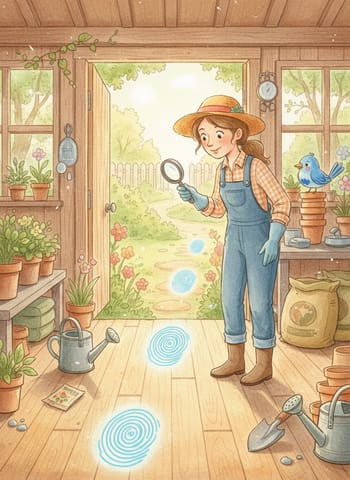
On Monday morning, Yasmin finds a blue thumbprint on the tap in the garden shed.
El lunes por la mañana, Yasmin encuentra una huella de pulgar azul en el grifo del cobertizo del jardín.
It is a clear print, as neat as a stamp. She looks at it for a while with a cup of coffee in her hand. Then she washes it away and starts her day.
Es una huella nítida, tan pulcra como un sello. La mira un rato con una taza de café en la mano. Luego la lava y empieza su día.
Yasmin is the head gardener at Larkfield Cemetery. Her shed stands behind the chapel, between the compost heap and the old fig tree. It smells of soil and cut grass. Inside are rakes, shears, seed trays, and a tap over a deep stone sink. The shed is hers. She never locks it, because nobody else ever comes in.
Yasmin es la jardinera jefa del Cementerio de Larkfield. Su cobertizo está detrás de la capilla, entre el montón de compost y la vieja higuera. Huele a tierra y a pasto recién cortado. Adentro hay rastrillos, tijeras de podar, bandejas de semillas y un grifo sobre una pila de piedra honda. El cobertizo es suyo. Nunca lo cierra con llave, porque nadie más entra.
That is why the thumbprint worries her a little.
Por eso la huella la inquieta un poco.
On Tuesday, she finds a second print on the same tap. On Wednesday, there is a third. By Thursday, it is a real puzzle, and she decides to treat it like one.
El martes encuentra una segunda huella en el mismo grifo. El miércoles hay una tercera. Para el jueves ya es un verdadero enigma, y decide tratarlo como tal.
"Someone is visiting my shed at night," she tells the groundsman, who is cutting a hedge nearby.
«Alguien visita mi cobertizo por las noches», le dice al encargado de los terrenos, que está podando un seto cercano.
"A ghost with ink on his fingers?" he says. "I like that. It is a polite ghost."
«¿Un fantasma con tinta en los dedos?», dice él. «Me gusta. Es un fantasma educado».
"It is not funny."
«No tiene gracia».
"It is a little funny," he says, and he goes on cutting.
«Tiene un poco de gracia», dice, y sigue podando.
Yasmin takes a notebook from her pocket. She does not feel like a detective, but she likes lists. At the top of the page, she writes, "What do I know?"
Yasmin saca una libreta del bolsillo. No se siente una detective, pero le gustan las listas. Arriba de la página escribe: «¿Qué sé?».
The first clue is the ink itself. It is deep blue and a little shiny, the kind that comes from an old fountain pen. The prints appear only on the tap, never on the door or the shelves. So the visitor comes in, turns on the water, and leaves.
La primera pista es la tinta misma. Es de un azul profundo y un poco brillante, de las que salen de una pluma fuente antigua. Las huellas aparecen solo en el grifo, nunca en la puerta ni en los estantes. Así que el visitante entra, abre el agua y se va.
On Friday, she finds the second clue, and it is stranger than the first.
El viernes encuentra la segunda pista, y es más extraña que la primera.
On her work table, beside the seed trays, lie twenty small wooden plant labels. She had left them there on Thursday evening with their old names almost gone. Now every label is rewritten. The letters are tall and careful, and the ink is blue. Lavender. Rosemary. Sweet pea. Foxglove. Nothing is spelled wrong. Even the Latin names are correct.
Sobre su mesa de trabajo, junto a las bandejas de semillas, hay veinte pequeñas etiquetas de madera para plantas. Las había dejado ahí el jueves por la tarde con sus viejos nombres casi borrados. Ahora cada etiqueta está reescrita. Las letras son altas y cuidadosas, y la tinta es azul. Lavanda. Romero. Chícharo de olor. Dedalera. Nada está mal escrito. Hasta los nombres en latín son correctos.
She sits down on her stool and reads them twice.
Se sienta en su taburete y las lee dos veces.
"A thief who corrects my labels," she says aloud. "That is new."
«Un ladrón que corrige mis etiquetas», dice en voz alta. «Eso sí que es nuevo».
She puts the labels in a neat row, and for the first time all week, she smiles. Whoever this is, they are kind. And they have beautiful handwriting.
Coloca las etiquetas en una hilera ordenada, y por primera vez en toda la semana sonríe. Quienquiera que sea, es amable. Y tiene una letra preciosa.
On Saturday, the third clue arrives, and it is the smallest one.
El sábado llega la tercera pista, y es la más pequeña.
The towel on the hook behind the door has two long blue marks on it. Beside the sink, the soap is wet. Someone has washed their hands for a long time. A fresh bar lies on the shelf, still wrapped. It is not her brand.
La toalla del gancho detrás de la puerta tiene dos largas marcas azules. Junto a la pila, el jabón está mojado. Alguien se ha lavado las manos durante mucho rato. Una pastilla nueva yace en el estante, todavía envuelta. No es de su marca.
Yasmin writes it all in her notebook. One: ink on the tap. Two: labels rewritten. Three: wet soap, blue towel, a new bar.
Yasmin lo anota todo en su libreta. Uno: tinta en el grifo. Dos: etiquetas reescritas. Tres: jabón mojado, toalla azul, una pastilla nueva.
She taps her pencil against her chin. A person who writes with a pen like that has a job with paper. A person who has ink on their hands every day must wash them often. A person who leaves a gift of soap is polite, and probably shy. And a shy person would never knock on the door of a gardener who talks to plants.
Se golpea la barbilla con el lápiz. Una persona que escribe con una pluma así tiene un trabajo con papel. Una persona que tiene tinta en las manos todos los días debe lavárselas a menudo. Una persona que deja un regalo de jabón es educada, y probablemente tímida. Y una persona tímida jamás tocaría la puerta de una jardinera que habla con las plantas.
She looks out of the window toward the white office building at the far side of the lawn. The records office. It has a very small kitchen and a very old sink.
Mira por la ventana hacia el edificio blanco de oficinas al otro lado del césped. La oficina de registros. Tiene una cocina muy pequeña y una pila muy vieja.
"Aha," she says. "Maybe."
«Ajá», dice. «Quizás».
On Sunday, the cemetery is closed to visitors. On Monday, Yasmin forgets her gloves at home. She has to come back to the shed an hour early. She walks across the lawn with her keys in one hand. The sun is just rising behind the chapel.
El domingo, el cementerio está cerrado a los visitantes. El lunes, Yasmin olvida los guantes en casa. Tiene que volver al cobertizo una hora antes. Cruza el césped con las llaves en una mano. El sol apenas sale detrás de la capilla.
She opens the door and stops.
Abre la puerta y se detiene.
A man stands in front of her sink with both hands under the tap. He is tall, with round glasses and a brown cardigan. A pen lies on the edge of the stone basin. His fingers are blue to the wrists. A blue line runs up one cheek where he touched his face.
Un hombre está de pie frente a su pila con las dos manos bajo el grifo. Es alto, con lentes redondos y un cárdigan marrón. Una pluma yace en el borde de la pila de piedra. Tiene los dedos azules hasta las muñecas. Una línea azul le sube por una mejilla, donde se tocó la cara.
He turns around slowly, and his eyes grow very wide.
Se da la vuelta lentamente, y los ojos se le abren mucho.
"Good morning," says Yasmin.
«Buenos días», dice Yasmin.
"Hello," the man says. He gives a small, miserable cough. "I can explain."
«Hola», dice el hombre. Da una pequeña y miserable tos. «Puedo explicarlo».
"I hope so."
«Eso espero».
"My name is Orson. I work in the records office, on the other side of the lawn." He lifts his blue hands, as if to show proof. "My pen leaks. It has leaked for two years. I carry it in my shirt pocket, and by eight o'clock my whole hand is blue."
«Me llamo Orson. Trabajo en la oficina de registros, al otro lado del césped». Levanta las manos azules, como para mostrar la prueba. «Mi pluma gotea. Gotea desde hace dos años. La llevo en el bolsillo de la camisa, y a las ocho toda mi mano está azul».
"I see."
«Ya veo».
"The sink in our office broke last week. The pipe makes a noise like an angry cat, and the manager says we must not use it. So I looked for another tap." He looks at the floor. "Yours was the nearest one. The door is never locked, and I knew there was a sink inside. I only wanted to wash my hands."
«La pila de nuestra oficina se rompió la semana pasada. La tubería hace un ruido como un gato furioso, y el gerente dice que no la usemos. Así que busqué otro grifo». Mira el suelo. «El suyo era el más cercano. La puerta nunca está cerrada con llave, y sabía que había una pila adentro. Solo quería lavarme las manos».
"Every morning," says Yasmin.
«Todas las mañanas», dice Yasmin.
"Every morning," he agrees. "And again at lunch."
«Todas las mañanas», concede él. «Y otra vez a la hora del almuerzo».
"And you never knocked."
«Y nunca tocó la puerta».
"You always seemed busy. You were talking to a rose bush, and I did not want to interrupt." He pauses. "I thought you might be annoyed."
«Usted siempre parecía ocupada. Estaba hablando con un rosal, y no quise interrumpir». Hace una pausa. «Pensé que se enojaría».
Yasmin looks at the blue hands, the blue cheek and the sad face above them. Then she laughs. It is a real laugh, loud and warm. She has to hold the door to stay up.
Yasmin mira las manos azules, la mejilla azul y la cara triste que hay encima. Entonces se ríe. Es una risa de verdad, fuerte y cálida. Tiene que sostenerse de la puerta para no caerse.
"I thought I had a ghost," she says. "I made notes."
«Pensé que tenía un fantasma», dice. «Tomé notas».
"I am so sorry."
«Lo siento muchísimo».
"Don't be. It is the best week I have had in years." She wipes her eyes and points at the table. "Did you write all those labels?"
«No lo sienta. Es la mejor semana que he tenido en años». Se seca los ojos y señala la mesa. «¿Usted escribió todas esas etiquetas?».
Orson looks at his boots. "Some of them were fading. I have a lot of time at lunch, and my writing is the only thing I do well. I did not want to leave your shed worse than I found it."
Orson mira sus botas. «Algunas se estaban borrando. Tengo mucho tiempo a la hora del almuerzo, y mi letra es lo único que hago bien. No quería dejar su cobertizo peor de como lo encontré».
"And the soap?"
«¿Y el jabón?».
"To say thank you. Your soap was almost finished." He looks hopeful. "Is it a good brand?"
«Para darle las gracias. Su jabón estaba casi acabado». Parece esperanzado. «¿Es una buena marca?».
"It is perfect." She takes the pen from the basin and holds it up to the light. The blue ink runs down her finger, and she wipes it on her trousers. "You know, there are better pens in the world."
«Es perfecta». Toma la pluma de la pila y la levanta a la luz. La tinta azul le corre por el dedo, y se la limpia en el pantalón. «Sabe, hay mejores plumas en el mundo».
"I love this one," Orson says, with great dignity. "My father gave it to me."
«Esta la quiero mucho», dice Orson, con gran dignidad. «Me la regaló mi padre».
"Then we must fix it, not throw it away." She opens a drawer and takes out a small roll of tape and a little jar of wax. "Come here. Gardeners can mend almost anything."
«Entonces hay que arreglarla, no tirarla». Abre un cajón y saca un pequeño rollo de cinta y un frasquito de cera. «Venga. Los jardineros podemos arreglar casi cualquier cosa».
They work together for twenty minutes, at the table, while the light grows stronger over the lawn. When the pen finally holds, Orson writes his name on the back of her hand to test it. The letters are dark and clean.
Trabajan juntos durante veinte minutos, en la mesa, mientras la luz se fortalece sobre el césped. Cuando por fin la pluma aguanta, Orson escribe su nombre en el dorso de la mano de ella para probarla. Las letras son oscuras y limpias.
"No more thumbprints on the tap," he says.
«Ya no habrá más huellas en el grifo», dice.
"Leave one," says Yasmin. "Just so I remember."
«Deje una», dice Yasmin. «Para que me acuerde».
When he goes back across the grass, she turns on the water to wash her hands. On the metal tap, a single clear thumbprint shines in the early light. It is small, blue and a little crooked, like a flower that has just opened.
Cuando él vuelve por el pasto, ella abre el agua para lavarse las manos. En el grifo de metal, una sola huella de pulgar nítida brilla en la luz temprana. Es pequeña, azul y un poco torcida, como una flor que acaba de abrirse.