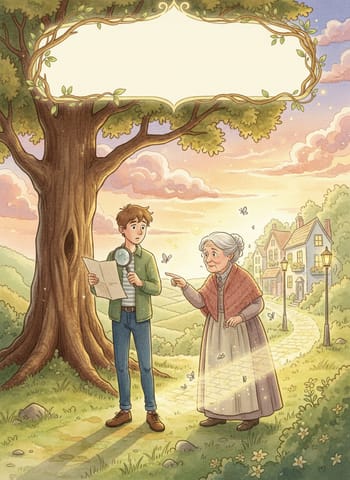
The Street That Isn't There
A free C1-level English story for language learners, readable online in 4 languages, with an option to listen via the free Storyteller app.
A map-data checker finds a lane that exists in the records but not on the ground, and has to decide whether an old woman's memory is enough to keep it.
That was the preview! Hear the full story in the free Storyteller app. Get the app
Audio isn't available right now.
Linus had been checking map data for eleven months before he met a street that failed every test. The aerial images showed a row of lock-up garages and a drainage ditch where the record claimed a lane called Tallow Row. It was one hundred and forty metres long, with seven house numbers and a dead end. No survey had touched it since the file was created, no delivery driver had ever flagged it, and no postcode pointed its way. By the rules of his job it was a ghost, and ghosts were deleted.
He could have clicked "remove" and moved on to the next of the afternoon's two hundred flags. Had the queue been shorter that Friday, he probably would have done exactly that. Instead, because the name nagged at him and the office was half empty, he took a train out to the district and walked to the place where the lane ought to have begun.
There was only a concrete wall, streaked green at the base, and in front of it an old woman on a folding stool with a flask of tea, sitting as if she were on guard. When he explained that he worked for the company that kept the maps, she nodded without surprise.
"Then you've come about Tallow Row," she said.
Her name was Wilhelmina, and she told the story with the evenness of someone who had rehearsed it for years without an audience. The lane had been cleared in her youth to make way for a road that was never finished. Within a year the neighbours had scattered across the city, and the garages had gone up over whatever remained. What she still did, most mornings, was walk it. Starting at the wall, she counted seven doors, past the cobbler's radio in the window and the third paving stone that always rocked, to the bakery's side entrance where the lane stopped.
Linus looked down. Beneath the skin of the tarmac he could just make out the grey line of an old kerb, curving where no kerb should. It would seem that the street had existed in every sense except the one his software could verify. Not until that moment had it occurred to him that a map might be less a record of where things are than an argument about which things count.
"It would take me a quarter of a minute to remove it," he said, more to himself than to her.
"I know." Wilhelmina poured the last of the tea into the flask's cup and held it out to him. "It took them rather longer to build the road, and they never finished that either."
On the train back he opened the file and let the cursor rest over "remove" until the screen dimmed. The system would allow him to mark the street as unverified for ninety days, after which the flag would return. That, he decided, was as much as a person in his position could honestly claim. He typed a single line into the notes field, "Visited; absent on the ground; walked daily by a resident", and saved it. Outside, the backs of the houses slid past in the dusk, and he caught himself counting their doors, seven to a row.