The Forged Letter
A free C1-level English story for language learners, readable online in 4 languages, with an option to listen via the free Storyteller app.
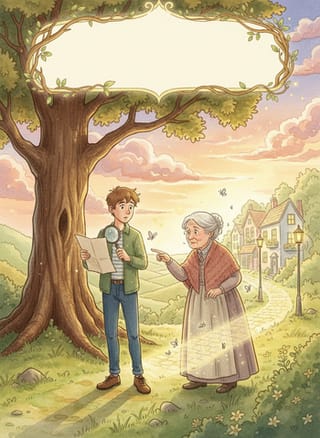
An archive volunteer finds that the town's most cherished letter was written decades after its supposed date, and tracks down the forger and a gentle motive.
That was the preview! Hear the full story in the free Storyteller app. Get the app
Audio isn't available right now.
Thaddeus had volunteered at the Harlow Bay Archive for six years, and in that time nothing had been more reliably loved than the letter in the glass case by the door. It was the poet's farewell to the town, written on the eve of his departure in 1931. Every schoolchild in the district could quote its last line: "Keep the lamp lit; I know the way back." Visitors stood in front of it with their hands behind their backs, as though in church. Thaddeus, who dusted the case on Thursdays, had never looked closely at the paper itself until the week the catalogue needed new photographs.
He took the letter to the window for the light, with the committee's permission and a pair of cotton gloves, and it was there, held up against the afternoon, that he saw the watermark. It was a tiny crescent and a number, the mark of a paper mill that, according to the trade directory on the reference shelf, had not begun production until 1958. He checked it twice. Then, because he was the kind of person who checks things a third time, he checked it again. The poet had been dead for nine years by then.
For several days he told no one, which was uncomfortable, since he was a poor liar and a worse keeper of secrets. Never had he wanted so badly to be wrong. Archive work trains the eye to distrust anything too tidy, and the more he looked, the more he found. The ink had faded evenly, as it never does on a genuinely old page, and the handwriting leaned a fraction too carefully, like a signature practised in a mirror. It was not the forgery itself that unsettled him so much as the patience of it. Whoever had made this had wanted it to be believed, and had wanted that for a reason.
The reason took him three weeks. The donation ledger recorded that the letter had arrived in 1968, presented by the poet's sister, with a covering note in a different, rounder hand. The note was signed by the assistant librarian of the day: Rita. Thaddeus found her, after a good deal of asking, in a flat above the hardware shop, eighty-eight years old, sharp-eyed, and entirely unsurprised to see a man holding a folder.
"You've found the paper," she said, before he had sat down. "I always said it would be the paper."
She had made the copy, she told him, because the original was lost in the flood of 1967, along with half of the poet's papers in his sister's cellar. The sister was ill by then and wanted only to read the letter once more. Rita, who had heard it read aloud so often in that house that she could have recited it in her sleep, wrote it out from memory. "Word for word, or near enough," she said. "She read it, and she cried, and she said it was exactly right. Then she gave it to the archive, and nobody asked, and I didn't like to say."
Thaddeus turned his hat over in his hands. Had Rita confessed in 1968, the letter would have been catalogued as a copy and forgotten within a year; it was precisely the small lie, he understood, that may well have kept the words alive. What he could not decide was whether that made the lie a kindness or merely a very successful one.
"The words are his," Rita said. "The hand is mine. I wouldn't call that a forgery. I'd call it a loan." She waved a thin hand towards the window. "Leave it be, Thaddeus. Nobody ever came to look at the paper."
He said he would think about it, and meant it. On Monday he went in early and stood in front of the case for a long time before he switched on the light.