The Locksmith's Box
A free C1-level English story for language learners, readable online in 4 languages, with an option to listen via the free Storyteller app.
A locksmith opens a late woman's metal box for her family and finds something she has to decide how to describe.
That was the preview! Hear the full story in the free Storyteller app. Get the app
Audio isn't available right now.
The box has been in the family for fifty years, and nobody has ever seen it open. Octavia sets her bag on the dining table of a house that smells of lemon polish and warm radiators. A nephew, his sister and her husband stand in a loose half-circle around it, wearing the careful faces of people at the reading of a will. "She kept the key on a chain," the nephew says. "It went missing before she died. Or she lost it on purpose."
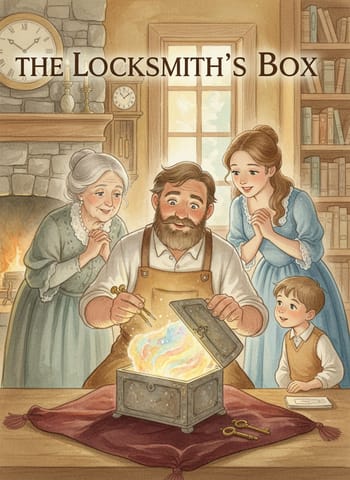
It is a plain grey metal box, the kind that once held petty cash behind a shop counter, with a handle worn smooth by decades of one particular hand. Octavia turns it over, checks the hinges, and decides the lock is cheaper than the box. She takes out two thin tools, closes her eyes the way she always does, and begins to listen with her fingertips.
It takes four minutes. Had the lock been newer, she would have had to drill it, and she would never have seen what was inside.
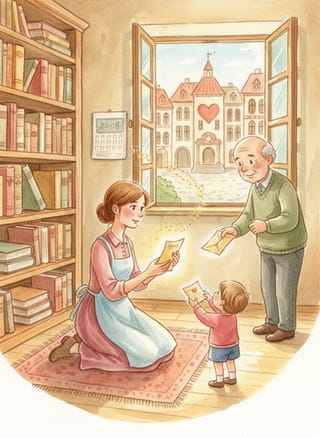
The lid rises with a small dry sigh. Inside, packed on edge like cards in an index, are envelopes, perhaps fifty of them, each addressed in the same upright hand. The ink runs from brown at the back to blue near the front. None of them has a stamp. None, as far as she can see, has ever been near a post box.
She does not mean to read anything. It is simply that the front envelope has slid open at the flap, and the top line of the page is facing her. I am sorry that I let you think it was your fault. She looks away at once, but the sentence has already gone in, and it sits in her like a swallowed stone.
What she notices next is not the contents but the pattern. Every envelope carries a different name, and she has just filled out the work order with the family's names, so she recognises the one on the seventh envelope from the front. Another belongs, she guesses, to the husband's mother. There are names she does not know at all, some with dates in the corner going back to before anyone in this room was born.
"Well?" the nephew says. His voice is too casual. He is hoping, she can tell, for a deed or a bank book, something with a number on it. "Is there anything in it?"
"Papers," Octavia says.
"What sort of papers?" says the sister.
Octavia has stood in a great many strangers' hallways with a bag of tools, and she knows how much a house can bear to be told in one afternoon. She could say nothing more and let the family find out alone. She could say everything and make herself the person who spoiled it. Neither seems right, and she is aware of how little the choice belongs to her.
"Letters," she says at last. "A lot of them. Some of them are addressed to people in this room. I haven't read them, and I won't." She lifts the lid fully and steps back from the table, so that the box belongs to them again.
Nobody moves. The sister puts a hand to her mouth.
At the front door, bag on her shoulder, Octavia hears the nephew come out of the dining room behind her. "Were they ever posted?" he asks.
"I don't think so. Not one."
"Then why would she keep them? Why not just send them?"
Octavia thinks of every key she has ever cut for someone who later changed the locks. "Some things are easier to write than to hand over," she says, and opens the door onto the cold.