The Guitar Behind the Cough Syrup
A free B2-level English story for language learners, readable online in 7 languages, with an option to listen via the free Storyteller app.
A new pharmacy assistant promises to save an abandoned guitar from the skip, and finds that keeping the promise means doing more than hiding it.
That was the preview! Hear the full story in the free Storyteller app. Get the app
Audio isn't available right now.
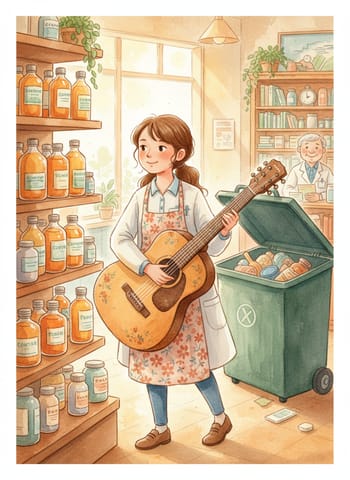
The back room of the pharmacy smelled of cardboard and mint. Anand had worked there for three weeks, and in that time he had learned that nobody ever tidied it properly. Shelves of cough syrup and bandages climbed to the ceiling, and between two of them, wrapped in a faded blanket, stood a guitar.
He found it on his second day. The wood was scratched, one tuning peg was missing, and on the lower curve of the body someone had carved a name with a knife. The letters spelled NELLY. They were deep and a little crooked, as if the carver had been laughing.
"Don't touch her," said Jovan from the doorway. He was the senior technician, a broad, calm man who ate one apple at exactly the same time every afternoon. "She isn't ours."
"Whose is she?" Anand asked.
Jovan told him the story while they counted boxes of painkillers. Twelve years earlier, a young musician had rushed in with a ruined voice and a concert that night. The venue had paid her late, and she had no money for the medicine. She left the guitar as a deposit.
"The pharmacist told her to come back when she could pay," Jovan said. "He promised the guitar would be waiting. She never came."
"Is Nelly her name, or the guitar's?" Anand said.
"Nobody knows. Nobody ever asked the right person." Jovan shrugged and bit into his apple. "The pharmacist retired, the owner changed twice, and Nelly stayed behind the cough syrup. That is how things work here."
Anand ran his thumb along the carved letters. The wood felt warm and smooth, like something that had been held by many hands before it was forgotten. He had played in a school band for one terrible year, and he knew what it meant to leave an instrument alone in the dark.
The next morning the owner called everyone into the shop for a meeting. The pharmacy was moving to a bigger building at the end of the month, and the old back room had to be empty by Friday. A cleaning crew would arrive at nine to clear whatever was left.
"Anything unclaimed goes into the skip," the owner said, looking at a list. "Old shelves, broken chairs, that guitar. I am sorry, but we cannot carry everything with us."
Jovan said nothing, but Anand saw his jaw tighten. Afterwards, in the back room, Jovan took his coat from its hook and sighed.
"I would fight for her, but I leave tomorrow for a week of training in another city. I will not be here on Friday."
"Then I will make sure she doesn't go in the skip," Anand said. The words came out before he had thought about them. "I promise."
Jovan looked at him for a long moment. "Then she is your problem now," he said, and he almost smiled.
Anand soon discovered how heavy a promise could be. On Monday he searched the old ledger from the shelf above the sink and found a line dated twelve years earlier. It read: guitar, deposit, throat medicine, and a phone number. He called it that evening. A recorded voice told him the number no longer existed.
On Tuesday he tried the address beside the number. It was a hairdressing salon, and the young woman at the desk had never heard of anyone called Nelly. She suggested he try the music shop two streets away. The music shop owner listened politely, looked at the photo Anand showed him, and shook his head.
"A battered guitar with a name carved in it," the man said. "I could name you fifty of those, and not one of them is looking for its owner."
On Wednesday Anand wrote a notice and taped it inside the shop window. It said: A guitar called Nelly has been waiting here for twelve years. If she is yours, please come and collect her. The owner read it at lunchtime and took it down again.
"We cannot have strange notices in the window while customers are coming in for medicine," the owner said, not unkindly. "And we cannot keep her either. The new shop has no space for a guitar."
That left Thursday, and a plan Anand was not proud of. He carried Nelly out through the loading door after closing time, wrapped in her blanket, and hung her from the handlebars of his bicycle. The ride home took twenty minutes. Twice she bumped against the wheel with a deep, hollow note that made a passing dog stop and stare.
His flatmate opened the door and looked at the guitar. "You have stolen an instrument," she said.
"I have rescued an instrument," Anand said. "It is different."
"Not legally," she said, but she let him in.
That night he sat on his bed and tried to understand what he had actually promised. He had not promised to find the owner. He had not promised to keep Nelly forever. He had promised that she would not go into the skip. If he kept her in his bedroom for the rest of his life, he would keep the promise. It would be a poor sort of keeping, because no one would ever hear her again.
He found a video of a teacher showing four simple chords. He bought a new tuning peg and a set of strings at the music shop. The owner of the shop, who now seemed interested in spite of himself, showed him how to fit them. By midnight Anand could play one song badly. By Friday morning he could play it a little less badly.
On Friday the cleaning crew arrived at nine and found the back room empty, except for the broken chairs. The owner arrived at ten, in a hurry, and found Anand waiting at the door with a guitar that was not his.
"I need five minutes," Anand said. "Please. Then I will not trouble you again."
The owner glanced at the clock, sighed, and followed him into the shop. It was nearly empty, because the last customers were leaving with their bags, and Anand stood beside the counter and played his one song.
It was not a good performance. He missed a chord in the second verse and played the last one twice by mistake. But the woman waiting for her prescription turned around, and two children stopped pulling at their father's sleeve, and the whole shop went quiet.
When he finished, someone clapped. It was the owner.
"I did not know she could sound like that," the owner said slowly. "Twelve years behind the cough syrup, and nobody ever played her." Then, after a pause: "The new shop has a long wall by the door. It is empty. A guitar can hang there."
"As decoration?" Anand asked.
"As the oldest member of staff," said the owner. "With a card beside her, saying that she is still waiting for her owner. Let people see her. If the musician is out there, perhaps she will walk past one day."
So Nelly moved to the new pharmacy in a taxi, wrapped in her blanket. Anand held her on his lap like a very important patient. By the following Monday she hung on the long wall, polished and restrung, under a small card that Anand had lettered himself.
Jovan came back from his training course that morning. He walked into the new shop, put down his bag, and stood in front of the wall for a long time. Then he read the card out loud.
"Nelly. Staff member since twelve years ago. Senior technician." He turned around slowly. "Senior technician? I am the senior technician."
"She has been here longer than you," Anand said.
Jovan looked at the guitar and sighed. "In that case," he said, "she can count the boxes."