The Coat the Lock Keeper Inherited
A free B2-level English story for language learners, readable online in 7 languages, with an option to listen via the free Storyteller app.
A new lock keeper wears an oversized uniform and misreads a barge pilot's repeated questions until she finally asks him why.
That was the preview! Hear the full story in the free Storyteller app. Get the app
Audio isn't available right now.
The uniform arrived on Bo's first morning in a plastic bag, folded as neatly as a letter. It was a dark green jacket with brass buttons, a pair of trousers, and a cap with the river authority's badge on the front. Everything was one size too large.
Bo stood in the little office beside the lock and rolled the sleeves up twice. The jacket hung from her shoulders like a tent, and the trousers collected in soft folds around her boots. When she looked in the cracked mirror on the wall, she saw a child dressed up for a school play.
"It will do for a week," she told herself. "Then you can order your own."
She had taken the job because the city had given her very little else. A temporary contract, a room above the lock-keeper's store, and a handbook as thick as a brick. The previous keeper had retired the month before, and the authority needed someone to run the gates until a permanent replacement was found. Bo knew rivers well enough to respect them. She did not yet know this particular lock, with its heavy black gates and its stubborn, groaning wheels.
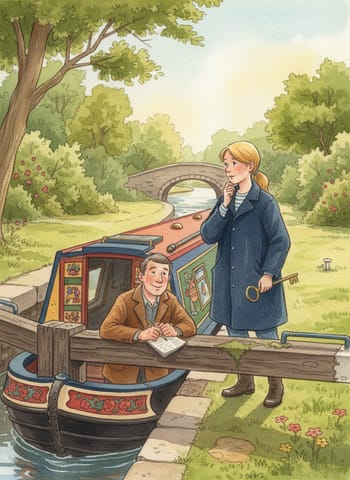
The first boat of the day appeared a little after seven. It was a long working barge, low in the water, loaded with sand. A tall man stood at the wheel with a flask of coffee in his hand. When the barge slid into the chamber, he looked up at Bo with an expression she could not read.
"Morning," he called. "Is the keeper in?"
"I am the keeper," said Bo, straightening her cap.
"Ah." He studied her for a moment, taking in the sleeves, the cap, and the buttons. "I see. Of course. I only meant, is the usual keeper in?"
Bo felt her face stiffen. She had expected people to doubt her, but she had not expected it to happen before breakfast. "The usual keeper has retired," she said. "I'm managing the gates now. I can take you through, if you're ready."
"I'm ready. Thank you." He smiled, slightly too widely, and she decided that he was laughing at the coat.
She closed the lower gates and opened the sluices with a clumsy rush of effort. The water seethed into the chamber, lifting the barge slowly towards the upper level. The man, whose name she saw painted on the boat as Naveen, kept glancing at her over the rail. Each time she caught him doing it, she stiffened and turned her attention to the wheel.
By the end of the week the same thing had happened four more times. Naveen's barge came through every morning and returned every evening, and every time he asked a variation of the same question.
"Is the boss in today?"
"Is the other keeper back yet?"
"Will the old coat be coming back, do you think?"
Bo's patience wore thin. On Friday she said nothing at all when he arrived, merely pointing at the gate and turning her face away. Naveen waited for a moment, as if hoping that she would speak. Then he sighed and drove the barge into the chamber.
That night she sat on the step outside her room and wrote a message to her sister. "Everyone here is lovely except one boatman," she typed. "He keeps asking where the real keeper is. I think he finds my coat funny. I think he finds me funny."
Her sister answered within a minute. "Maybe he doesn't. Have you asked him?"
Bo looked at the message for a long time. It had not occurred to her to ask. It had seemed far easier to be offended, a simple feeling that needed no courage at all.
The next morning she stood by the gate at six, cold and slightly sleepless, and watched the barge approach. When it entered the chamber, she did not wait for the question.
"Before you say anything," she began, "I know the uniform is too big. The authority sent the wrong size, and I couldn't wear anything else. If you have a problem with that, tell me directly."
Naveen blinked. For a few seconds the only sound was the water slapping against the stone walls.
"A problem?" he said. "Why would I have a problem?"
"You laugh every time you see me. You keep asking whether the real keeper is in."
"I laugh because I am nervous." He put his flask down on the deck. "And I ask because I didn't understand. May I show you something?"
He disappeared into the little cabin at the back of the barge and returned carrying a flat parcel wrapped in brown paper. His hands, she noticed, were not quite steady.
"Last month, before the old keeper left, he asked me to look after this," Naveen said. "He wanted it to go to whoever came next. But nobody told me who that would be, so I kept asking whether the keeper was in. I wanted to give it to the right person."
Bo took the parcel, though she felt foolish doing so. Inside lay a small leather notebook, its cover worn smooth at the corners. On the first page, in slanting, careful handwriting, was a heading: Things the lock will not tell you.
She turned the pages slowly. They were full of small observations. Which gate stuck in the frosty months. Which sluice leaked if it was opened too fast. Which boatmen were in a hurry, which of them were frightened of the dark chamber, and which of them liked to chat. On the last page was one short line. "The coat is always too big. You grow into it."
For a moment Bo could not speak.
"He wore that coat for thirty years," said Naveen quietly. "When it first arrived, he said it was so large he could have fitted his dog in the pocket. The first morning I saw you in it, I thought of him, and I couldn't stop smiling. I'm sorry. I should have said so at once."
"I thought you were mocking me."
"I thought you were angry that I kept asking." He rubbed the back of his neck. "We were both being very quiet, weren't we?"
She laughed, an unsteady little laugh, and wiped her eyes with the cuff of her enormous sleeve. Naveen laughed too, with real relief, and the sound bounced off the stone and came back to them twice.
Then they worked together, as if the morning had only just begun. She raised the water, and he steadied the barge against the wall with his long hook. The gates opened one by one. The sun was climbing over the trees on the far bank. Its light reached down into the chamber and turned the water to a smooth sheet of gold.
When the barge slid out into the upper river, Bo stood at the gate in her borrowed coat, the notebook warm in her pocket. Her sleeves were still too long. She left them as they were, and she watched the wake spread slowly across the water, and flatten, and disappear.