A Door for Thirty Cheeses
A free A2-level English story for language learners, readable online in 7 languages, with an option to listen via the free Storyteller app.
Two cheesemakers must deliver thirty cheeses past a closed bridge, so they try a strange brass key that opens doors to wherever they think.
That was the preview! Hear the full story in the free Storyteller app. Get the app
Audio isn't available right now.
Madu had a problem, and the problem had thirty wheels.
Madu made cheese in a cellar under a green hill. The cellar was cold and dark. It smelled of milk and stone. Round cheeses sat on long wooden shelves. Every morning, Jabu turned them one by one. Jabu was Madu's helper. He was young, quick, and always hungry.
Between two shelves, a brass key hung on a nail. It was as long as a hand. It had no door. No lock in the cellar fit it. No lock in the village did either. The key came with the cellar, long before Madu. He never took it down.
On Monday afternoon, a letter came from the town school. The school needed thirty cheeses for a big festival. They must arrive by noon the next day. But the bridge on the valley road was closed for repairs. The long way took a whole day by cart.
"We cannot do it," Madu said. He sat on a box. He put his head in his hands. "No bridge, no cheese, no money."
Jabu looked at the key. He looked at it a thousand times a year. "What if it opens something?" he said.
"It opens nothing."
"Everything opens something," said Jabu. He lifted the key off its nail. It was warm, like a cup of fresh milk.
Madu stood up. "Do not touch it," he said. But he did not say it very strongly.
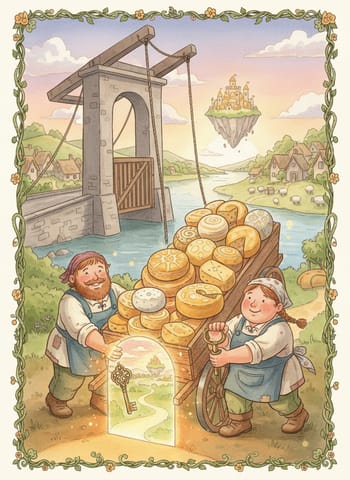
Jabu walked to the bare stone wall. He held the key out in front of him. He turned it, as if there was a lock. There was a soft click. A thin line of light ran across the stone. It drew a small round door with a wooden frame. The key now sat in a brass keyhole at its side.
They looked at each other. Neither of them breathed.
"Think about the school," said Madu. "Think hard."
Jabu turned the key again. The door swung open. Behind it was a huge room with a shiny floor. A man in a grey suit sat at a long desk. He stamped a paper and looked up.
"Who are you?" the man asked.
"Oh no," whispered Madu. "That is the tax office. I thought about money."
"Sorry!" shouted Jabu. He pulled the door shut. The light faded. The wall was only stone again.
That was the first plan, and it was a bad one.
"My turn," said Jabu. "I will think about the school, and only the school." He closed his eyes. His hand shook a little. He turned the key.
The door opened on a classroom. Thirty children turned their heads at once. At the front stood a teacher with a long ruler.
"You are late, young man," she said to Jabu.
Jabu shut the door so fast that the cellar shook. His face was pale. "That was my old teacher," he said. "I only wanted to think about the school. But I remembered her."
Madu sat down again. A cheese rolled off a shelf and bumped his foot. He picked it up and held it like a baby. Time went fast. It was already late in the afternoon.
"The door follows the mind," he said slowly. "It goes where the holder thinks. And your mind and my mind are two different places."
"Then we need one mind," said Jabu.
They both stopped. Then they both smiled at the same moment.
"The school song," said Madu.
"The goat song!" said Jabu.
They both went to that school as boys, many years apart. Every child there learned the same silly song about a goat. They both knew every word.
Madu took one end of the key. Jabu took the other. They stood in front of the wall. Together they began to sing.
"A goat on a hill, a goat on a hill! He eats all the grass, but he is hungry still!"
They sang it badly. They sang it loudly. The words filled the cellar and rolled between the shelves. And in each of their heads, the same picture grew. It was the school kitchen door, with its old blue paint. It smelled of boiled beans.
The key turned by itself. Click.
The door opened. Behind it was a small, cool room. It had tall shelves and a stone floor. A cook in a tall white hat stood there. He held a spoon. He looked at the door. He looked at the two singing men. The spoon fell on the floor.
"Good afternoon," said Madu politely. "We have your cheeses."
"Where did you come from?" the cook whispered.
"From the hills," said Jabu. "Where do you want them?"
The cook pointed at an empty shelf. His hand shook.
Then the work began. Madu and Jabu rolled the cheeses across the cellar, one by one. Each wheel went through the little round door. Each wheel bumped over the frame with a soft bump. The cook counted out loud. He sounded a bit afraid. When the last wheel went through, the shelves were empty. Their arms were tired, and their shirts were wet.
"Thirty," said the cook. He looked at the door again, and then at Madu. "How did you…"
"Better not to ask," said Madu. He took the coins the cook gave him. They were warm from the cook's pocket.
Jabu pulled out the key. The door grew smaller, and smaller, and smaller. It became a thin line of light. Then the line was gone. Only the stone wall was left. The key cooled slowly in his hand.
Madu laughed until he had to hold a shelf. "A goat on a hill," he said.
"A goat on a hill," Jabu said, and he laughed too.
Jabu walked to the nail. He hung the key back in its place. He stepped away and looked at it. It was only a brass key, and it opened nothing.
Then, from somewhere deep inside the wall, came a tiny sound.
Click.