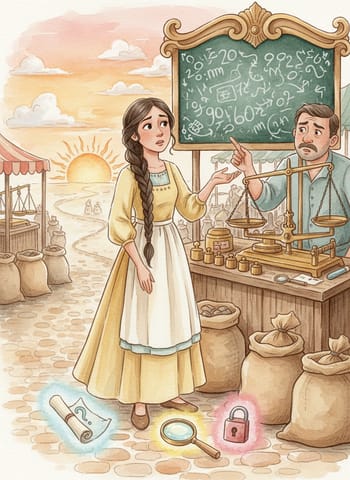
Nobody bought anything from Yasmin's stall for three days.
整整三天,没有人买亚斯明摊位上的任何东西。
Yasmin sold scales and weights at the edge of the market. Her stall was small. It had a wooden table and a blue cloth. On the cloth sat a row of shiny brass weights. Behind the table stood a tall iron scale. She used it to test every weight she sold.
亚斯明在集市边上卖秤和砝码。她的摊位不大,一张木桌,一块蓝布。布上摆着一排闪亮的黄铜砝码。桌子后面立着一台高高的铁秤,她用它检验卖出去的每一个砝码。
On the first day, Yasmin blamed the crowd. On the second day, she blamed the new fruit stall. On the third day, she sat on her stool. She looked up at her price board.
第一天,亚斯明怪人流不旺。第二天,她怪新来的水果摊。第三天,她坐在凳子上,抬头看着自己的价目牌。
The board was new. Her friend Clara made it on Monday. Clara painted signs for half the market. She wrote the prices in black ink on a long white board. Then she hung it over the table.
价目牌是新的,是她朋友克拉拉星期一做的。克拉拉给半个集市画招牌。她用黑墨水把价钱写在一块长长的白板上,然后挂在桌子上方。
Yasmin read it slowly. Small brass weight, 11 coins. Big brass weight, 21 coins. Pocket scale, 31 coins. The prices looked fair to her. They were the same as last year.
亚斯明慢慢地读着:小铜砝码,11枚硬币。大铜砝码,21枚硬币。便携秤,31枚硬币。在她看来,这些价钱很公道,和去年一样。
"So why does nobody buy?" Yasmin asked the scale.
“那为什么没人买呢?”亚斯明问那台秤。
The scale did not answer. Scales never do. But Yasmin loved a good puzzle. She decided to solve this one before the market closed.
秤没有回答。秤从来不回答。不过亚斯明就爱解谜。她决定在集市收摊前把这个谜解开。
She started with a memory. On Tuesday, a woman stopped at the stall. The woman looked up at the board, and her eyebrows jumped.
她从一段记忆开始。星期二,有个女人在摊位前停下来。女人抬头看了看价目牌,眉毛一下子跳了起来。
"Seventy-seven coins for that tiny thing?" the woman said.
“那么个小东西要七十七枚硬币?”女人说。
Then she laughed and walked away. At the time, Yasmin thought it was a joke. Now she was not so sure. Her small weight cost eleven coins. Why did the woman say seventy-seven?
然后她笑着走开了。当时亚斯明以为那是开玩笑。现在她不那么确定了。她的小砝码卖十一枚硬币,那女人为什么说七十七?
That was the first clue.
这是第一条线索。
For the second clue, Yasmin closed the stall early. She crossed the lane to the fish seller. He had a loud voice and very good eyes.
第二条线索,亚斯明提早收了摊。她穿过小巷,走到卖鱼的人那里。他嗓门很大,眼力很好。
"Read my board for me," she said. "Read it from here."
“帮我读读我的价目牌,”她说,“就从这儿读。”
The fish seller looked up from his fish. He moved his lips. "Small weight, seventy-seven coins," he said. "Big weight, twenty-seven. Pocket scale, thirty-seven."
卖鱼的人从鱼上抬起头,嘴唇动了动。“小砝码,七十七枚硬币,”他说,“大砝码,二十七。便携秤,三十七。”
"Now come closer," said Yasmin.
“现在走近点,”亚斯明说。
He walked to her stall and tipped his head back. He looked at the board for a long time.
他走到她的摊位前,仰起头,对着价目牌看了很久。
"Eleven," he said slowly. "Twenty-one. Thirty-one." He scratched his neck. "Your board tells me two different things. From far away, it says one thing. Close up, it says another."
“十一,”他慢慢地说,“二十一,三十一。”他挠了挠脖子。“你的牌子告诉我两件不同的事。远看一个说法,近看另一个说法。”
"Thank you," said Yasmin. "That is very useful."
“谢谢你,”亚斯明说,“这很有用。”
It was useful, but it was not an answer. She sat on a crate and thought hard. The board was the same board. The ink was the same ink. Only the distance changed what people saw.
有用,但还不算答案。她坐在一个板条箱上,苦苦思索。牌子还是那块牌子,墨水还是那种墨水,只有距离改变了人们看到的东西。
Yasmin looked at the lane. People walked past her stall in both directions. Each of them looked up at the board from far away. Each of them saw something silly. Then they walked on, and nobody asked her why.
亚斯明望着小巷。人们从她的摊位前往两个方向走过。每个人都在远处抬头看那块牌子,每个人都看到了荒唐的数字。然后他们走开了,没有人来问她。
For the third clue, Yasmin walked to Clara's workshop. It was in a narrow street behind the market. The door stood open. Boards and paint pots covered every table.
第三条线索,亚斯明走到克拉拉的作坊。它在集市后面一条狭窄的街上,门开着。每张桌子上都堆满了木板和颜料罐。
Clara looked up from a half-painted sign. "Yasmin! Does the new board bring you many customers?"
克拉拉从一块画到一半的招牌上抬起头。“亚斯明!新牌子给你带来很多顾客了吗?”
"No customers at all," Yasmin said. "That is why I am here."
“一个顾客也没有,”亚斯明说,“所以我才来了。”
"Oh dear," said Clara. "Sit down. I will find some water for you."
“哎呀,”克拉拉说,“坐吧。我去给你找点水。”
While Clara looked, Yasmin looked around. On a shelf stood a big glass jar. It was full to the top with nails. A small paper list lay next to it.
克拉拉去找水时,亚斯明环顾四周。架子上放着一个大玻璃罐,里面装满了钉子,一直满到罐口。旁边放着一张小纸单。
"Why do you have so many nails?" she asked.
“你为什么有这么多钉子?”她问。
Clara sighed. "It is a silly story. Last week, I wrote a list for the hardware shop. I needed eleven nails. The shop man gave me seventy-seven. He showed me my list. He said, 'It says seventy-seven.'" She pointed at the jar. "Now I must use all of them. I put extra nails in every sign I make."
克拉拉叹了口气。“说来可笑。上星期我给五金店写了张单子,我需要十一根钉子。店里的人给了我七十七根。他拿我的单子给我看,说:‘上面写的是七十七。’”她指了指罐子。“现在我只好把它们都用掉。我做的每块招牌里都多钉上几根。”
Yasmin took the list from the shelf. She held it far from her face. Then she held it close to her nose. Then she started to laugh.
亚斯明从架子上拿起单子,先举得离脸远远的,再凑到鼻子跟前,然后笑了起来。
"Clara," she said. "How do you write the number one?"
“克拉拉,”她说,“你怎么写数字1?”
"Like this." Clara picked up a pencil and drew on a piece of wood. It was a tall line with a long flag on top.
“这样。”克拉拉拿起一支铅笔,在一块木片上画了出来:一条高高的竖线,顶上带一面长长的小旗。
"That is a seven," said Yasmin.
“这是个7,”亚斯明说。
"No, a seven has a little line across the middle," said Clara. "Mine is a one. My teacher showed me."
“不对,7的中间有一小横,”克拉拉说,“我这个是1。我老师教我的。”
"From far away, nobody sees the little line."
“从远处看,没人看得见那小小的一横。”
Clara stared at the wood. She stared at the list. She stared at the jar of nails. Her mouth fell open.
克拉拉盯着木片,盯着单子,又盯着那罐钉子,嘴巴张得老大。
"Seventy-seven nails," she whispered. "And seventy-seven coins."
“七十七根钉子,”她低声说,“还有七十七枚硬币。”
They laughed until they had to sit on the floor. The whole workshop shook with it. Outside, a man stopped in the street and looked in. Then he walked on, shaking his head.
她们笑得不得不坐到地板上,整个作坊都在笑声里发抖。外面街上有个男人停下来朝里张望,然后摇着头走开了。
When they could speak again, Clara found a clean board. "I will write the prices in words," she said. "Eleven coins. Twenty-one coins. And from now on, every number one will be a plain stick. No flag. No hat."
等她们终于能说话,克拉拉找来一块干净的木板。“我要把价钱写成汉字,”她说,“十一枚硬币。二十一枚硬币。还有,从今往后,每个1都写成一根光溜溜的竖线。不带旗,不戴帽。”
She worked by lamp until midnight. Yasmin held the lamp. She told Clara about the woman with the jumping eyebrows. Clara laughed so hard that she had to stop painting twice.
她在灯下一直干到半夜,亚斯明替她举着灯。亚斯明跟她讲起那个挑眉毛的女人,克拉拉笑得厉害,画到一半停下来两次。
Early the next morning, Yasmin hung the new board over her table. The market was still half asleep. A boy stopped to look at it. He read it with his finger, one word at a time.
第二天一早,亚斯明把新牌子挂在桌子上方。集市还半睡半醒。一个男孩停下来看,用手指一个字一个字地读。
"Eleven coins," he said. "That is cheap."
“十一枚硬币,”他说,“真便宜。”
He put his coins on the table. He chose the smallest brass weight. Yasmin set it on the iron scale. The long arm swung once, then twice. Then it stood perfectly still, level, in the early light.
他把硬币放在桌上,挑了最小的那个铜砝码。亚斯明把它放到铁秤上。长长的秤杆摆了一下,又摆了一下,然后在清晨的光线里稳稳地停住了,平平的,一动不动。