The Quarrel of the Monkey and the Crab
A free B1-level English story for language learners, readable online in 7 languages, with an option to listen via the free Storyteller app.
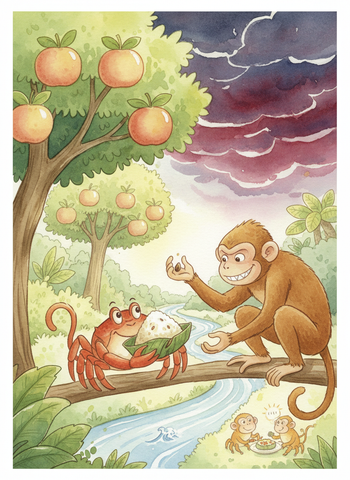
A crab trades her rice-dumpling for a monkey's worthless seed, trusting his promise of future fruit — but greed turns their old friendship into a deadly betrayal.
Long, long ago, one bright autumn day in Japan, it happened, that a pink-faced monkey and a yellow crab were playing together along the bank of a river. As they were running about, the crab found a rice-dumpling and the monkey a persimmon-seed.
Há muito, muito tempo, num belo dia de outono no Japão, aconteceu que um macaco de rosto rosado e um caranguejo amarelo brincavam juntos à margem de um rio. Enquanto corriam por ali, o caranguejo encontrou um bolinho de arroz e o macaco uma semente de caqui.
The crab picked up the rice-dumpling and showed it to the monkey, saying:
O caranguejo pegou o bolinho de arroz e o mostrou ao macaco, dizendo:
“Look what a nice thing I have found!”
"Olha que coisa boa eu encontrei!"
Then the monkey held up his persimmon-seed and said:
Então o macaco ergueu sua semente de caqui e disse:
“I also have found something good! Look!”
"Eu também encontrei uma coisa boa! Olha!"
Now though the monkey is always very fond of persimmon fruit, he had no use for the seed he had just found. The persimmon-seed is as hard and uneatable as a stone. He, therefore, in his greedy nature, felt very envious of the crab’s nice dumpling, and he proposed an exchange. The crab naturally did not see why he should give up his prize for a hard stone-like seed, and would not consent to the monkey’s proposition.
Ora, embora o macaco goste muito da fruta caqui, não tinha nenhuma utilidade para a semente que acabara de encontrar. A semente de caqui é tão dura e intragável quanto uma pedra. Ele, portanto, em sua natureza gananciosa, sentiu grande inveja do belo bolinho do caranguejo, e propôs uma troca. O caranguejo, naturalmente, não via por que deveria abrir mão de seu prêmio por uma semente dura como pedra, e não quis consentir com a proposta do macaco.
Then the cunning monkey began to persuade the crab, saying:
Então o macaco astuto começou a persuadir o caranguejo, dizendo:
“How unwise you are not to think of the future! Your rice-dumpling can be eaten now, and is certainly much bigger than my seed; but if you sow this seed in the ground it will soon grow and become a great tree in a few years, and bear an abundance of fine ripe persimmons year after year. If only I could show it to you then with the yellow fruit hanging on its branches! Of course, if you don’t believe me I shall sow it myself; though I am sure, later on, you will be very sorry that you did not take my advice.”
"Que imprudente você é, por não pensar no futuro! Seu bolinho de arroz pode ser comido agora, e é certamente muito maior que minha semente; mas se você plantar essa semente na terra, ela logo vai crescer e se tornar uma grande árvore em poucos anos, e dar uma abundância de belos caquis maduros, ano após ano. Quem me dera poder mostrar a você, então, os frutos amarelos pendurados em seus galhos! Claro, se você não acredita em mim, vou plantá-la eu mesmo; embora eu tenha certeza de que, mais adiante, você vai se arrepender muito de não ter seguido meu conselho."
The simple-minded crab could not resist the monkey’s clever persuasion. He at last gave in and consented to the monkey’s proposal, and the exchange was made. The greedy monkey soon gobbled up the dumpling, and with great reluctance gave up the persimmon-seed to the crab. He would have liked to keep that too, but he was afraid of making the crab angry and of being pinched by his sharp scissor-like claws. They then separated, the monkey going home to his forest trees and the crab to his stones along the river-side. As soon as the crab reached home he put the persimmon-seed in the ground as the monkey had told him.
O caranguejo, de mente simples, não conseguiu resistir à esperta persuasão do macaco. Por fim cedeu e consentiu com a proposta do macaco, e a troca foi feita. O macaco ganancioso logo devorou o bolinho, e com grande relutância entregou a semente de caqui ao caranguejo. Teria gostado de ficar com ela também, mas temia deixar o caranguejo com raiva e ser beliscado por suas afiadas garras em forma de tesoura. Então se separaram, o macaco indo para casa, entre as árvores da floresta, e o caranguejo para suas pedras à beira do rio. Assim que o caranguejo chegou em casa, plantou a semente de caqui na terra, como o macaco lhe dissera.
In the following spring the crab was delighted to see the shoot of a young tree push its way up through the ground. Each year it grew bigger, till at last it blossomed one spring, and in the following autumn bore some fine large persimmons. Among the broad smooth green leaves the fruit hung like golden balls, and as they ripened they mellowed to a deep orange. It was the little crab’s pleasure to go out day by day and sit in the sun and put out his long eyes in the same way as a snail puts out its horn, and watch the persimmons ripening to perfection.
Na primavera seguinte, o caranguejo ficou encantado ao ver o broto de uma jovem árvore se abrir caminho através da terra. A cada ano ela crescia mais, até que finalmente floresceu numa primavera, e no outono seguinte deu alguns belos caquis grandes. Entre as largas e lisas folhas verdes, os frutos pendiam como bolas douradas, e à medida que amadureciam, ganhavam um tom laranja profundo. Era o prazer do pequeno caranguejo sair dia após dia e sentar-se ao sol e esticar seus longos olhos, do mesmo modo que um caramujo estica seus chifres, e observar os caquis amadurecendo até a perfeição.
“How delicious they will be to eat!” he said to himself.
"Como serão deliciosos de comer!" disse ele para si mesmo.
At last, one day, he knew the persimmons must be quite ripe and he wanted very much to taste one. He made several attempts to climb the tree, in the vain hope of reaching one of the beautiful persimmons hanging above him; but he failed each time, for a crab’s legs are not made for climbing trees but only for running along the ground and over stones, both of which he can do most cleverly. In his dilemma he thought of his old playmate the monkey, who, he knew, could climb trees better than any one else in the world. He determined to ask the monkey to help him, and set out to find him.
Por fim, um dia, soube que os caquis deviam estar bem maduros e desejou muito provar um deles. Fez várias tentativas de subir na árvore, na esperança vã de alcançar um dos belos caquis pendurados acima dele; mas falhou a cada vez, pois as pernas de um caranguejo não são feitas para subir em árvores, mas apenas para correr pelo chão e sobre as pedras, ambas as coisas que ele fazia com muita habilidade. Em seu dilema, pensou em seu velho companheiro de brincadeiras, o macaco, que, sabia, conseguia subir em árvores melhor do que qualquer outro no mundo. Decidiu pedir ajuda ao macaco, e partiu para encontrá-lo.
Running crab-fashion up the stony river bank, over the pathways into the shadowy forest, the crab at last found the monkey taking an afternoon nap in his favorite pine-tree, with his tail curled tight around a branch to prevent him from falling off in his dreams. He was soon wide awake, however, when he heard himself called, and eagerly listening to what the crab told him. When he heard that the seed which he had long ago exchanged for a rice-dumpling had grown into a tree and was now bearing good fruit, he was delighted, for he at once devised a cunning plan which would give him all the persimmons for himself.
Correndo à moda dos caranguejos pela margem pedregosa do rio, pelos caminhos até a floresta sombria, o caranguejo finalmente encontrou o macaco tirando uma soneca de tarde em seu pinheiro favorito, com o rabo enrolado firmemente em torno de um galho para evitar que caísse enquanto sonhava. Logo, porém, ficou bem desperto, quando se ouviu chamado, e escutou avidamente o que o caranguejo lhe contava. Quando soube que a semente que havia muito tempo trocara por um bolinho de arroz tinha se tornado uma árvore e agora dava bons frutos, ficou encantado, pois de imediato arquitetou um plano astuto que lhe daria todos os caquis só para si.
He consented to go with the crab to pick the fruit for him. When they both reached the spot, the monkey was astonished to see what a fine tree had sprung from the seed, and with what a number of ripe persimmons the branches were loaded.
Concordou em ir com o caranguejo colher os frutos para ele. Quando os dois chegaram ao local, o macaco ficou espantado ao ver que árvore magnífica havia brotado da semente, e com que quantidade de caquis maduros os galhos estavam carregados.
He quickly climbed the tree and began to pluck and eat, as fast as he could, one persimmon after another. Each time he chose the best and ripest he could find, and went on eating till he could eat no more. Not one would he give to the poor hungry crab waiting below, and when he had finished there was little but the hard, unripe fruit left.
Rapidamente subiu na árvore e começou a colher e a comer, o mais depressa que podia, um caqui após outro. A cada vez escolhia o melhor e o mais maduro que conseguia encontrar, e continuou comendo até não conseguir comer mais. Não deu nem um sequer ao pobre caranguejo faminto que esperava embaixo, e quando terminou, restava pouco além dos frutos duros e verdes.
You can imagine the feelings of the poor crab after waiting patiently, for so long as he had done, for the tree to grow and the fruit to ripen, when he saw the monkey devouring all the good persimmons. He was so disappointed that he ran round and round the tree calling to the monkey to remember his promise. The monkey at first took no notice of the crab’s complaints, but at last he picked out the hardest, greenest persimmon he could find and aimed it at the crab’s head.
Podem imaginar os sentimentos do pobre caranguejo, depois de ter esperado pacientemente, por tanto tempo como havia esperado, para que a árvore crescesse e os frutos amadurecessem, ao ver o macaco devorando todos os bons caquis. Ficou tão decepcionado que correu em torno da árvore, chamando o macaco para que se lembrasse de sua promessa. O macaco, a princípio, não deu atenção às queixas do caranguejo, mas por fim escolheu o caqui mais duro e mais verde que conseguiu encontrar e o atirou na cabeça do caranguejo.
The persimmon is as hard as stone when it is unripe. The monkey’s missile struck home and the crab was sorely hurt by the blow. Again and again, as fast as he could pick them, the monkey pulled off the hard persimmons and threw them at the defenseless crab till he dropped dead, covered with wounds all over his body. There he lay a pitiful sight at the foot of the tree he had himself planted.
O caqui é duro como pedra quando ainda está verde. O projétil do macaco acertou em cheio, e o caranguejo ficou gravemente ferido pelo golpe. Repetidas vezes, tão depressa quanto conseguia colhê-los, o macaco arrancava os caquis duros e os atirava contra o caranguejo indefeso, até que ele caiu morto, coberto de feridas por todo o corpo. Ali ficou, uma cena lamentável, aos pés da árvore que ele mesmo tinha plantado.
When the wicked monkey saw that he had killed the crab he ran away from the spot as fast as he could, in fear and trembling, like a coward as he was.
Quando o macaco perverso viu que tinha matado o caranguejo, fugiu do local o mais depressa que pôde, trêmulo de medo, como o covarde que era.
Now the crab had a son who had been playing with a friend not far from the spot where this sad work had taken place. On the way home he came across his father dead, in a most dreadful condition—his head was smashed and his shell broken in several places, and around his body lay the unripe persimmons which had done their deadly work. At this dreadful sight the poor young crab sat down and wept.
Ora, o caranguejo tinha um filho que estava brincando com um amigo não muito longe do local onde aquele triste episódio havia ocorrido. No caminho de volta para casa, deparou-se com o pai morto, num estado terrível — a cabeça esmagada e a casca quebrada em vários pontos, e ao redor de seu corpo jaziam os caquis verdes que tinham feito seu trabalho mortal. Diante dessa visão terrível, o pobre jovem caranguejo se sentou e chorou.
But when he had wept for some time he told himself that this crying would do no good; it was his duty to avenge his father’s murder, and this he determined to do. He looked about for some clue which would lead him to discover the murderer. Looking up at the tree he noticed that the best fruit had gone, and that all around lay bits of peel and numerous seeds strewn on the ground as well as the unripe persimmons which had evidently been thrown at his father.
Mas depois de chorar por algum tempo, disse a si mesmo que aquele choro não adiantaria de nada; era seu dever vingar o assassinato do pai, e isso ele decidiu fazer. Procurou alguma pista que o levasse a descobrir o assassino. Olhando para a árvore, notou que os melhores frutos tinham sumido, e que ao redor havia pedaços de casca e numerosas sementes espalhadas pelo chão, assim como os caquis verdes que evidentemente haviam sido atirados contra seu pai.
Then he understood that the monkey was the murderer, for he now remembered that his father had once told him the story of the rice-dumpling and the persimmon-seed. The young crab knew that monkeys liked persimmons above all other fruit, and he felt sure that his greed for the coveted fruit had been the cause of the old crab’s death. Alas!
Então compreendeu que o macaco era o assassino, pois agora se lembrava de que seu pai certa vez lhe contara a história do bolinho de arroz e da semente de caqui. O jovem caranguejo sabia que os macacos gostavam de caquis acima de qualquer outra fruta, e teve certeza de que a ganância do macaco pela fruta cobiçada havia sido a causa da morte do velho caranguejo. Ai de mim!
He at first thought of going to attack the monkey at once, for he burned with rage. Second thoughts, however, told him that this was useless, for the monkey was an old and cunning animal and would be hard to overcome. He must meet cunning with cunning and ask some of his friends to help him, for he knew it would be quite out of his power to kill him alone.
A princípio pensou em ir atacar o macaco imediatamente, pois ardia de raiva. Pensando melhor, porém, percebeu que isso seria inútil, pois o macaco era um animal velho e astuto e seria difícil de vencer. Precisava combater astúcia com astúcia e pedir a alguns amigos que o ajudassem, pois sabia que estaria completamente fora de seu alcance matá-lo sozinho.
The young crab set out at once to call on the mortar, his father’s old friend, and told him of all that had happened. He besought the mortar with tears to help him avenge his father’s death. The mortar was very sorry when he heard the woful tale and promised at once to help the young crab punish the monkey to death. He warned him that he must be very careful in what he did, for the monkey was a strong and cunning enemy.
O jovem caranguejo partiu de imediato para visitar o pilão, velho amigo de seu pai, e lhe contou tudo o que tinha acontecido. Suplicou ao pilão, em lágrimas, que o ajudasse a vingar a morte do pai. O pilão ficou muito triste ao ouvir a triste história e prometeu de imediato ajudar o jovem caranguejo a punir o macaco com a morte. Avisou-o de que precisava ser muito cuidadoso no que fizesse, pois o macaco era um inimigo forte e astuto.
The mortar now sent to fetch the bee and the chestnut (also the crab’s old friends) to consult them about the matter. In a short time the bee and the chestnut arrived. When they were told all the details of the old crab’s death and of the monkey’s wickedness and greed, they both gladly consented to help the young crab in his revenge.
O pilão então mandou chamar a abelha e a castanha (também velhos amigos do caranguejo) para consultá-los sobre o assunto. Em pouco tempo, a abelha e a castanha chegaram. Quando lhes foram contados todos os detalhes da morte do velho caranguejo e da maldade e ganância do macaco, ambos concordaram de bom grado em ajudar o jovem caranguejo em sua vingança.
After talking for a long time as to the ways and means of carrying out their plans they separated, and Mr. Mortar went home with the young crab to help him bury his poor father.
Depois de conversarem por muito tempo sobre os meios e modos de executar seus planos, se separaram, e o Senhor Pilão foi para casa com o jovem caranguejo para ajudá-lo a enterrar seu pobre pai.
While all this was taking place the monkey was congratulating himself (as the wicked often do before their punishment comes upon them) on all he had done so neatly. He thought it quite a fine thing that he had robbed his friend of all his ripe persimmons and then that he had killed him. Still, smile as hard as he might, he could not banish altogether the fear of the consequences should his evil deeds be discovered.
Enquanto tudo isso acontecia, o macaco se parabenizava (como os perversos costumam fazer antes que o castigo lhes caia em cima) por tudo o que havia feito tão bem. Achava uma coisa das mais boas ter roubado do amigo todos os seus caquis maduros e depois tê-lo matado. Ainda assim, por mais que se esforçasse para sorrir, não conseguia banir por completo o medo das consequências, caso seus atos malignos fossem descobertos.
If he were found out (and he told himself that this could not be for he had escaped unseen) the crab’s family would be sure to bear him hatred and seek to take revenge on him. So he would not go out, and kept himself at home for several days. He found this kind of life, however, extremely dull, accustomed as he was to the free life of the woods, and at last he said:
Se fosse descoberto (e dizia a si mesmo que isso não podia acontecer, pois havia escapado sem ser visto), a família do caranguejo certamente o odiaria e buscaria vingança contra ele. Então não saiu de casa, e ficou recluso por vários dias. Achou esse tipo de vida, porém, extremamente entediante, acostumado como estava à vida livre dos bosques, e por fim disse:
“No one knows that it was I who killed the crab! I am sure that the old thing breathed his last before I left him. Dead crabs have no mouths! Who is there to tell that I am the murderer? Since no one knows, what is the use of shutting myself up and brooding over the matter? What is done cannot be undone!”
"Ninguém sabe que fui eu quem matou o caranguejo! Tenho certeza de que aquele velho bicho deu seu último suspiro antes que eu o deixasse. Caranguejos mortos não têm boca! Quem há para dizer que sou o assassino? Já que ninguém sabe, de que adianta ficar trancado remoendo o assunto? O que está feito não pode ser desfeito!"
With this he wandered out into the crab settlement and crept about as slyly as possible near the crab’s house and tried to hear the neighbors’ gossip round about. He wanted to find out what the crabs were saving about their chief’s death, for the old crab had been the chief of the tribe. But he heard nothing and said to himself:
Com isso, saiu vagando pelo bairro dos caranguejos e se esgueirou o mais dissimuladamente possível perto da casa do caranguejo, tentando ouvir as fofocas dos vizinhos por ali. Queria descobrir o que os caranguejos andavam dizendo sobre a morte do chefe deles, pois o velho caranguejo tinha sido o chefe da tribo. Mas não ouviu nada, e disse a si mesmo:
“They are all such fools that they don’t know and don’t care who murdered their chief!”
"São todos tão tolos que não sabem e não se importam com quem assassinou o chefe deles!"
Little did he know in his so-called “monkey’s wisdom” that this seeming unconcern was part of the young crab’s plan. He purposely pretended not to know who killed his father, and also to believe that he had met his death through his own fault. By this means he could the better keep secret the revenge on the monkey, which he was meditating.
Mal sabia ele, em sua chamada "sabedoria de macaco", que essa aparente indiferença fazia parte do plano do jovem caranguejo. Este fingia de propósito não saber quem tinha matado seu pai, e também fazer de conta que acreditava que ele havia encontrado a morte por culpa própria. Dessa forma, poderia manter em segredo, com mais facilidade, a vingança contra o macaco que estava tramando.
So the monkey returned home from his walk quite content. He told himself he had nothing now to fear.
Então o macaco voltou para casa de seu passeio bastante satisfeito. Disse a si mesmo que agora não tinha mais nada a temer.
One fine day, when the monkey was sitting at home, he was surprised by the appearance of a messenger from the young crab. While he was wondering what this might mean, the messenger bowed before him and said:
Certo belo dia, quando o macaco estava sentado em casa, foi surpreendido pela chegada de um mensageiro do jovem caranguejo. Enquanto se perguntava o que aquilo poderia significar, o mensageiro se curvou diante dele e disse:
“I have been sent by my master to inform you that his father died the other day in falling from a persimmon tree while trying to climb the tree after fruit. This, being the seventh day, is the first anniversary after his death, and my master has prepared a little festival in his father’s honor, and bids you come to participate in it as you were one of his best friends. My master hopes you will honor his house with your kind visit.”
"Fui enviado pelo meu senhor para informá-lo de que seu pai morreu outro dia, caindo de uma árvore de caqui enquanto tentava subir nela atrás de frutos. Este, sendo o sétimo dia, é o primeiro aniversário depois de sua morte, e meu senhor preparou um pequeno festival em honra a seu pai, e pede que o senhor venha participar, já que foi um de seus melhores amigos. Meu senhor espera que o senhor honre sua casa com sua gentil visita."
When the monkey heard these words he rejoiced in his inmost heart, for all his fears of being suspected were now at rest. He could not guess that a plot had just been set in motion against him. He pretended to be very surprised at the news of the crab’s death, and said:
Quando o macaco ouviu essas palavras, alegrou-se no fundo de seu coração, pois todos os seus temores de ser suspeito agora se aquietavam. Não podia imaginar que uma trama já estava em movimento contra ele. Fingiu ficar muito surpreso com a notícia da morte do caranguejo, e disse:
“I am, indeed, very sorry to hear of your chief’s death. We were great friends as you know. I remember that we once exchanged a rice-dumpling for a persimmon-seed. It grieves me much to think that that seed was in the end the cause of his death. I accept your kind invitation with many thanks. I shall be delighted to do honor to my poor old friend!” And he screwed some false tears from his eyes.
"Sinto muito, de fato, saber da morte de seu chefe. Éramos grandes amigos, como você sabe. Lembro-me de que uma vez trocamos um bolinho de arroz por uma semente de caqui. Aflige-me muito pensar que aquela semente foi, no fim, a causa de sua morte. Aceito seu gentil convite com muitos agradecimentos. Terei o maior prazer em honrar meu pobre e velho amigo!" E espremeu algumas lágrimas falsas dos olhos.
The messenger laughed inwardly and thought, “The wicked monkey is now dropping false tears, but within a short time he shall shed real ones.” But aloud he thanked the monkey politely and went home.
O mensageiro riu por dentro e pensou: "O macaco perverso agora derrama lágrimas falsas, mas dentro em pouco vai derramar lágrimas de verdade." Mas em voz alta agradeceu ao macaco educadamente e voltou para casa.
When he had gone, the wicked monkey laughed aloud at what he thought was the young crab’s innocence, and without the least feeling began to look forward to the feast to be held that day in honor of the dead crab, to which he had been invited. He changed his dress and set out solemnly to visit the young crab.
Depois que ele partiu, o macaco perverso riu alto do que julgava ser a inocência do jovem caranguejo, e sem o menor remorso começou a ansiar pela festa que seria realizada naquele dia em honra do caranguejo morto, para a qual fora convidado. Trocou de roupa e partiu solenemente para visitar o jovem caranguejo.
He found all the members of the crab’s family and his relatives waiting to receive and welcome him. As soon as the bows of meeting were over they led him to a hall. Here the young chief mourner came to receive him. Expressions of condolence and thanks were exchanged between them, and then they all sat down to a luxurious feast and entertained the monkey as the guest of honor.
Encontrou todos os membros da família do caranguejo e seus parentes esperando para recebê-lo e dar-lhe as boas-vindas. Assim que as reverências de saudação terminaram, o levaram até um salão. Ali o jovem enlutado principal veio recebê-lo. Trocaram entre si expressões de condolências e agradecimentos, e então todos se sentaram para um banquete luxuoso e entretiveram o macaco como convidado de honra.
The feast over, he was next invited to the tea-ceremony room to drink a cup of tea. When the young crab had conducted the monkey to the tearoom he left him and retired. Time passed and still he did not return. At last the monkey became impatient. He said to himself:
Terminado o banquete, foi em seguida convidado à sala da cerimônia do chá, para beber uma xícara de chá. Quando o jovem caranguejo conduziu o macaco até a sala de chá, deixou-o ali e se retirou. O tempo passou e ele ainda não voltava. Por fim o macaco ficou impaciente. Disse a si mesmo:
“This tea ceremony is always a very slow affair. I am tired of waiting so long. I am very thirsty after drinking so much sake at the dinner!”
"Essa cerimônia do chá é sempre um assunto muito demorado. Estou cansado de esperar tanto tempo. Estou com muita sede depois de beber tanto saquê no jantar!"
He then approached the charcoal fire-place and began to pour out some hot water from the kettle boiling there, when something burst out from the ashes with a great pop and hit the monkey right in the neck. It was the chestnut, one of the crab’s friends, who had hidden himself in the fireplace. The monkey, taken by surprise, jumped backward, and then started to run out of the room.
Então se aproximou da lareira de carvão e começou a despejar um pouco de água quente da chaleira que fervia ali, quando algo saltou das cinzas com um grande estouro e acertou o macaco bem no pescoço. Era a castanha, uma das amigas do caranguejo, que tinha se escondido na lareira. O macaco, pego de surpresa, saltou para trás, e então começou a correr para fora da sala.
The bee, who was hiding outside the screens, now flew out and stung him on the cheek. The monkey was in great pain, his neck was burned by the chestnut and his face badly stung by the bee, but he ran on screaming and chattering with rage.
A abelha, que estava escondida do lado de fora dos biombos, agora voou para fora e o picou na bochecha. O macaco sentiu muita dor, o pescoço queimado pela castanha e o rosto duramente picado pela abelha, mas continuou correndo, gritando e tagarelando de raiva.
Now the stone mortar had hidden himself with several other stones on the top of the crab’s gate, and as the monkey ran underneath, the mortar and all fell down on the top of the monkey’s head. Was it possible for the monkey to bear the weight of the mortar falling on him from the top of the gate? He lay crushed and in great pain, quite unable to get up. As he lay there helpless the young crab came up, and, holding his great claw scissors over the monkey, he said:
Ora, o pilão de pedra tinha se escondido, junto com várias outras pedras, no alto do portão do caranguejo, e quando o macaco correu por baixo dele, o pilão e tudo mais caíram bem em cima da cabeça do macaco. Seria possível para o macaco suportar o peso do pilão caindo sobre ele do alto do portão? Ficou caído, esmagado e com grande dor, incapaz de se levantar. Enquanto jazia ali indefeso, o jovem caranguejo se aproximou, e, segurando suas grandes garras em forma de tesoura sobre o macaco, disse:
“Do you now remember that you murdered my father?”
"Você se lembra agora de que assassinou meu pai?"
“Then you—are—my—enemy?” gasped the monkey brokenly.
"Então você — é — meu — inimigo?" ofegou o macaco, entrecortado.
“Of course,” said the young crab.
"Claro que sim", disse o jovem caranguejo.
“It—was—your—father’s—fault—not—mine!” gasped the unrepentant monkey.
"A culpa — foi — do seu pai — não — minha!" ofegou o macaco, sem o menor arrependimento.
“Can you still lie? I will soon put an end to your breath!” and with that he cut off the monkey’s head with his pitcher claws. Thus the wicked monkey met his well-merited punishment, and the young crab avenged his father’s death.
"Ainda consegue mentir? Vou logo pôr fim à sua respiração!" e com isso cortou a cabeça do macaco com suas garras em forma de jarro. Assim o macaco perverso encontrou seu castigo bem merecido, e o jovem caranguejo vingou a morte de seu pai.
This is the end of the story of the monkey, the crab, and the persimmon-seed.
Este é o fim da história do macaco, do caranguejo, e da semente de caqui.
