The Dog Who Carried His Master's Dinner
Uma história gratuita em inglês de nível B2 para estudantes, para ler online em 7 idiomas, com opção de ouvir no app gratuito Storyteller.
A disciplined dog resists the temptation of the dinner he's carrying for his master — until a pack of hungry strays forces him to find a clever way to keep the peace.
Essa foi a prévia! Ouça a história completa no app gratuito Storyteller. Baixar o app
O áudio não está disponível no momento.
Our hands are no more proof against gold than our eyes are proof against beauty. There are but few who guard their treasures with care enough.
Nossas mãos não são mais resistentes ao ouro do que nossos olhos são resistentes à beleza. São poucos os que guardam seus tesouros com cuidado suficiente.
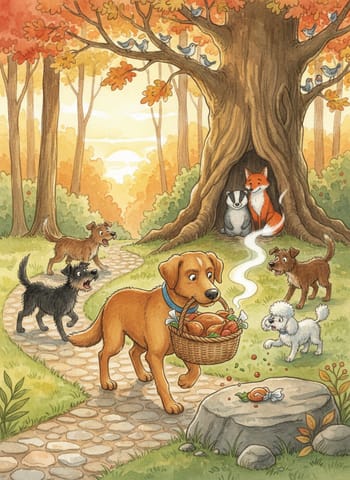
A certain dog who had been taught to carry to his master the mid-day meal was one day trotting along with the savoury burden slung around his neck. He was tempted to take a taste himself; but knew that it would be wrong to do so, and being a temperate, self-governed dog he refrained. We of the human race allow ourselves to be tempted by covetable things often enough; but, strange as it is, there seems to be more difficulty in teaching mankind to resist temptation than there is in teaching dogs to do so.
Certo cão que havia sido ensinado a levar ao seu dono a refeição do meio-dia trotava um dia carregando o saboroso fardo pendurado ao pescoço. Ele foi tentado a experimentar um pouco para si mesmo; mas sabia que seria errado fazer isso, e, sendo um cão comedido e disciplinado, absteve-se. Nós, da raça humana, permitimo-nos ser tentados por coisas cobiçáveis com bastante frequência; mas, por estranho que pareça, parece haver mais dificuldade em ensinar os humanos a resistir à tentação do que em ensinar os cães a fazê-lo.
On this particular day the dog was met by a mastiff who at once wanted the dinner, but did not find it so easy to capture as he thought; for our dog put it down and stood guard over it. There was a mighty tussle. Soon others arrived; curs that were used to knocks and kicks while picking up a living in the streets. Seeing that he should be badly over-matched, and that his master's dinner was in danger of being devoured by the crowd, he bethought himself how he too might have his share, if shared it must be.
Naquele dia em particular, o cão encontrou um mastim que logo quis o jantar, mas não achou tão fácil tomá-lo quanto pensava; pois nosso cão o pôs no chão e ficou de guarda sobre ele. Houve uma briga tremenda. Logo outros chegaram; vira-latas acostumados a pancadas e pontapés enquanto buscavam a vida nas ruas. Vendo que seria amplamente superado, e que o jantar de seu dono corria o risco de ser devorado pela multidão, ele pensou em como também poderia ter sua parte, já que teria que ser dividido de qualquer forma.
So he very wisely exclaimed, "No fighting, gentlemen, my bit will suffice me. Do as you please with the rest." With these words he snapped up a portion, upon which all the rest began to pull and jostle to their utmost and feasted merrily.
Então ele exclamou muito sabiamente: "Sem briga, senhores, meu pedaço me basta. Façam o que quiserem com o resto." Com essas palavras, ele abocanhou uma porção, ao que todos os outros começaram a puxar e empurrar com toda a força e festejaram alegremente.
In this I seem to see the picture of one of those unfortunate towns or states which occasionally have suffered from the greed of their ministers and officials. Each functionary has an eye to his own advantage, and the smartest sets a pattern for the others. The way in which the public funds disappear is amusing. If one sheriff or provost, having a scruple of conscience, finds a trifling argument in defence of the public interest the others show him that he is a fool if he utters half a word. So, with a very little trouble, he gives way, and often becomes the leading offender.
Nisso me parece ver o retrato de uma daquelas infelizes cidades ou nações que ocasionalmente sofrem com a ganância de seus ministros e funcionários. Cada funcionário fica de olho em sua própria vantagem, e o mais esperto dá o exemplo para os demais. É divertido ver como o dinheiro público desaparece. Se algum xerife ou prefeito, tendo um escrúpulo de consciência, encontra um argumento por menor que seja em defesa do interesse público, os outros lhe mostram que ele é um tolo se ousar dizer meia palavra. Assim, com muito pouco esforço, ele cede, e frequentemente se torna o principal culpado.