The Dog Who Carried His Master's Dinner
Una historia gratuita en inglés de nivel B2 para estudiantes, para leer en línea en 7 idiomas, con opción de escucharla en la app gratuita Storyteller.
A disciplined dog resists the temptation of the dinner he's carrying for his master — until a pack of hungry strays forces him to find a clever way to keep the peace.
¡Ese fue el avance! Escucha la historia completa en la app gratuita Storyteller. Descargar la app
El audio no está disponible en este momento.
Our hands are no more proof against gold than our eyes are proof against beauty. There are but few who guard their treasures with care enough.
Nuestras manos no son más resistentes al oro que nuestros ojos a la belleza. Son pocos los que guardan sus tesoros con suficiente cuidado.
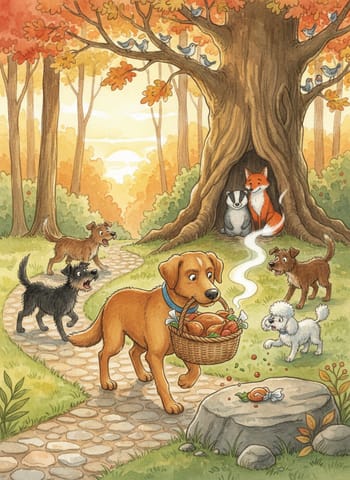
A certain dog who had been taught to carry to his master the mid-day meal was one day trotting along with the savoury burden slung around his neck. He was tempted to take a taste himself; but knew that it would be wrong to do so, and being a temperate, self-governed dog he refrained. We of the human race allow ourselves to be tempted by covetable things often enough; but, strange as it is, there seems to be more difficulty in teaching mankind to resist temptation than there is in teaching dogs to do so.
Cierto perro al que habían enseñado a llevarle a su amo la comida del mediodía iba un día trotando con la sabrosa carga colgada del cuello. Sintió la tentación de probarla él mismo, pero sabía que estaría mal hacerlo, y siendo un perro moderado y dueño de sí mismo, se contuvo. Nosotros, los seres humanos, nos dejamos tentar a menudo por cosas codiciables; pero, por extraño que parezca, parece haber más dificultad en enseñar al hombre a resistir la tentación que en enseñar a los perros a hacerlo.
On this particular day the dog was met by a mastiff who at once wanted the dinner, but did not find it so easy to capture as he thought; for our dog put it down and stood guard over it. There was a mighty tussle. Soon others arrived; curs that were used to knocks and kicks while picking up a living in the streets. Seeing that he should be badly over-matched, and that his master's dinner was in danger of being devoured by the crowd, he bethought himself how he too might have his share, if shared it must be.
Aquel día en particular, el perro se encontró con un mastín que de inmediato quiso quitarle la comida, pero no le resultó tan fácil como pensaba, pues nuestro perro la dejó en el suelo y montó guardia sobre ella. Hubo una feroz pelea. Pronto llegaron otros: perros callejeros acostumbrados a golpes y patadas mientras se ganaban la vida en las calles. Al ver que sería ampliamente superado, y que la cena de su amo corría peligro de ser devorada por la multitud, pensó en cómo también él podría obtener su parte, si es que había que compartirla.
So he very wisely exclaimed, "No fighting, gentlemen, my bit will suffice me. Do as you please with the rest." With these words he snapped up a portion, upon which all the rest began to pull and jostle to their utmost and feasted merrily.
Así que, muy sabiamente, exclamó: "Nada de peleas, señores; con mi bocado me basta. Hagan lo que quieran con el resto." Con estas palabras, tomó una porción, ante lo cual todos los demás comenzaron a tirar y empujarse con todas sus fuerzas y se dieron un festín alegremente.
In this I seem to see the picture of one of those unfortunate towns or states which occasionally have suffered from the greed of their ministers and officials. Each functionary has an eye to his own advantage, and the smartest sets a pattern for the others. The way in which the public funds disappear is amusing. If one sheriff or provost, having a scruple of conscience, finds a trifling argument in defence of the public interest the others show him that he is a fool if he utters half a word. So, with a very little trouble, he gives way, and often becomes the leading offender.
En esto me parece ver la imagen de aquellos desafortunados pueblos o estados que a veces han sufrido por la codicia de sus ministros y funcionarios. Cada funcionario mira por su propio beneficio, y el más astuto marca la pauta para los demás. Es curioso ver cómo desaparecen los fondos públicos. Si algún alguacil o gobernador, movido por un escrúpulo de conciencia, presenta un argumento en defensa del interés público, los demás le hacen ver que es un necio si dice media palabra. Así, sin mucho esfuerzo, termina cediendo, y a menudo se convierte en el principal culpable.