The Sign for the Park
Una historia gratuita en inglés de nivel B2 para estudiantes, para leer en línea en 4 idiomas, con opción de escucharla en la app gratuita Storyteller.
When the town plans to turn her neighborhood's only park into a parking lot, Gaia argues with her parents about how to protest.
¡Ese fue el avance! Escucha la historia completa en la app gratuita Storyteller. Descargar la app
El audio no está disponible en este momento.
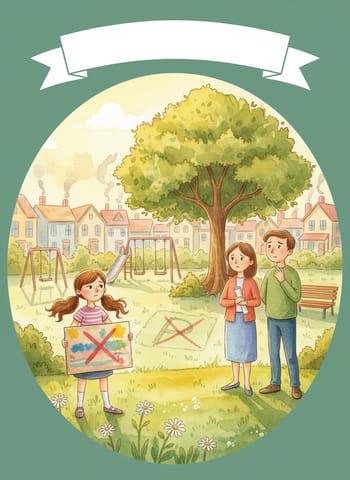
The notice on the lamppost is only a sheet of white paper, but Gaia reads it four times. The council plans to turn Mulberry Square, the only park in her neighborhood, into a parking lot with sixty spaces. A hearing is scheduled for Thursday.
El aviso del poste de luz es solo una hoja de papel blanco, pero Gaia lo lee cuatro veces. El ayuntamiento planea convertir la plaza Mulberry, el único parque de su barrio, en un estacionamiento con sesenta plazas. Hay una audiencia programada para el jueves.
She knows every inch of that park. The mulberry tree with a branch low enough for small children to sit on. The drinking fountain that works only if you hit it. The path where her father once ran behind her bicycle, holding the seat.
Conoce cada palmo de ese parque. El moral con una rama lo bastante baja para que se sienten los niños pequeños. La fuente de agua que solo funciona si le das un golpe. El sendero por donde su padre corrió una vez detrás de su bicicleta, sujetando el asiento.
That evening she drags a flattened delivery box into the kitchen and starts painting. "SAVE MULBERRY SQUARE," she writes, in letters that shrink as she runs out of room. The last word nearly climbs off the edge.
Esa tarde arrastra una caja de reparto aplastada hasta la cocina y se pone a pintar. «SALVEMOS LA PLAZA MULBERRY», escribe, con letras que se encogen conforme se le acaba el espacio. La última palabra casi se sale por el borde.
Her mother looks up from the table. "What is that for?"
Su madre levanta la vista de la mesa. «¿Para qué es eso?».
"Thursday. I'm going to stand outside the town hall with it. Everyone should."
«Para el jueves. Voy a pararme frente al ayuntamiento con él. Todos deberían».
Her parents exchange a glance, the particular one that means they have already discussed this without her.
Sus padres intercambian una mirada, esa en particular que significa que ya lo han hablado sin ella.
"Gaia," her father says, "I agree with you about the park. I just don't think a sign will change anything. Councils don't read cardboard."
«Gaia», dice su padre, «estoy de acuerdo contigo sobre el parque. Solo que no creo que un cartel cambie nada. Los ayuntamientos no leen cartón».
"Then what will? Letters? Nobody reads those either."
«Entonces, ¿qué lo hará? ¿Cartas? Esas tampoco las lee nadie».
"People read facts. How many children use the park, how many cars the lot would bring to your street." He rubs his forehead. "If somebody had spoken at the last hearing about the school, the crossing would have been built years ago."
«La gente lee datos. Cuántos niños usan el parque, cuántos autos traería el estacionamiento a tu calle». Se frota la frente. «Si alguien hubiera hablado en la última audiencia sobre la escuela, el paso de peatones se habría construido hace años».
Her mother shakes her head. "I disagree with both of you. I think the sign is exactly right. People walk past meetings, but they stop for signs. My worry is different. You are fifteen, and these hearings run until ten at night. I would want to be there."
Su madre niega con la cabeza. «Yo no estoy de acuerdo con ninguno de los dos. Creo que el cartel es justo lo adecuado. La gente pasa de largo ante las reuniones, pero se detiene ante los carteles. Mi preocupación es otra. Tienes quince años, y esas audiencias duran hasta las diez de la noche. Yo querría estar allí».
"So you're not against it," Gaia says.
«O sea que no estás en contra», dice Gaia.
"I was never against it. I was against you doing it alone."
«Nunca estuve en contra. Estaba en contra de que lo hicieras sola».
For a while, nobody speaks. The paint on the cardboard is still wet. Gaia realizes that she has been arguing with a version of her parents she invented, one who would simply say no.
Durante un rato, nadie habla. La pintura del cartón sigue húmeda. Gaia se da cuenta de que ha estado discutiendo con una versión de sus padres que se inventó, una que simplemente diría que no.
"What if I do both?" she says at last. "I hold the sign outside, and I ask to speak inside. Two minutes, with real numbers."
«¿Y si hago las dos cosas?», dice por fin. «Sostengo el cartel afuera y pido la palabra adentro. Dos minutos, con cifras reales».
Her father considers this, then slowly pulls out a chair. "Two minutes is hard," he says. "Everyone writes four minutes of material. I'll help you cut it."
Su padre lo piensa, y luego saca lentamente una silla. «Dos minutos es difícil», dice. «Todo el mundo escribe cuatro minutos de material. Te ayudaré a recortar».
"And I'll bring snacks," her mother says, "because I refuse to stand in a cold hallway without them."
«Y yo traeré algo de comer», dice su madre, «porque me niego a estar en un pasillo frío sin nada».
Gaia turns the sign around. On the back, in her smallest letters, she writes Thursday's date, and under it a single word: FACTS. Then she picks up a pencil and starts with the first one.
Gaia da la vuelta al cartel. En el reverso, con sus letras más pequeñas, escribe la fecha del jueves y, debajo, una sola palabra: DATOS. Luego toma un lápiz y empieza por el primero.