The Sign for the Park
Uma história gratuita em inglês de nível B2 para estudantes, para ler online em 4 idiomas, com opção de ouvir no app gratuito Storyteller.
When the town plans to turn her neighborhood's only park into a parking lot, Gaia argues with her parents about how to protest.
Essa foi a prévia! Ouça a história completa no app gratuito Storyteller. Baixar o app
O áudio não está disponível no momento.
The notice on the lamppost is only a sheet of white paper, but Gaia reads it four times. The council plans to turn Mulberry Square, the only park in her neighborhood, into a parking lot with sixty spaces. A hearing is scheduled for Thursday.
O aviso no poste é só uma folha de papel branco, mas Gaia o lê quatro vezes. A prefeitura planeja transformar a Praça da Amoreira, o único parque do bairro dela, num estacionamento com sessenta vagas. Uma audiência está marcada para quinta-feira.
She knows every inch of that park. The mulberry tree with a branch low enough for small children to sit on. The drinking fountain that works only if you hit it. The path where her father once ran behind her bicycle, holding the seat.
Ela conhece cada centímetro daquele parque. A amoreira com um galho baixo o bastante para crianças pequenas se sentarem. O bebedouro que só funciona se você bater nele. O caminho onde o pai dela corria atrás da bicicleta, segurando o banco.
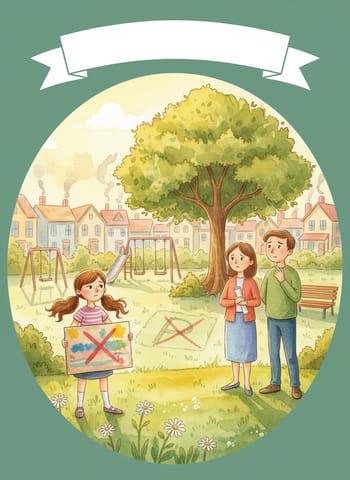
That evening she drags a flattened delivery box into the kitchen and starts painting. "SAVE MULBERRY SQUARE," she writes, in letters that shrink as she runs out of room. The last word nearly climbs off the edge.
Naquela noite, arrasta para a cozinha uma caixa de papelão de entrega desmontada e começa a pintar. "SALVEM A PRAÇA DA AMOREIRA", escreve, com letras que vão encolhendo à medida que falta espaço. A última palavra quase escala para fora da borda.
Her mother looks up from the table. "What is that for?"
A mãe levanta os olhos da mesa. "Para que é isso?"
"Thursday. I'm going to stand outside the town hall with it. Everyone should."
"Quinta. Vou ficar na frente da prefeitura com ele. Todo mundo devia ir."
Her parents exchange a glance, the particular one that means they have already discussed this without her.
Os pais trocam um olhar, aquele específico que significa que já discutiram o assunto sem ela.
"Gaia," her father says, "I agree with you about the park. I just don't think a sign will change anything. Councils don't read cardboard."
"Gaia", diz o pai, "concordo com você sobre o parque. Só não acho que uma placa vá mudar alguma coisa. Prefeituras não leem papelão."
"Then what will? Letters? Nobody reads those either."
"Então o que vai? Cartas? Ninguém lê essas também."
"People read facts. How many children use the park, how many cars the lot would bring to your street." He rubs his forehead. "If somebody had spoken at the last hearing about the school, the crossing would have been built years ago."
"As pessoas leem fatos. Quantas crianças usam o parque, quantos carros o estacionamento traria para a sua rua." Ele esfrega a testa. "Se alguém tivesse falado na última audiência sobre a escola, a faixa de pedestres teria sido construída anos atrás."
Her mother shakes her head. "I disagree with both of you. I think the sign is exactly right. People walk past meetings, but they stop for signs. My worry is different. You are fifteen, and these hearings run until ten at night. I would want to be there."
A mãe balança a cabeça. "Discordo dos dois. Acho que a placa está certíssima. As pessoas passam direto pelas reuniões, mas param diante de placas. Minha preocupação é outra. Você tem quinze anos, e essas audiências vão até as dez da noite. Eu quereria estar lá."
"So you're not against it," Gaia says.
"Então você não é contra", diz Gaia.
"I was never against it. I was against you doing it alone."
"Nunca fui contra. Eu era contra você fazer isso sozinha."
For a while, nobody speaks. The paint on the cardboard is still wet. Gaia realizes that she has been arguing with a version of her parents she invented, one who would simply say no.
Por um tempo, ninguém fala. A tinta no papelão ainda está úmida. Gaia percebe que estava discutindo com uma versão dos pais que ela mesma inventara, uma que simplesmente diria não.
"What if I do both?" she says at last. "I hold the sign outside, and I ask to speak inside. Two minutes, with real numbers."
"E se eu fizer as duas coisas?", diz por fim. "Eu seguro a placa do lado de fora e peço para falar lá dentro. Dois minutos, com números reais."
Her father considers this, then slowly pulls out a chair. "Two minutes is hard," he says. "Everyone writes four minutes of material. I'll help you cut it."
O pai considera, depois puxa devagar uma cadeira. "Dois minutos é difícil", diz. "Todo mundo escreve quatro minutos de material. Eu ajudo você a cortar."
"And I'll bring snacks," her mother says, "because I refuse to stand in a cold hallway without them."
"E eu levo lanches", diz a mãe, "porque me recuso a ficar num corredor frio sem eles."
Gaia turns the sign around. On the back, in her smallest letters, she writes Thursday's date, and under it a single word: FACTS. Then she picks up a pencil and starts with the first one.
Gaia vira a placa. No verso, com suas letras menores, escreve a data de quinta-feira e, embaixo, uma única palavra: FATOS. Depois pega um lápis e começa pelo primeiro.