The Part-Time Job Choice
Una historia gratuita en inglés de nivel B1 para estudiantes, para leer en línea en 3 idiomas, con opción de escucharla en la app gratuita Storyteller.
Amir must choose between a higher-paying warehouse job and a bookstore job that would finally give him time and space to write.
¡Ese fue el avance! Escucha la historia completa en la app gratuita Storyteller. Descargar la app
El audio no está disponible en este momento.
Amir has two job offers sitting on his desk. He has exactly two days to decide between them.
Amir tiene dos ofertas de trabajo sobre su escritorio. Tiene exactamente dos días para decidir entre ellas.
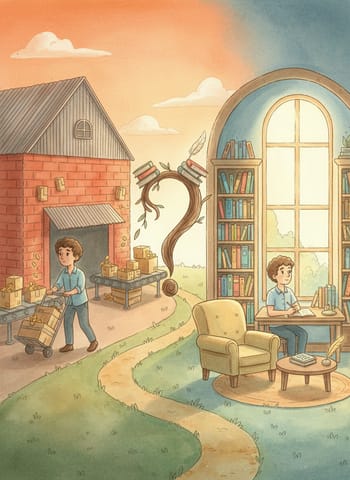
The first is at the bookstore downtown, a few hours a week, helping customers and restocking shelves. It pays less than minimum wage would somewhere else. But the owner has already said he can write during slow afternoons, if the store is empty. The second is at a warehouse near the highway, sorting packages for almost twice the pay. More hours are available too, if he wants them.
La primera es en la librería del centro, unas horas por semana, ayudando a los clientes y reponiendo los estantes. Paga menos que el salario mínimo en otro lugar. Pero el dueño ya le dijo que puede escribir durante las tardes tranquilas, si la tienda está vacía. La segunda es en un almacén cerca de la autopista, clasificando paquetes por casi el doble de pago. También hay más horas disponibles, si las quiere.
His parents don't say much about it directly. But he can tell his father thinks the warehouse job is the obvious choice. "You're saving for a car," his father reminds him at dinner. "The extra money adds up faster than you'd think."
Sus padres no dicen mucho al respecto directamente. Pero él puede notar que su padre piensa que el trabajo del almacén es la opción obvia. «Estás ahorrando para un carro», le recuerda su padre durante la cena. «El dinero extra se acumula más rápido de lo que crees».
Amir knows that's true. He has done the math more than once. If he takes the warehouse job, he could have a car by next spring, maybe even sooner.
Amir sabe que eso es cierto. Ha hecho los cálculos más de una vez. Si toma el trabajo del almacén, podría tener un carro para la próxima primavera, tal vez incluso antes.
But the bookstore keeps pulling at him in a way he can't fully explain. He has been writing stories in a notebook since he was twelve. He has never once had somewhere quiet to actually do it. His house is noisy, and the school library is always crowded.
Pero la librería sigue atrayéndolo de una forma que no puede explicar del todo. Ha estado escribiendo historias en un cuaderno desde que tenía doce años. Nunca ha tenido un lugar tranquilo para realmente hacerlo. Su casa es ruidosa, y la biblioteca de la escuela siempre está llena.
That night, he calls his older cousin, who works two jobs herself. She rarely has time for anything else. "Money problems are real," she tells him, "but so is losing time you'll never get back. I took the higher-paying job at your age. I don't regret it exactly, but I also stopped writing completely. I still wonder sometimes what I gave up."
Esa noche, llama a su prima mayor, que trabaja en dos empleos ella misma. Casi nunca tiene tiempo para otra cosa. «Los problemas de dinero son reales», le dice, «pero también lo es perder tiempo que nunca vas a recuperar. Yo tomé el trabajo mejor pagado a tu edad. No me arrepiento exactamente, pero también dejé de escribir por completo. Todavía a veces me pregunto qué dejé atrás».
Her words stay with him longer than he expects.
Sus palabras se quedan con él más tiempo del que esperaba.
The next morning, Amir tells his father he's chosen the bookstore. His father looks disappointed for a moment, then nods. "It's your decision. Just don't let me hear you complaining about the car taking longer."
A la mañana siguiente, Amir le dice a su padre que eligió la librería. Su padre se ve decepcionado por un momento, y luego asiente. «Es tu decisión. Solo no me hagas escuchar tus quejas cuando el carro tarde más en llegar».
"Deal," Amir says.
«Trato hecho», dice Amir.
Six months later, the car is still a distant goal, and Amir is still counting coins some weeks. But he has also filled half a notebook with stories he actually likes. He wrote them during slow Tuesday afternoons between customers. For now, that feels like the better trade.
Seis meses después, el carro todavía es una meta lejana, y Amir sigue contando monedas algunas semanas. Pero también ha llenado medio cuaderno con historias que realmente le gustan. Las escribió durante las tardes tranquilas de los martes entre clientes. Por ahora, eso se siente como el mejor intercambio.