The Parrot at the Door
Una historia gratuita en inglés de nivel A1 para estudiantes, para leer en línea en 7 idiomas, con opción de escucharla en la app gratuita Storyteller.
A visiting parrot copies the doorbell so well that a whole family keeps running to an empty door.
¡Ese fue el avance! Escucha la historia completa en la app gratuita Storyteller. Descargar la app
El audio no está disponible en este momento.
Sana's uncle has a green parrot called Kiwi. Her uncle is on a trip for ten days. Kiwi stays with Sana's family. Sana's mother puts the cage in the living room.
El tío de Sana tiene un loro verde llamado Kiwi. Su tío está de viaje por diez días. Kiwi se queda con la familia de Sana. La mamá de Sana pone la jaula en la sala.
On the first day, everything is fine. Kiwi eats seeds and says, "Hello." He says it to the lamp. He says it to the couch. He says it to the shoes by the door.
El primer día, todo está bien. Kiwi come semillas y dice: «Hola». Se lo dice a la lámpara. Se lo dice al sofá. Se lo dice a los zapatos junto a la puerta.
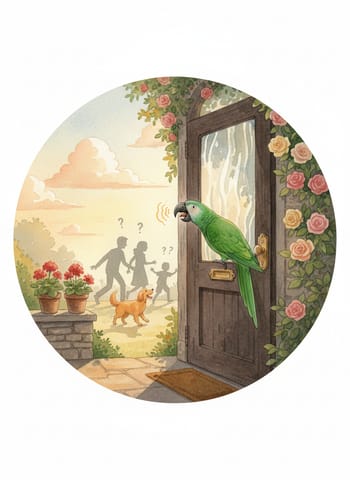
On the second morning, the doorbell rings. Ding-dong. Sana runs to the door and opens it. Nobody is there. She looks left and right. The street is empty. "Strange," she says.
La segunda mañana, suena el timbre. Ding-dong. Sana corre a la puerta y la abre. No hay nadie. Mira a la izquierda y a la derecha. La calle está vacía. «Qué raro», dice.
She goes back to her cereal. Two minutes later, the bell rings again. Ding-dong. Sana's father walks to the door. He opens it. Nobody is there. "Maybe it is a child," he says.
Vuelve a su cereal. Dos minutos después, el timbre suena otra vez. Ding-dong. El papá de Sana camina hasta la puerta. La abre. No hay nadie. «Quizás sea un niño», dice.
"A child plays a game."
«Un niño que juega.»
"I think the bell is broken," says Sana.
«Creo que el timbre está descompuesto», dice Sana.
They check the bell. It is fine. When they push it, it makes the same sound. But there is something odd. When the bell rings, the parrot is always quiet. He looks at them with one black eye.
Revisan el timbre. Está bien. Cuando lo presionan, suena igual. Pero hay algo extraño. Cuando suena el timbre, el loro siempre está callado. Los mira con un ojo negro.
By noon, the bell rings six times. Every time, someone goes to the door. Every time, there is no one. Sana's mother is tired and a little angry. She looks through the window first.
Al mediodía, el timbre suena seis veces. Cada vez, alguien va a la puerta. Cada vez, no hay nadie. La mamá de Sana está cansada y un poco enojada. Ahora mira primero por la ventana.
At one o'clock, the bell rings. Sana looks at the parrot. His beak is open. His small head moves up and down. She hears the sound come out of him. Ding-dong. "Mama!" she shouts.
A la una, suena el timbre. Sana mira al loro. Tiene el pico abierto. Su cabecita se mueve de arriba abajo. Oye el sonido salir de él. Ding-dong. «¡Mamá!», grita.
"It is Kiwi!" Her mother comes in. She has a spoon in her hand.
«¡Es Kiwi!» Su mamá entra. Tiene una cuchara en la mano.
"What?"
«¿Qué?»
"Kiwi rings the bell," says Sana.
«Kiwi toca el timbre», dice Sana.
"He does it with his mouth." Her mother stares at the parrot. The parrot stares back. Then he makes the sound again. He does it slowly. Ding-dong.
«Lo hace con la boca.» Su mamá se queda mirando al loro. El loro la mira también. Luego hace el sonido otra vez. Lo hace despacio. Ding-dong.
"You," says her mother, "are a very bad bird."
«Tú», dice su mamá, «eres un pájaro muy malo».
"Hello," says Kiwi.
«Hola», dice Kiwi.
"Do not say hello to me," says her mother.
«No me digas hola», dice su mamá.
Sana laughs until her stomach hurts. Her father laughs too, from the hall. Her mother tries to look serious. But she smiles.
Sana se ríe hasta que le duele la barriga. Su papá también se ríe, desde el pasillo. Su mamá intenta ponerse seria. Pero sonríe.
For the next two days, they ignore Kiwi's bell. It is not easy. The sound is the same as the real one. Every time it rings, Sana's feet want to run. She learns to wait for one more second. She learns to look at Kiwi first.
Durante los dos días siguientes, ignoran el timbre de Kiwi. No es fácil. El sonido es igual al del timbre de verdad. Cada vez que suena, a Sana le dan ganas de correr. Aprende a esperar un segundo más. Aprende a mirar primero a Kiwi.
On the fourth day, a real visitor comes. The postman knocks and then pushes the bell. Ding-dong. Nobody moves. The family sits on the couch and drinks tea. "It is Kiwi," says Sana's father. "It is Kiwi," says her mother.
El cuarto día llega una visita de verdad. El cartero golpea y luego toca el timbre. Ding-dong. Nadie se mueve. La familia está sentada en el sofá tomando té. «Es Kiwi», dice el papá de Sana. «Es Kiwi», dice su mamá.
The bell rings again. The postman knocks harder. Kiwi looks at the door and says, "Come in!" Sana jumps up.
El timbre suena otra vez. El cartero golpea más fuerte. Kiwi mira la puerta y dice: «¡Pase!». Sana se levanta de un salto.
"It is a real man," she says.
«Es un hombre de verdad», dice.
"Open the door!" Her mother runs. The postman stands outside with a box. He looks cold.
«¡Abre la puerta!» Su mamá corre. El cartero está afuera con una caja. Parece tener frío.
"Did someone call me?" he asks.
«¿Alguien me llamó?», pregunta.
"Yes," says Sana's mother.
«Sí», dice la mamá de Sana.
"Our parrot did."
«Nuestro loro.»
The postman looks past her into the living room. Kiwi bows his head, as if he is proud. "A very nice parrot," says the postman.
El cartero mira más allá de ella, hacia la sala. Kiwi baja la cabeza, como si estuviera orgulloso. «Un loro muy simpático», dice el cartero.
"He has a fine voice."
«Tiene una buena voz.»
"He has too many voices," says Sana's mother.
«Tiene demasiadas voces», dice la mamá de Sana.
The postman leaves. They put Kiwi's cage in the back room. It is quieter there, and the bell sounds far away. But Sana misses the bird. Before dinner, she brings the cage back. She hangs a blue cloth over it. At night, she sits on the floor. She whispers to him. "Kiwi, say my name."
El cartero se va. Ponen la jaula de Kiwi en el cuarto de atrás. Allí hay más tranquilidad y el timbre suena lejos. Pero Sana extraña al pájaro. Antes de la cena, trae la jaula de vuelta. Le cuelga encima un paño azul. Por la noche, se sienta en el suelo. Le susurra. «Kiwi, di mi nombre».
Kiwi looks at her for a moment. Then he opens his beak. In her mother's voice, he says, "Sana, dinner!" Sana laughs loudly. Her mother comes to the door.
Kiwi la mira un momento. Luego abre el pico. Con la voz de su mamá, dice: «¡Sana, a cenar!». Sana se ríe a carcajadas. Su mamá viene a la puerta.
"What is it?" asks her mother.
«¿Qué pasa?», pregunta su mamá.
"Nothing," says Sana.
«Nada», dice Sana.
"Kiwi did it again." Her mother crosses her arms.
«Kiwi lo hizo otra vez.» Su mamá se cruza de brazos.
"Did what?"
«¿Qué hizo?»
Kiwi says, "Ding-dong," and Sana's mother cannot help herself. She laughs too.
Kiwi dice: «Ding-dong», y la mamá de Sana no puede evitarlo. Ella también se ríe.