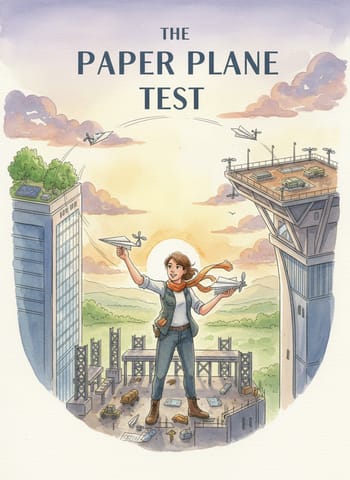
The Paper Plane Test
Una historia gratuita en inglés de nivel A2 para estudiantes, para leer en línea en 7 idiomas, con opción de escucharla en la app gratuita Storyteller.
A drone chief throws paper planes to choose between two places for a new landing pad on a building site.
¡Ese fue el avance! Escucha la historia completa en la app gratuita Storyteller. Descargar la app
El audio no está disponible en este momento.
The canteen on the building site smelled of soup and wet boots. At noon it was full of loud workers. They wore orange jackets and dusty boots.
La cantina de la obra olía a sopa y a botas mojadas. Al mediodía estaba llena de obreros ruidosos. Llevaban chalecos naranjas y botas polvorientas.
Gabi sat alone at the back table. In front of her stood a stack of paper planes. There were twenty, and she folded them herself that morning.
Gabi estaba sentada sola en la mesa del fondo. Frente a ella había una pila de aviones de papel. Eran veinte, y los había doblado ella misma esa mañana.
Salma, the site manager, walked over with a tray. She looked at the planes and raised one eyebrow. "Is it a hobby?"
Salma, la jefa de la obra, se acercó con una bandeja. Miró los aviones y levantó una ceja. «¿Es un pasatiempo?».
"It is a test," Gabi said. "Sit down. I need your help."
«Es una prueba», dijo Gabi. «Siéntate. Necesito tu ayuda».
Salma sat. Outside the window, a small gray drone rose from the yard. It carried a box of screws up to the third floor. It made a soft buzzing sound, like a big fly.
Salma se sentó. Afuera de la ventana, un pequeño dron gris se elevó desde el patio. Llevaba una caja de tornillos hasta el tercer piso. Hacía un zumbido suave, como una mosca grande.
"The delivery drones are good," Salma said. "But they have no safe place to land. Tomorrow, the company sends the new ones. We need a landing pad for them by tonight."
«Los drones de entrega son buenos», dijo Salma. «Pero no tienen un lugar seguro donde aterrizar. Mañana, la empresa manda los nuevos. Necesitamos una plataforma de aterrizaje para ellos antes de esta noche».
"I know," Gabi said. "I am the one who must choose where it goes."
«Lo sé», dijo Gabi. «Yo soy la que debe elegir dónde va».
Gabi was the site's drone chief. Last year, she was a crane driver. Then the company brought in flying machines. They asked her to learn them. She learned fast, and she liked the work.
Gabi era la jefa de drones de la obra. El año anterior, era operadora de grúa. Luego la empresa trajo las máquinas voladoras. Le pidieron que las aprendiera. Aprendió rápido, y le gustaba el trabajo.
"There are two places," she said. She put two fingers on the table. "The roof of the canteen is close to the tower. The drones save four minutes on each trip."
«Hay dos lugares», dijo. Puso dos dedos sobre la mesa. «El techo de la cantina está cerca de la torre. Los drones ahorran cuatro minutos en cada viaje».
"That is a lot of time," Salma said.
«Es mucho tiempo», dijo Salma.
"But the roof is above our heads. A drone can fall here." Gabi pointed at the ceiling. "The other place is the gravel yard behind the fence. It is safe, but far. We lose time on every trip."
«Pero el techo está sobre nuestras cabezas. Aquí puede caer un dron». Gabi señaló el cielo raso. «El otro lugar es el patio de grava detrás de la cerca. Es seguro, pero está lejos. Perdemos tiempo en cada viaje».
Salma ate some soup and thought. "Both are okay. Take the roof. Time matters."
Salma tomó un poco de sopa y pensó. «Los dos están bien. Elige el techo. El tiempo importa».
"Or take the yard. Safety is safety." Gabi sighed. "That is the problem. Both are okay. I cannot see a wrong choice."
«O elige el patio. La seguridad es la seguridad». Gabi suspiró. «Ese es el problema. Los dos están bien. No veo ninguna mala opción».
"So how do the planes help?"
«Entonces, ¿cómo ayudan los aviones?».
"Air is invisible," Gabi said. "But a paper plane shows you where it goes. I want to see how the air moves above each place."
«El aire es invisible», dijo Gabi. «Pero un avión de papel te muestra adónde va. Quiero ver cómo se mueve el aire sobre cada lugar».
Salma smiled. "That is clever. Or very silly."
Salma sonrió. «Qué ingenioso. O muy tonto».
"We will see," Gabi said.
«Ya veremos», dijo Gabi.
They took the planes. They went up the stairs to the canteen roof. The wind was calm there, with a soft push from the left. Behind them, the crane turned slowly against the sky.
Tomaron los aviones. Subieron por las escaleras hasta el techo de la cantina. Allí el viento estaba calmo, con un suave empujón desde la izquierda. Detrás de ellas, la grúa giraba lentamente contra el cielo.
Gabi stood at the edge. She held the first plane high. "Watch where it goes."
Gabi se paró en el borde. Levantó el primer avión bien alto. «Mira adónde va».
She threw it. The plane flew straight for a few seconds. Then it turned in a tight circle. It fell back to the roof.
Lo lanzó. El avión voló recto unos segundos. Luego giró en un círculo cerrado. Cayó de vuelta al techo.
"One," Salma counted.
«Uno», contó Salma.
Gabi threw the second one. It also turned. The third dropped like a stone. The fourth flew upward, then stopped and fell back. By the tenth plane, Salma stopped counting out loud.
Gabi lanzó el segundo. También giró. El tercero cayó como una piedra. El cuarto subió, luego se detuvo y cayó. Para el décimo avión, Salma dejó de contar en voz alta.
"The roof is a mess," Gabi said. "Look. The air bends around the canteen wall. It goes up, then down, then around. A drone shakes."
«El techo es un desastre», dijo Gabi. «Mira. El aire se curva alrededor de la pared de la cantina. Sube, luego baja, luego da vueltas. Un dron se sacudiría».
"But the planes are light. Drones are heavy."
«Pero los aviones son ligeros. Los drones son pesados».
"Drones are heavy," Gabi agreed. "But they have small, quick wings. They feel the air very strongly. It is the same problem, only bigger."
«Los drones son pesados», concedió Gabi. «Pero tienen alas pequeñas y rápidas. Sienten el aire con mucha fuerza. Es el mismo problema, solo que más grande».
Salma looked at the fallen planes. Four lay near the edge. One hung from a pipe. "So the roof is a bad place."
Salma miró los aviones caídos. Cuatro yacían cerca del borde. Uno colgaba de un tubo. «Entonces el techo es un mal lugar».
"A bad place for a landing, yes. A big wall can fix it. That costs money and time." Gabi picked up the planes, one by one. "Now the yard."
«Un mal lugar para aterrizar, sí. Una pared grande podría arreglarlo. Eso cuesta dinero y tiempo». Gabi recogió los aviones, uno por uno. «Ahora el patio».
They went down again. The yard was a wide, flat square of gray gravel. It lay behind the metal fence. There was nothing tall near it except a pile of pipes.
Bajaron otra vez. El patio era un cuadrado amplio y plano de grava gris. Quedaba detrás de la cerca metálica. No había nada alto cerca, salvo una pila de tubos.
Gabi walked to the middle. She held up the first plane from the second batch.
Gabi caminó hasta el centro. Levantó el primer avión de la segunda tanda.
It flew like a bird. It went straight, slow, and long. It crossed the whole yard and landed softly near the fence.
Voló como un pájaro. Fue recto, lento y largo. Cruzó todo el patio y aterrizó suavemente cerca de la cerca.
"Oh," Salma said.
«Vaya», dijo Salma.
The second plane did the same. And the third. Gabi threw ten planes, and nine of them flew smoothly. One hit the pile of pipes. That was her own bad throw.
El segundo avión hizo lo mismo. Y el tercero. Gabi lanzó diez aviones, y nueve de ellos volaron sin problemas. Uno chocó contra la pila de tubos. Ese fue un mal tiro suyo.
"The yard is calm," Gabi said. "The air is clean here."
«El patio está tranquilo», dijo Gabi. «El aire es limpio aquí».
"But it is far from the tower."
«Pero está lejos de la torre».
"Yes. It is four minutes slower on every trip." Gabi picked up a plane. "But it never shakes, never falls, and never lands on your lunch. And we can move the pipes."
«Sí. Son cuatro minutos más lentos en cada viaje». Gabi tomó un avión. «Pero nunca se sacude, nunca se cae y nunca aterriza sobre tu almuerzo. Y podemos mover los tubos».
Salma was silent for a while. She looked at the roof. She looked at the yard. Then she looked at the tiny plane.
Salma guardó silencio un rato. Miró el techo. Miró el patio. Luego miró el pequeño avión.
"You had the answer before you came here," she said. "Tell me the truth."
«Tenías la respuesta antes de venir aquí», dijo. «Dime la verdad».
"No." Gabi shook her head. "I had two good choices. I wanted to feel the difference, not just count it. Now I know why I choose the yard. I do not just guess."
«No». Gabi negó con la cabeza. «Tenía dos buenas opciones. Quería sentir la diferencia, no solo contarla. Ahora sé por qué elijo el patio. No lo adivino sin más».
Salma took out her phone and typed a message to the office. Then she wrote a second message to the pipe crew. "The yard it is. I will tell the pipe team to move their stack."
Salma sacó su teléfono y escribió un mensaje a la oficina. Luego escribió un segundo mensaje al equipo de tubería. «Será el patio. Le diré al equipo de tubos que mueva su pila».
"Thank you."
«Gracias».
"And I will tell the cook his roof is safe." Salma grinned. "He was afraid of the drones."
«Y le diré al cocinero que su techo está a salvo». Salma sonrió con picardía. «Les tenía miedo a los drones».
They walked slowly back to the canteen. The afternoon sun was warm on the gravel. One last plane lay in the yard. Its nose was in the stones.
Caminaron despacio de regreso a la cantina. El sol de la tarde estaba tibio sobre la grava. Un último avión yacía en el patio. Tenía la nariz entre las piedras.
Gabi picked it up. She looked at it for a moment. Then she put it in her pocket.
Gabi lo recogió. Lo miró un momento. Luego se lo guardó en el bolsillo.
Salma opened the canteen door. The smell of soup came out. "One more thing," she said. "The new drones are twice as big. Does the yard work for them too?"
Salma abrió la puerta de la cantina. Salió el olor a sopa. «Una cosa más», dijo. «Los nuevos drones son el doble de grandes. ¿El patio también les sirve?».