The Marginalia
Una historia gratuita en inglés de nivel C1 para estudiantes, para leer en línea en 3 idiomas, con opción de escucharla en la app gratuita Storyteller.
A secondhand bookshop owner traces a decade-long argument written in the margins of used books between two readers she can never identify.
¡Ese fue el avance! Escucha la historia completa en la app gratuita Storyteller. Descargar la app
El audio no está disponible en este momento.
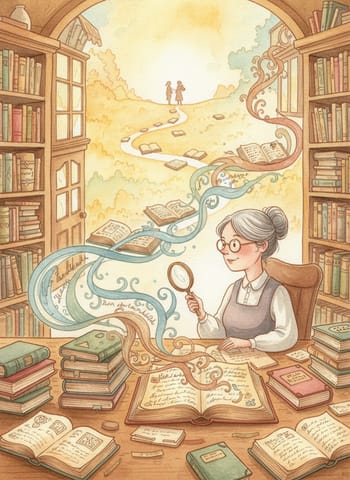
Priya had owned the secondhand bookshop for six years before she noticed the handwriting.
Priya llevaba seis años siendo dueña de la librería de segunda mano cuando notó la letra manuscrita por primera vez.
It appeared first in a battered copy of an old travel memoir: a single line in blue ink, cramped and slanted, disagreeing with something the author had written about the loneliness of long journeys. A few shelves over, in an entirely different book by an entirely different author, the same hand had written something else, this time about grief. It read as if continuing a conversation no one else had been invited to. Having sorted secondhand stock for years without once paying attention to marginalia, Priya found herself, almost against her will, reading the edges of every book that came through the door.
Apareció por primera vez en un ejemplar maltratado de unas viejas memorias de viaje: una sola línea en tinta azul, apretada e inclinada, en desacuerdo con algo que el autor había escrito sobre la soledad de los viajes largos. Unos estantes más allá, en un libro completamente distinto de un autor completamente distinto, la misma mano había escrito otra cosa, esta vez sobre el duelo. Se leía como si continuara una conversación a la que nadie más había sido invitado. Después de años clasificando existencias de segunda mano sin haber prestado atención jamás a las anotaciones en los márgenes, Priya se encontró, casi contra su voluntad, leyendo los bordes de cada libro que entraba por la puerta.
Not until the sixth book did she realize the two hands were arguing with one another, rather than simply annotating alone. What unsettled her was not the handwriting itself but the fact that it argued with a second hand. In a paperback of poems, the blue ink had underlined a stanza and written, "This is sentimental and Marta knows it." Three books later, a looser hand, in pencil, replied in the margin of an entirely separate novel: "Sentimental is not the same as false. You always did confuse the two." Neither writer signed a name. Neither, as far as Priya could tell, had ever left so much as an initial.
No fue hasta el sexto libro que se dio cuenta de que las dos manos discutían entre sí, en lugar de simplemente anotar por separado. Lo que la inquietó no fue la letra en sí, sino el hecho de que discutía con una segunda mano. En un libro de bolsillo de poemas, la tinta azul había subrayado una estrofa y escrito: «Esto es sentimental y Marta lo sabe». Tres libros después, una mano más suelta, en lápiz, respondió en el margen de una novela completamente distinta: «Sentimental no es lo mismo que falso. Siempre confundiste los dos». Ninguno de los dos firmó con un nombre. Ninguno, hasta donde Priya pudo notar, había dejado siquiera una inicial.
She began keeping the books aside instead of shelving them, a small and growing pile on the counter that her assistant teased her about. It was the dates, once she started checking them against the shop's old purchase records, that told her the truth. The exchange had run for the better part of nine years. Two readers had been buying and presumably trading these same secondhand books, arguing in the margins across a decade without, so far as she could reconstruct it, ever meeting in person.
Empezó a apartar los libros en vez de colocarlos en los estantes, una pila pequeña y creciente sobre el mostrador de la que su asistente se burlaba. Fueron las fechas, una vez que empezó a compararlas con los viejos registros de compra de la tienda, las que le revelaron la verdad. El intercambio había durado casi nueve años. Dos lectores habían estado comprando y, presumiblemente, intercambiando estos mismos libros de segunda mano, discutiendo en los márgenes durante una década sin, hasta donde ella pudo reconstruir, haberse conocido nunca en persona.
Then, as abruptly as it had started, it stopped. The last book she found, a thin volume of essays bought at an estate sale eighteen months ago, carried only the blue ink. It held only one line: "I don't think you're going to read this one. I'm leaving it here anyway."
Entonces, tan abruptamente como había empezado, terminó. El último libro que encontró, un volumen delgado de ensayos comprado en una liquidación de bienes hace dieciocho meses, tenía solo la tinta azul. Contenía solo una línea: «No creo que vayas a leer este. De todos modos, lo dejo aquí».
Priya spent a full week trying to trace the estate sale back to a name, a family, anyone who might explain who "Marta" had been. She wondered, too, who had written to her so faithfully for so long without ever once identifying himself. The trail went nowhere useful. Wills are not public record in any way a bookshop owner can easily search, and the auction house that had handled the sale had long since closed.
Priya pasó una semana entera intentando rastrear la liquidación hasta un nombre, una familia, alguien que pudiera explicar quién había sido «Marta». También se preguntó quién le había escrito a ella con tanta fidelidad durante tanto tiempo sin identificarse nunca. La pista no llevó a nada útil. Los testamentos no son un registro público que una dueña de librería pueda consultar fácilmente, y la casa de subastas que había gestionado la venta llevaba mucho tiempo cerrada.
She still has the books, six of them now, kept together on a shelf behind the register that is not for sale. Customers sometimes ask about them, and she tells them the truth, which is that she doesn't know who the writers were, only that they had once, apparently, known each other very well.
Todavía tiene los libros, seis en total, guardados juntos en un estante detrás de la caja que no está a la venta. A veces los clientes preguntan por ellos, y ella les dice la verdad: que no sabe quiénes fueron los autores de las notas, solo que en algún momento, al parecer, se conocieron muy bien.
Not knowing, she has come to think, is not quite the same as the story being unfinished. Some conversations end because someone stops answering. This one, as best she can tell, ended because someone finally did.
No saber, ha llegado a pensar, no es exactamente lo mismo que la historia esté sin terminar. Algunas conversaciones terminan porque alguien deja de responder. Esta, hasta donde puede notar, terminó porque alguien finalmente respondió.