The Marginalia
Uma história gratuita em inglês de nível C1 para estudantes, para ler online em 4 idiomas, com opção de ouvir no app gratuito Storyteller.
A secondhand bookshop owner traces a decade-long argument written in the margins of used books between two readers she can never identify.
Essa foi a prévia! Ouça a história completa no app gratuito Storyteller. Baixar o app
O áudio não está disponível no momento.
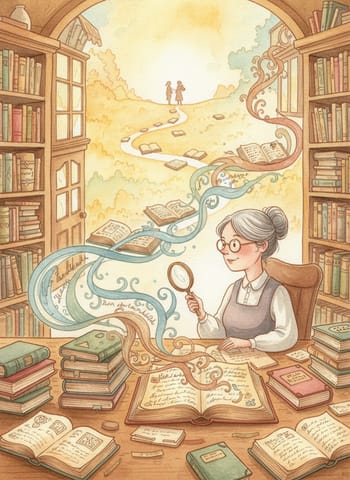
Priya had owned the secondhand bookshop for six years before she noticed the handwriting.
Priya era dona do sebo havia seis anos antes de reparar na caligrafia.
It appeared first in a battered copy of an old travel memoir: a single line in blue ink, cramped and slanted, disagreeing with something the author had written about the loneliness of long journeys. A few shelves over, in an entirely different book by an entirely different author, the same hand had written something else, this time about grief. It read as if continuing a conversation no one else had been invited to. Having sorted secondhand stock for years without once paying attention to marginalia, Priya found herself, almost against her will, reading the edges of every book that came through the door.
Ela apareceu primeiro em um exemplar surrado de uma velha memória de viagem: uma única linha em tinta azul, apertada e inclinada, discordando de algo que o autor tinha escrito sobre a solidão de longas jornadas. Algumas estantes adiante, em um livro totalmente diferente de um autor totalmente diferente, a mesma mão tinha escrito outra coisa, dessa vez sobre luto. Lia-se como se estivesse dando continuidade a uma conversa à qual mais ninguém tinha sido convidado. Tendo organizado o estoque de livros usados por anos sem nunca prestar atenção às anotações de margem, Priya se pegou, quase contra a própria vontade, lendo as bordas de todo livro que passava pela loja.
Not until the sixth book did she realize the two hands were arguing with one another, rather than simply annotating alone. What unsettled her was not the handwriting itself but the fact that it argued with a second hand. In a paperback of poems, the blue ink had underlined a stanza and written, "This is sentimental and Marta knows it." Three books later, a looser hand, in pencil, replied in the margin of an entirely separate novel: "Sentimental is not the same as false. You always did confuse the two." Neither writer signed a name. Neither, as far as Priya could tell, had ever left so much as an initial.
Só no sexto livro ela percebeu que as duas mãos estavam discutindo entre si, e não apenas anotando cada uma por conta própria. O que a incomodou não foi a caligrafia em si, mas o fato de que ela discutia com uma segunda mão. Em um livro de poesia em brochura, a tinta azul tinha sublinhado uma estrofe e escrito: "Isso é piegas e Marta sabe disso." Três livros depois, uma letra mais solta, a lápis, respondia na margem de um romance totalmente diferente: "Piegas não é a mesma coisa que falso. Você sempre confundiu as duas coisas." Nenhum dos dois assinava um nome. Nenhum deles, pelo que Priya conseguiu perceber, jamais tinha deixado sequer uma inicial.
She began keeping the books aside instead of shelving them, a small and growing pile on the counter that her assistant teased her about. It was the dates, once she started checking them against the shop's old purchase records, that told her the truth. The exchange had run for the better part of nine years. Two readers had been buying and presumably trading these same secondhand books, arguing in the margins across a decade without, so far as she could reconstruct it, ever meeting in person.
Ela começou a separar os livros em vez de colocá-los na estante, uma pilha pequena e crescente sobre o balcão que sua assistente vivia zoando. Foram as datas, quando ela começou a conferi-las com os antigos registros de compra da loja, que lhe revelaram a verdade. A troca tinha durado quase nove anos. Duas leitoras — ou leitores — tinham comprado, e provavelmente trocado, esses mesmos livros usados, discutindo nas margens ao longo de uma década sem, pelo que ela conseguiu reconstruir, jamais terem se encontrado pessoalmente.
Then, as abruptly as it had started, it stopped. The last book she found, a thin volume of essays bought at an estate sale eighteen months ago, carried only the blue ink. It held only one line: "I don't think you're going to read this one. I'm leaving it here anyway."
Então, tão abruptamente quanto tinha começado, aquilo parou. O último livro que ela encontrou, um volume fino de ensaios comprado em um leilão de espólio dezoito meses atrás, trazia apenas a tinta azul. Continha somente uma linha: "Acho que você não vai ler este aqui. Vou deixá-lo mesmo assim."
Priya spent a full week trying to trace the estate sale back to a name, a family, anyone who might explain who "Marta" had been. She wondered, too, who had written to her so faithfully for so long without ever once identifying himself. The trail went nowhere useful. Wills are not public record in any way a bookshop owner can easily search, and the auction house that had handled the sale had long since closed.
Priya passou uma semana inteira tentando rastrear o leilão de espólio até um nome, uma família, alguém que pudesse explicar quem tinha sido "Marta". Ela também se perguntou quem tinha lhe escrito com tanta fidelidade por tanto tempo sem nunca se identificar. A pista não levou a lugar nenhum útil. Testamentos não são registro público de nenhuma forma que a dona de um sebo consiga pesquisar com facilidade, e a casa de leilões que tinha cuidado da venda havia muito tinha fechado.
She still has the books, six of them now, kept together on a shelf behind the register that is not for sale. Customers sometimes ask about them, and she tells them the truth, which is that she doesn't know who the writers were, only that they had once, apparently, known each other very well.
Ela ainda guarda os livros, seis deles agora, mantidos juntos em uma estante atrás do caixa que não está à venda. Às vezes os clientes perguntam sobre eles, e ela conta a verdade, que é que não sabe quem foram os autores, apenas que, aparentemente, um dia se conheceram muito bem.
Not knowing, she has come to think, is not quite the same as the story being unfinished. Some conversations end because someone stops answering. This one, as best she can tell, ended because someone finally did.
Não saber, ela passou a pensar, não é bem a mesma coisa que a história estar inacabada. Algumas conversas terminam porque alguém para de responder. Essa, pelo que ela consegue perceber, terminou porque alguém finalmente respondeu.