The Light in the East Wing
Una historia gratuita en inglés de nivel C1 para estudiantes, para leer en línea en 3 idiomas, con opción de escucharla en la app gratuita Storyteller.
Simone spends weeks trying to decode her widowed neighbor's nightly lamp signal before learning it was never meant for her to solve.
¡Ese fue el avance! Escucha la historia completa en la app gratuita Storyteller. Descargar la app
El audio no está disponible en este momento.
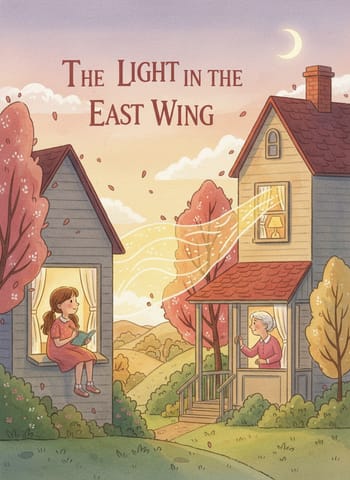
Simone's new bedroom faced the courtyard, and the courtyard faced the east wing, and it was there, on her third night in the building, that she first noticed the light.
El nuevo cuarto de Simone daba al patio interior, y el patio interior daba al ala este, y fue ahí, en su tercera noche en el edificio, donde vio la luz por primera vez.
It came on at exactly six-forty, stayed lit for eleven minutes, and went out. The next evening it did the same. Having nothing better to do in a city where she knew no one yet, Simone started timing it, convinced she had found a pattern worth solving. Six-forty came to feel less like a coincidence and more like an appointment somebody was keeping with an empty room.
Se encendía exactamente a las seis y cuarenta, se quedaba prendida por once minutos, y se apagaba. La noche siguiente pasó lo mismo. Sin nada mejor que hacer en una ciudad donde todavía no conocía a nadie, Simone empezó a cronometrarla, convencida de que había encontrado un patrón que valía la pena resolver. Las seis y cuarenta empezaron a sentirse menos como una coincidencia y más como una cita que alguien mantenía con un cuarto vacío.
She mentioned it to her mother, who barely looked up from unpacking boxes. "That's Mr. Renner's flat. Poor man lost his wife last spring. Leave him be."
Se lo mencionó a su madre, que apenas levantó la vista de las cajas que estaba desempacando. «Ese es el departamento del señor Renner. El pobre hombre perdió a su esposa la primavera pasada. Déjalo tranquilo».
Simone did not leave him be, not entirely. She noticed him some mornings in the courtyard, a tall, unhurried man who watered a single pot of geraniums and nodded at neighbors without quite meeting their eyes. It was hard to picture him running any kind of code from that window, and harder still to imagine what message he could possibly be sending, or to whom.
Simone no lo dejó tranquilo del todo. Lo veía algunas mañanas en el patio, un hombre alto y sin prisa que regaba una sola maceta de geranios y saludaba con la cabeza a los vecinos sin llegar a mirarlos a los ojos. Era difícil imaginarlo transmitiendo algún tipo de código desde esa ventana, y todavía más difícil imaginar qué mensaje podría estar enviando, o a quién.
By the second week she had a theory: Morse. She spent an evening with her phone propped against the glass, timing the light against a Morse chart she had found online, certain she was about to crack something. The intervals refused to cooperate. Nothing spelled out a word, a name, or anything resembling one. What had looked so deliberately structured from across the courtyard turned out, on close counting, to have no code in it at all — only the same eleven minutes, every evening, without variation.
Para la segunda semana ya tenía una teoría: código Morse. Pasó una noche con el celular apoyado contra el vidrio, cronometrando la luz frente a una tabla de Morse que había encontrado en internet, segura de que estaba a punto de descifrar algo. Los intervalos se negaron a cooperar. Nada formaba una palabra, un nombre, ni nada parecido. Lo que desde el otro lado del patio había parecido tan deliberadamente estructurado resultó, al contarlo con cuidado, no tener ningún código en absoluto: solo los mismos once minutos, cada noche, sin variación.
It was a chance encounter by the mailboxes that finally explained it, not her spreadsheet of timings. Mr. Renner was struggling with a stuck lock, and Simone held the door while he wrestled his key free.
Fue un encuentro casual junto a los buzones lo que finalmente lo explicó, no su hoja de cálculo con los tiempos. El señor Renner luchaba con una cerradura atascada, y Simone sostuvo la puerta mientras él lograba sacar la llave.
"You're the girl who watches my window," he said, not unkindly, and she felt her face go hot. "My wife worked the evening shift for thirty years. Six-forty was when her train got in. I'd put the lamp on so she could see the flat was lit from the platform, and I'd leave it on until she was through the door."
«Usted es la chica que mira mi ventana», dijo él, sin mala intención, y ella sintió que la cara se le encendía. «Mi esposa trabajaba en el turno de la tarde desde hacía treinta años. Las seis y cuarenta era cuando llegaba su tren. Yo encendía la lámpara para que ella pudiera ver desde el andén que el departamento estaba iluminado, y la dejaba prendida hasta que ella entraba por la puerta».
"And now?" Simone asked, before she could think better of it.
«¿Y ahora?», preguntó Simone, antes de pensarlo mejor.
"Now I put it on anyway," he said, "and I leave it on for exactly as long as it used to take her to walk from the station. Then I turn it off, because by then, in my head, she's home."
«Ahora la enciendo de todas formas», dijo él, «y la dejo prendida exactamente el tiempo que a ella le tomaba caminar desde la estación. Después la apago, porque para entonces, en mi cabeza, ella ya está en casa».
Simone did not know what to say to that, so she said nothing, which turned out to be the right choice. Had she pressed him further, she suspected, he would have stopped telling her anything at all.
Simone no supo qué decir a eso, así que no dijo nada, y resultó ser la decisión correcta. Si hubiera insistido, sospechaba, él habría dejado de contarle nada más.
She never mentioned the light again, not to her mother, not to Mr. Renner himself. But most evenings now, at six-forty, she found some reason to be near her own window. She left her own lamp on until his went dark, a small and useless signal that nobody had asked her to send.
Nunca volvió a mencionar la luz, ni a su madre ni al señor Renner. Pero casi todas las noches, ahora, a las seis y cuarenta, encontraba alguna razón para estar cerca de su propia ventana. Dejaba su propia lámpara encendida hasta que la de él se apagaba, una señal pequeña e inútil que nadie le había pedido enviar.