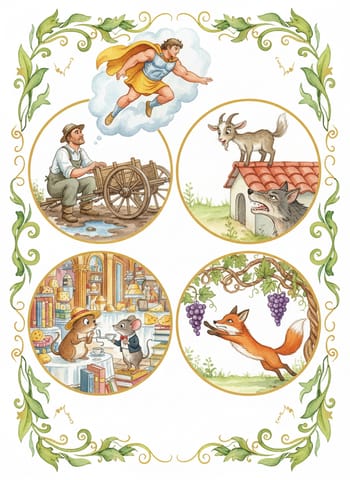
Fables: Hercules and the Wagoner, The Kid and the Wolf, The Town Mouse and the Country Mouse, The Fox and the Grapes
Una historia gratuita en inglés de nivel B1 para estudiantes, para leer en línea en 7 idiomas, con opción de escucharla en la app gratuita Storyteller.
Four bite-sized Aesop fables: a farmer waiting for Hercules to do the work, a cheeky kid taunting a wolf from a safe rooftop, a country mouse's eye-opening city visit, and a fox after grapes just out of reach.
¡Ese fue el avance! Escucha la historia completa en la app gratuita Storyteller. Descargar la app
El audio no está disponible en este momento.
A Farmer was driving his wagon along a miry country road after a heavy rain. The horses could hardly drag the load through the deep mud, and at last came to a standstill when one of the wheels sank to the hub in a rut.
Un Granjero conducía su carreta por un camino de campo lleno de lodo, tras una fuerte lluvia. Los caballos apenas podían arrastrar la carga por el barro profundo, y al final se detuvieron por completo cuando una de las ruedas se hundió hasta el eje en un bache.
The farmer climbed down from his seat and stood beside the wagon looking at it but without making the least effort to get it out of the rut. All he did was to curse his bad luck and call loudly on Hercules to come to his aid. Then, it is said, Hercules really did appear, saying:
El granjero bajó de su asiento y se quedó de pie junto a la carreta, mirándola sin hacer el menor esfuerzo por sacarla del bache. Lo único que hizo fue maldecir su mala suerte y llamar a gritos a Hércules para que acudiera en su ayuda. Entonces, según se cuenta, Hércules apareció de verdad y dijo:
"Put your shoulder to the wheel, man, and urge on your horses. Do you think you can move the wagon by simply looking at it and whining about it? Hercules will not help unless you make some effort to help yourself."
«Pon tu hombro en la rueda, hombre, y anima a tus caballos. ¿Crees que puedes mover la carreta con solo mirarla y quejarte? Hércules no ayudará a menos que tú mismo hagas algún esfuerzo por ayudarte.»
And when the farmer put his shoulder to the wheel and urged on the horses, the wagon moved very readily, and soon the Farmer was riding along in great content and with a good lesson learned.
Y cuando el granjero puso su hombro en la rueda y animó a los caballos, la carreta se movió con facilidad, y pronto el Granjero seguía su camino muy contento y con una buena lección aprendida.
_Self help is the best help._
_La mejor ayuda es la que uno mismo se da._
_Heaven helps those who help themselves._
_El cielo ayuda a quienes se ayudan a sí mismos._
THE KID AND THE WOLF
EL CABRITILLO Y EL LOBO
A frisky young Kid had been left by the herdsman on the thatched roof of a sheep shelter to keep him out of harm's way. The Kid was browsing near the edge of the roof, when he spied a Wolf and began to jeer at him, making faces and abusing him to his heart's content.
Un travieso Cabritillo había sido dejado por el pastor sobre el techo de paja de un refugio para ovejas, para mantenerlo fuera de peligro. El Cabritillo pastaba cerca del borde del techo, cuando divisó a un Lobo y empezó a burlarse de él, haciendo muecas e insultándolo a su antojo.
"I hear you," said the Wolf, "and I haven't the least grudge against you for what you say or do. When you are up there it is the roof that's talking, not you."
«Te oigo», dijo el Lobo, «y no te guardo el menor rencor por lo que dices o haces. Cuando estás ahí arriba, es el techo el que habla, no tú.»
_Do not say anything at any time that you would not say at all times._
_No digas nunca nada que no estés dispuesto a decir en cualquier momento._
THE TOWN MOUSE AND THE COUNTRY MOUSE
EL RATÓN DE CIUDAD Y EL RATÓN DE CAMPO
A Town Mouse once visited a relative who lived in the country. For lunch the Country Mouse served wheat stalks, roots, and acorns, with a dash of cold water for drink. The Town Mouse ate very sparingly, nibbling a little of this and a little of that, and by her manner making it very plain that she ate the simple food only to be polite.
Un Ratón de Ciudad visitó una vez a un pariente que vivía en el campo. Para el almuerzo, el Ratón de Campo sirvió tallos de trigo, raíces y bellotas, con un poco de agua fría para beber. El Ratón de Ciudad comió con gran moderación, mordisqueando un poco de esto y un poco de aquello, y con sus modales dejaba muy claro que solo comía aquel alimento sencillo por cortesía.
After the meal the friends had a long talk, or rather the Town Mouse talked about her life in the city while the Country Mouse listened. They then went to bed in a cozy nest in the hedgerow and slept in quiet and comfort until morning. In her sleep the Country Mouse dreamed she was a Town Mouse with all the luxuries and delights of city life that her friend had described for her. So the next day when the Town Mouse asked the Country Mouse to go home with her to the city, she gladly said yes.
Después de la comida, las amigas tuvieron una larga charla, o más bien el Ratón de Ciudad habló de su vida en la ciudad mientras el Ratón de Campo escuchaba. Luego se fueron a dormir a un cómodo nido en el seto y durmieron tranquilas y cómodas hasta la mañana. En su sueño, el Ratón de Campo soñó que era un Ratón de Ciudad, con todos los lujos y placeres de la vida urbana que su amiga le había descrito. Así que al día siguiente, cuando el Ratón de Ciudad le pidió al Ratón de Campo que se fuera con ella a la ciudad, esta aceptó con gusto.
When they reached the mansion in which the Town Mouse lived, they found on the table in the dining room the leavings of a very fine banquet. There were sweetmeats and jellies, pastries, delicious cheeses, indeed, the most tempting foods that a Mouse can imagine.
Cuando llegaron a la mansión donde vivía el Ratón de Ciudad, encontraron sobre la mesa del comedor las sobras de un banquete espléndido. Había dulces y gelatinas, pasteles, quesos deliciosos, en fin, los alimentos más tentadores que un ratón pueda imaginar.
But just as the Country Mouse was about to nibble a dainty bit of pastry, she heard a Cat mew loudly and scratch at the door. In great fear the Mice scurried to a hiding place, where they lay quite still for a long time, hardly daring to breathe. When at last they ventured back to the feast, the door opened suddenly and in came the servants to clear the table, followed by the House Dog.
Pero justo cuando el Ratón de Campo estaba a punto de mordisquear un delicioso trozo de pastel, oyó a un gato maullar fuerte y arañar la puerta. Llenos de miedo, los ratones corrieron a esconderse, donde permanecieron muy quietos durante largo rato, sin apenas atreverse a respirar. Cuando por fin se aventuraron a volver al banquete, la puerta se abrió de repente y entraron los sirvientes a recoger la mesa, seguidos del Perro de la casa.
The Country Mouse stopped in the Town Mouse's den only long enough to pick up her carpet bag and umbrella.
El Ratón de Campo solo se detuvo en la madriguera del Ratón de Ciudad el tiempo justo para recoger su bolso de viaje y su paraguas.
"You may have luxuries and dainties that I have not," she said as she hurried away, "but I prefer my plain food and simple life in the country with the peace and security that go with it."
«Puede que tú tengas lujos y manjares que yo no tengo», dijo mientras se marchaba a toda prisa, «pero prefiero mi comida sencilla y mi vida tranquila en el campo, con la paz y la seguridad que la acompañan.»
_Poverty with security is better than plenty in the midst of fear and uncertainty._
_Más vale pobreza con seguridad que abundancia en medio del miedo y la incertidumbre._
THE FOX AND THE GRAPES
LA ZORRA Y LAS UVAS
A Fox one day spied a beautiful bunch of ripe grapes hanging from a vine trained along the branches of a tree. The grapes seemed ready to burst with juice, and the Fox's mouth watered as he gazed longingly at them.
Un día, una Zorra divisó un hermoso racimo de uvas maduras que colgaba de una parra tendida entre las ramas de un árbol. Las uvas parecían listas para reventar de jugo, y a la Zorra se le hizo agua la boca mientras las miraba con anhelo.
The bunch hung from a high branch, and the Fox had to jump for it. The first time he jumped he missed it by a long way. So he walked off a short distance and took a running leap at it, only to fall short once more. Again and again he tried, but in vain.
El racimo colgaba de una rama alta, y la Zorra tuvo que saltar para alcanzarlo. La primera vez que saltó, falló por mucho. Así que se alejó un poco y tomó impulso para un salto largo, pero de nuevo se quedó corta. Lo intentó una y otra vez, pero en vano.
Now he sat down and looked at the grapes in disgust.
Entonces se sentó y miró las uvas con desprecio.
"What a fool I am," he said. "Here I am wearing myself out to get a bunch of sour grapes that are not worth gaping for."
«Qué tonta soy», dijo. «Aquí estoy, agotándome por conseguir un racimo de uvas agrias que no valen la pena.»
And off he walked very, very scornfully.
Y se marchó con mucho desdén.
_There are many who pretend to despise and belittle that which is beyond their reach._
_Hay muchos que fingen despreciar y menospreciar aquello que está fuera de su alcance._