Clever Hans
A free A2-level English story for language learners, readable online in 7 languages, with an option to listen via the free Storyteller app.
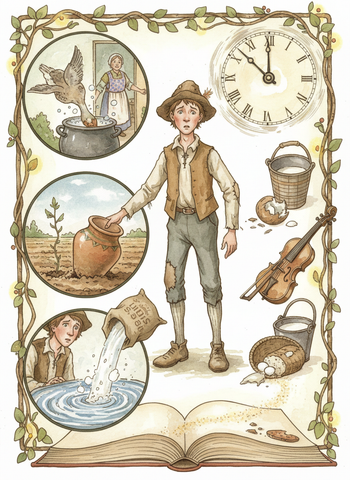
A foolish young man follows his mother's advice so literally, one gift at a time, that he manages to ruin every single one.
The mother of Hans said, “Whither away, Hans?” Hans answered, “To Grethel.” “Behave well, Hans.” “Oh, I’ll behave well. Good-bye, mother.” “Good-bye, Hans.” Hans comes to Grethel, “Good day, Grethel.” “Good day, Hans. What dost thou bring that is good?” “I bring nothing, I want to have something given me.” Grethel presents Hans with a needle. Hans says, “Good-bye, Grethel.” “Good-bye, Hans.”
La madre de Hans dijo: —¿Adónde vas, Hans? —Hans respondió: —A casa de Gretel. —Pórtate bien, Hans. —Ah, me portaré bien. Adiós, madre. —Adiós, Hans. Hans llega a casa de Gretel: —Buenos días, Gretel. —Buenos días, Hans. ¿Qué me traes de bueno? —No traigo nada, quiero que me den algo. Gretel le regala a Hans una aguja. Hans dice: —Adiós, Gretel. —Adiós, Hans.
Hans takes the needle, sticks it into a hay-cart, and follows the cart home. “Good evening, mother.” “Good evening, Hans. Where hast thou been?” “With Grethel.” “What didst thou take her?” “Took nothing; had something given me.” “What did Grethel give thee?” “Gave me a needle.” “Where is the needle, Hans?” “Stuck it in the hay-cart.” “That was ill done, Hans. Thou shouldst have stuck the needle in thy sleeve.” “Never mind, I’ll do better next time.”
Hans toma la aguja, la clava en un carro de heno y sigue el carro hasta su casa. —Buenas noches, madre. —Buenas noches, Hans. ¿Dónde has estado? —Con Gretel. —¿Qué le llevaste? —No le llevé nada; me dieron algo. —¿Qué te dio Gretel? —Me dio una aguja. —¿Dónde está la aguja, Hans? —La clavé en el carro de heno. —Eso está mal hecho, Hans. Debiste habértela clavado en la manga. —No importa, lo haré mejor la próxima vez.
“Whither away, Hans?” “To Grethel, mother.” “Behave well, Hans.” “Oh, I’ll behave well. Good-bye, mother.” “Good-bye, Hans.”
—¿Adónde vas, Hans? —A casa de Gretel, madre. —Pórtate bien, Hans. —Ah, me portaré bien. Adiós, madre. —Adiós, Hans.
Hans comes to Grethel. “Good day, Grethel.” “Good day, Hans. What dost thou bring that is good?” “I bring nothing; I want to have something given to me.” Grethel presents Hans with a knife. “Good-bye, Grethel.” “Good-bye Hans.”
Hans llega a casa de Gretel. —Buenos días, Gretel. —Buenos días, Hans. ¿Qué me traes de bueno? —No traigo nada; quiero que me den algo. Gretel le regala a Hans un cuchillo. —Adiós, Gretel. —Adiós, Hans.
Hans takes the knife, sticks it in his sleeve, and goes home. “Good evening, mother.” “Good evening, Hans. Where hast thou been?” “With Grethel.” “What didst thou take her?” “Took her nothing, she gave me something.” “What did Grethel give thee?” “Gave me a knife.” “Where is the knife, Hans?” “Stuck in my sleeve.” “That’s ill done, Hans, thou shouldst have put the knife in thy pocket.” “Never mind, will do better next time.” “Whither away, Hans?” “To Grethel, mother.” “Behave well, Hans.” “Oh, I’ll behave well. Good-bye, mother.” “Good-bye, Hans.”
Hans toma el cuchillo, se lo clava en la manga y se va a casa. —Buenas noches, madre. —Buenas noches, Hans. ¿Dónde has estado? —Con Gretel. —¿Qué le llevaste? —No le llevé nada, ella me dio algo. —¿Qué te dio Gretel? —Me dio un cuchillo. —¿Dónde está el cuchillo, Hans? —Clavado en mi manga. —Eso está mal hecho, Hans, debiste habértelo puesto en el bolsillo. —No importa, lo haré mejor la próxima vez. —¿Adónde vas, Hans? —A casa de Gretel, madre. —Pórtate bien, Hans. —Ah, me portaré bien. Adiós, madre. —Adiós, Hans.
Hans comes to Grethel. “Good day, Grethel.” “Good day, Hans. What good thing dost thou bring?” “I bring nothing, I want something given me.” Grethel presents Hans with a young goat. “Good-bye, Grethel.” “Good-bye, Hans.” Hans takes the goat, ties its legs, and puts it in his pocket. When he gets home it is suffocated. “Good evening, mother.” “Good evening, Hans. Where hast thou been?” “With Grethel.” “What didst thou take her?” “Took nothing, she gave me something.” “What did Grethel give thee?” “She gave me a goat.” “Where is the goat, Hans?” “Put it in my pocket.” “That was ill done, Hans, thou shouldst have put a rope round the goat’s neck.” “Never mind, will do better next time.”
Hans llega a casa de Gretel. —Buenos días, Gretel. —Buenos días, Hans. ¿Qué cosa buena me traes? —No traigo nada, quiero que me den algo. Gretel le regala a Hans un cabritillo. —Adiós, Gretel. —Adiós, Hans. Hans toma el cabrito, le ata las patas y se lo mete en el bolsillo. Cuando llega a casa, está asfixiado. —Buenas noches, madre. —Buenas noches, Hans. ¿Dónde has estado? —Con Gretel. —¿Qué le llevaste? —No le llevé nada, ella me dio algo. —¿Qué te dio Gretel? —Me dio un cabrito. —¿Dónde está el cabrito, Hans? —Lo metí en mi bolsillo. —Eso está mal hecho, Hans, debiste haberle puesto una cuerda al cuello del cabrito. —No importa, lo haré mejor la próxima vez.
“Whither away, Hans?” “To Grethel, mother.” “Behave well, Hans.” “Oh, I’ll behave well. Good-bye, mother.” “Good-bye, Hans.” Hans comes to Grethel. “Good day, Grethel.” “Good day, Hans. What good thing dost thou bring?” “I bring nothing, I want something given me.” Grethel presents Hans with a piece of bacon. “Good-bye, Grethel.” “Good-bye, Hans.”
—¿Adónde vas, Hans? —A casa de Gretel, madre. —Pórtate bien, Hans. —Ah, me portaré bien. Adiós, madre. —Adiós, Hans. Hans llega a casa de Gretel. —Buenos días, Gretel. —Buenos días, Hans. ¿Qué cosa buena me traes? —No traigo nada, quiero que me den algo. Gretel le regala a Hans un trozo de tocino. —Adiós, Gretel. —Adiós, Hans.
Hans takes the bacon, ties it to a rope, and drags it away behind him. The dogs come and devour the bacon. When he gets home, he has the rope in his hand, and there is no longer anything hanging to it.
Hans toma el tocino, lo ata a una cuerda y lo arrastra tras de sí. Los perros vienen y devoran el tocino. Cuando llega a casa, tiene la cuerda en la mano, y ya no le cuelga nada de ella.
“Good evening, mother.” “Good evening, Hans.” “Where hast thou been?” “With Grethel.” “What didst thou take her?” “I took her nothing, she gave me something.” “What did Grethel give thee?” “Gave me a bit of bacon.” “Where is the bacon, Hans?” “I tied it to a rope, brought it home, dogs took it.” “That was ill done, Hans, thou shouldst have carried the bacon on thy head.” “Never mind, will do better next time.” “Whither away, Hans?” “To Grethel, mother.” “Behave well, Hans.” “I’ll behave well. Good-bye, mother.” “Good-bye, Hans.”
—Buenas noches, madre. —Buenas noches, Hans. —¿Dónde has estado? —Con Gretel. —¿Qué le llevaste? —No le llevé nada, ella me dio algo. —¿Qué te dio Gretel? —Me dio un trozo de tocino. —¿Dónde está el tocino, Hans? —Lo até a una cuerda, lo traje a casa, los perros se lo llevaron. —Eso está mal hecho, Hans, debiste haber llevado el tocino sobre la cabeza. —No importa, lo haré mejor la próxima vez. —¿Adónde vas, Hans? —A casa de Gretel, madre. —Pórtate bien, Hans. —Me portaré bien. Adiós, madre. —Adiós, Hans.
Hans comes to Grethel. “Good day, Grethel.” “Good day, Hans.” “What good thing dost thou bring?” “I bring nothing, but would have something given.” Grethel presents Hans with a calf. “Good-bye, Grethel.” “Good-bye, Hans.”
Hans llega a casa de Gretel. —Buenos días, Gretel. —Buenos días, Hans. —¿Qué cosa buena me traes? —No traigo nada, pero quisiera que me dieran algo. Gretel le regala a Hans un ternero. —Adiós, Gretel. —Adiós, Hans.
Hans takes the calf, puts it on his head, and the calf kicks his face. “Good evening, mother.” “Good evening, Hans. Where hast thou been?” “With Grethel.” “What didst thou take her?” “I took nothing, but had something given me.” “What did Grethel give thee?” “A calf.” “Where hast thou the calf, Hans?” “I set it on my head and it kicked my face.” “That was ill done, Hans, thou shouldst have led the calf, and put it in the stall.” “Never mind, will do better next time.”
Hans toma el ternero, se lo pone sobre la cabeza, y el ternero le da una patada en la cara. —Buenas noches, madre. —Buenas noches, Hans. ¿Dónde has estado? —Con Gretel. —¿Qué le llevaste? —No le llevé nada, pero me dieron algo. —¿Qué te dio Gretel? —Un ternero. —¿Dónde tienes el ternero, Hans? —Me lo puse en la cabeza y me dio una patada en la cara. —Eso está mal hecho, Hans, debiste haber llevado el ternero de la rienda y haberlo puesto en el establo. —No importa, lo haré mejor la próxima vez.
“Whither away, Hans?” “To Grethel, mother.” “Behave well, Hans.” “I’ll behave well. Good-bye, mother.” “Good-bye, Hans.”
—¿Adónde vas, Hans? —A casa de Gretel, madre. —Pórtate bien, Hans. —Me portaré bien. Adiós, madre. —Adiós, Hans.
Hans comes to Grethel. “Good day, Grethel.” “Good day, Hans. What good thing dost thou bring?” “I bring nothing, but would have something given.” Grethel says to Hans, “I will go with thee.”
Hans llega a casa de Gretel. —Buenos días, Gretel. —Buenos días, Hans. ¿Qué cosa buena me traes? —No traigo nada, pero quisiera que me dieran algo. Gretel le dice a Hans: —Iré contigo.
Hans takes Grethel, ties her to a rope, leads her to the rack and binds her fast. Then Hans goes to his mother. “Good evening, mother.” “Good evening, Hans. Where hast thou been?” “With Grethel.” “What didst thou take her?” “I took her nothing.” “What did Grethel give thee?” “She gave me nothing, she came with me.” “Where hast thou left Grethel?” “I led her by the rope, tied her to the rack, and scattered some grass for her.” “That was ill done, Hans, thou shouldst have cast friendly eyes on her.” “Never mind, will do better.”
Hans toma a Gretel, la ata con una cuerda, la lleva hasta el pesebre y la sujeta bien. Luego Hans va a ver a su madre. —Buenas noches, madre. —Buenas noches, Hans. ¿Dónde has estado? —Con Gretel. —¿Qué le llevaste? —No le llevé nada. —¿Qué te dio Gretel? —No me dio nada, vino conmigo. —¿Dónde dejaste a Gretel? —La llevé de la cuerda, la até al pesebre y le esparcí un poco de hierba. —Eso está mal hecho, Hans, debiste haberle dirigido miradas cariñosas. —No importa, lo haré mejor.
Hans went into the stable, gathered up all the calves’ and sheep’s eyes he could find, and tossed them to Grethel as a token of his goodwill. Then Grethel became angry, tore herself loose and ran away, and became the bride of Hans.
Hans fue al establo, recogió todos los ojos de terneros y ovejas que pudo encontrar, y se los llevó a Gretel como muestra de su buena voluntad. Entonces Gretel se enfadó, se soltó y salió corriendo, y así se convirtió en la novia de Hans. </content>
