The Tin That Hummed
A free A2-level English story for language learners, readable online in 7 languages, with an option to listen via the free Storyteller app.
A glassblower waits twenty years for a visitor to ask about the tin of buttons that hums on her shelf.
That was the preview! Hear the full story in the free Storyteller app. Get the app
Audio isn't available right now.
Zuri opens the workshop doors at ten. The furnace is already hot. A line of visitors waits on the pavement.
The workshop is her whole life. It has one big furnace and two long benches. A rope keeps visitors back. Every day, people come to watch her make glass.
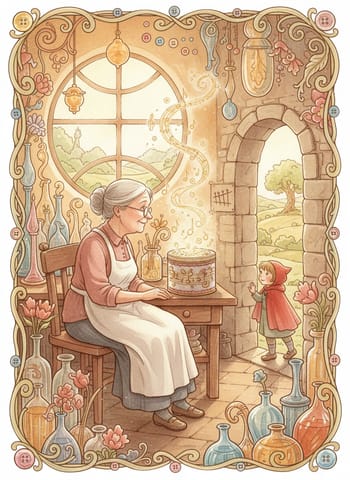
On a shelf by the window sits an old tin. It is round and dented. It is full to the top with buttons. Big ones, small ones, brown ones, silver ones.
Today, forty visitors stand behind the rope. Zuri takes a long steel pipe and puts it in the fire. The glass at the end glows like orange honey.
"How hot is it?" a boy asks.
"Hotter than your oven," she says. "About a thousand degrees."
"How long does it take to learn this?" asks a woman.
"Many years," Zuri says. "And many burned fingers."
She turns the pipe. She blows a soft breath through it. A bubble grows at the end, round and clear. The visitors say "ooh" together.
This is the same every day. The visitors ask about heat. They ask about price. They ask if the glass is safe to touch. Nobody asks about the tin.
Zuri looks at it sometimes. Twenty years ago, Zuri opened this workshop. Nobody asks the one simple question. It sits there on the shelf, full of buttons. Everyone looks past it.
At noon, the last group leaves. Zuri sits down and drinks some cold water. The tin hums a little. It is a soft, low sound, like a fridge in another room. It hums only a little. It hums only when a lost button's owner is near.
"Not today," she tells it. "Nobody asks."
The next day is the same. And the next. A school class comes, then a family from far away. A man takes fifty photos of the furnace. No one looks at the shelf.
On Thursday, a woman comes in late. Her name is Hiba. She wears a long green coat. She stands at the back, behind everyone else. She does not take photos. She just watches Zuri's hands.
Zuri makes a small blue bowl. She turns it and shapes it. A quick tap cuts it free. The visitors clap.
Then they leave, one by one. Soon the room is empty. Only Hiba stays.
"You are very good at this," Hiba says.
"Thank you."
Hiba walks slowly around the room. She looks at the benches. She looks at the furnace. Then she stops in front of the shelf.
The tin hums. It is louder now. Zuri holds her breath.
"What is this?" Hiba asks. "Why are there so many buttons?"
For a moment, Zuri cannot speak. Twenty years, she thinks. Twenty years of waiting for this.
"Do you really want to know?" she asks.
"Yes. I think so." Hiba smiles a little. "It hums. Is that normal?"
"Not for a normal tin." Zuri stands up. She takes the tin from the shelf. It feels warm in her hands, like a living thing. "Please sit."
Hiba sits on a stool. Zuri puts the tin on the bench between them.
"Every button here fell from a visitor's coat," Zuri says. "Over twenty years. People stand close to the furnace, and they lean over the rope. Buttons come loose. They roll on the floor, and I find them in the evening."
"That is normal," says Hiba. "Buttons fall off."
"Yes. But they do not stay lost." Zuri touches the tin. "When its owner comes back to this room, a button hums. Only that one. It calls to them."
Hiba looks at the tin. Her eyes are wide. "That is not possible."
"I know. But it happens." Zuri smiles. "The problem is simple. A button cannot go home unless someone asks about the tin. That is the rule. I cannot give it back. Someone must ask first."
"Nobody ever asks?"
"Nobody. In twenty years." Zuri shrugs. "People look at the fire. They look at the glass. A tin of old buttons is not interesting."
Hiba smiles. Then she stops. She looks down at her coat. The left sleeve has a loose thread at the end. It has no button.
"I lost a button ten days ago," she says softly. "A big green one. It matched the coat. I looked everywhere."
"Was it a big green button with a gold ring?"
"Yes!" Hiba says. "How do you know that?"
Zuri opens the tin. She puts her hand inside. The humming gets louder and louder. The whole bench seems to shake. She moves past the brown buttons and the silver ones. She passes a pile of tiny white ones.
At the bottom, she finds it. It is large and green. A thin gold ring runs around the edge. It hums in her palm like a small bird.
"It fell here last Monday," says Zuri. "I did not know whose it was. I only put it in the tin."
Hiba stares at it. "You waited for me to ask."
"No, I waited for anyone to ask." Zuri puts the button in her hand. "It is lucky that you came on Thursday."
The button stops humming. It lies still and quiet. The tin goes silent, too, for the first time in many days.
Zuri's hands shake. After twenty years, a button goes home.
"Thank you," says Hiba. She holds the button up to the light. "I do not know what to say. Do all of them do this?"
"All of them. Every single one." Zuri looks at the tin. It is still half full. "So many people come back to this town. I think they all want to see the glass again. But nobody asks."
"Then I will tell my friends," Hiba says. "I will tell them to ask you about the tin."
"Please do." Zuri laughs. "I am tired of sitting here with a humming box."
Hiba looks at her sleeve again. "Do you have a needle?"
"There is one in the drawer, with some green thread." Zuri points. "I keep it for days like this."
Hiba stands up and opens the drawer. She takes out the needle and the thread. She sits down on the stool again. She threads the needle on the first try.
Zuri puts the tin back on the shelf. She turns up the furnace, and picks up her steel pipe. Outside, the doors open and the next group of visitors comes in.