The Leak in Tray Nine
A free B1-level English story for language learners, readable online in 7 languages, with an option to listen via the free Storyteller app.
Two college students keep rare Moon moss warm with hot-water bottles, but one careless fill leads to a night of repairs and a strange glow.
That was the preview! Hear the full story in the free Storyteller app. Get the app
Audio isn't available right now.
Arvid carries a bucket of warm water across the greenhouse. He walks like a waiter in a very bad restaurant. The glass roof is black above him. Only the grow lamps shine, long purple lines over the benches.
"You are spilling," Nuri says.
"I am not spilling. I am carefully spreading."
Nuri laughs and writes a note on the clipboard. She keeps the logbook, and she never forgets a number. Arvid keeps everything else.
The greenhouse sits on the roof of the college science block. But the back corner, behind a plastic curtain, holds twelve small trays of moss. The moss is not ordinary. Its spores came back from the Moon last year in a research capsule. The science club is the first school group allowed to grow them.
The moss is also very fussy. It needs a temperature between twenty-two and twenty-six degrees, day and night. This week, the old heating pipes are broken. The repair team comes on Friday. Until then, the club has to keep the trays warm with nothing but hot-water bottles and blankets.
"Twelve trays, twelve bottles," Nuri says, counting on her fingers. "We fill them at six in the evening and again at seven in the morning."
"And the water must never be hotter than forty degrees."
They work as a team. Arvid pours, and Nuri checks the thermometer. Each bottle goes under a small towel, and each towel goes beside a tray. Then they pull a thick blanket over the whole bench, like putting twelve very small people to bed.
Tray Nine is the last one. Its bottle is the oldest, a faded blue rubber thing that somebody found in a cupboard. Arvid holds it up to the light.
"This one looks tired," he says.
"It looked tired yesterday, and it worked. Fill it."
Here is the mistake, though neither of them knows it yet. The bucket water has cooled by now. Arvid goes to the kettle in the staff room and fills the bottle there. He does not stop to measure. He is hungry, and the football match starts soon. He tells himself that the water is probably forty degrees.
It is not forty degrees. It is nearly boiling.
The old rubber goes soft. Arvid feels the bottle sag in his hands. He puts it down on its towel without a second look. Nuri signs the logbook, and they both walk out into the cold corridor. The blanket stays over the bench. The lights stay on.
Arvid goes home and falls asleep in front of the match.
At three in the morning, his phone buzzes. The sound wakes him, and he stares at the screen with one eye open. It is the greenhouse app, the one the club built last term. Every tray has a small sensor, and the app sends an alert if anything strange happens.
The message says: TRAY NINE. HUMIDITY 100%. TEMPERATURE 31.
Arvid sits up. He reads the message three times. Then he calls Nuri, who answers on the second ring.
"Tell me it's a joke," she says.
"It's tray nine. It's too hot and too wet."
"The bottle."
"I think the bottle."
"I'm coming," Nuri says. "Bring the keys."
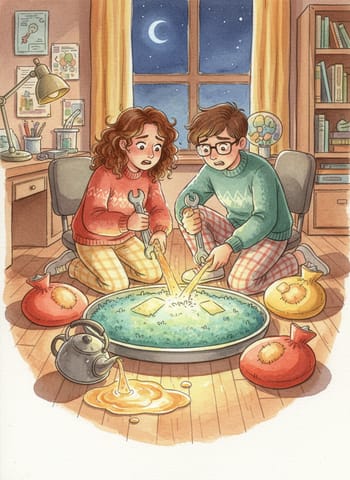
Twenty minutes later, they stand in the greenhouse with their coats over their pyjamas. The blanket on the bench is dark and heavy. When Arvid lifts it, a cloud of steam rolls out into the cold air. The old bottle lies on its side, split along one seam like a broken sausage. Warm water has run across the tray and onto the floor.
"No, no, no," Nuri says.
She kneels beside the tray. Half the moss is pale and soft, almost grey. The other half, near the wall, still looks green. In the light of her phone, the line between the two parts is sharp as a ruler.
"I did this," Arvid says. "I used the kettle. I didn't check."
"We both signed the log. We both said it was fine."
"You didn't fill the bottle."
"I didn't ask if you measured. That is also my fault."
For a moment, neither of them speaks. Water drips on the tiles.
Then Nuri stands up and pushes her hair out of her face.
"Okay," she says. "We can be sorry later. Fix it now."
They make a list, because Nuri always makes a list. First, move Tray Nine away from the wet bench. Second, mop the floor before anyone slips. Third, save whatever moss is still alive. Fourth, find a better way to keep the tray warm.
Arvid carries the tray to a dry table by the door. Nuri brings a clean towel and a pair of long tweezers from the lab drawer. She works slowly, lifting the pale clumps one at a time and placing them on a plate. The soft ones fall apart in her fingers. The ones near the wall stay firm.
"Eight clumps are still green," she whispers. "Maybe nine."
"Then we have eight. Eight is not zero."
"Eight is not twelve."
While she sorts the clumps, Arvid goes to the supply shelf. He finds a glass jam jar with a metal lid and fills it from the tap. This time, he stands next to the thermometer and waits until the water shows exactly thirty-eight degrees. He screws the lid on tight and wraps the jar in an old sock. Then he puts it beside the tray.
"A bottle breaks," he says. "A jar doesn't. We should have thought of this on Monday."
"We should have tested the bottles on Monday," Nuri says. "Every single one."
"All twelve?"
"All twelve. Tomorrow, before school. I'll make a new checklist."
They wipe the floor until it shines. They check the other eleven trays and find nothing wrong. By half past four, the greenhouse is calm again. The wall screen shows a steady twenty-four degrees.
Arvid looks at the clock. "We should tell our teacher before she finds the bottle herself."
"We tell her at eight. With the logbook open and the whole story written down."
"Even the part about the kettle?"
"Especially the part about the kettle."
Nuri opens the logbook on her knee and starts to write. She writes the time, the temperature, and the exact words of the alert. She writes that the mistake was Arvid's. Then she crosses it out and writes that the mistake was theirs.
When she finishes, they sit side by side on two upside-down buckets, tired and a little cold. Outside the glass roof, the sky begins to turn the colour of a grey pearl.
Arvid looks at the rescued moss on the dry table. The eight green clumps sit under the small lamp, quiet and ordinary. But next to them lies the plate of pale, ruined pieces, which they have not yet thrown away.
"Nuri," he says slowly. "Turn off the big lights."
"Why?"
"Just do it."
She walks to the wall and flips the switch. The greenhouse falls into soft shadow, with only the little lamp still glowing. And there, on the plate of grey moss, something shines.
It is a faint blue light, no bigger than a grain of rice. It glows for three seconds, then fades. Ten seconds later, it glows again.
"Is that a reflection?" Nuri asks.
"There is nothing here to reflect."
Nuri takes her phone and films the plate. On the screen, the blue point appears again. It blinks twice and then waits, as if it heard them talking.
Neither of them has an answer. They only know that the light comes from moss that should be dead. The logbook has no page for it yet.