The Gate That Never Stays Open
A free B1-level English story for language learners, readable online in 7 languages, with an option to listen via the free Storyteller app.
A ticket seller who fights a noisy gate every evening meets a customer who wants two tickets, one for a goat.
That was the preview! Hear the full story in the free Storyteller app. Get the app
Audio isn't available right now.
Every evening at six, Esteban opens the ticket booth of the Lumen Cinema. Every evening at six, the gate slams.
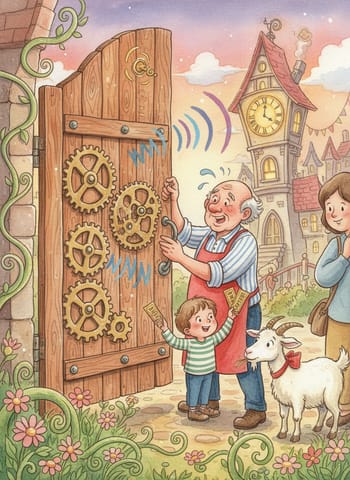
The gate belongs to the old iron fence beside the booth. It guards a narrow side alley. The cinema keeps its bins, its spare chairs and one tired plant there. The gate has a bent hinge. It swings shut by itself with a clang that you can hear three streets away. Esteban has complained about it to the owner for eleven years. The owner always says the same thing: "It adds atmosphere."
Esteban does not want atmosphere. He wants to sit in his small glass booth, read the newspaper and sell tickets in peace.
He tries to fight the gate in different ways. First, he tries a brick to hold it open. The gate pushes the brick across the pavement. Then he tries a heavy bucket of sand. The gate drags that along too, with a scraping noise like an angry animal. Today he has a new plan. He has tied the gate to the fence with a long piece of green string.
"It won't work," says Zosia.
She is leaning out of the little window above the booth, where the projection room is. She has worked there for twenty years, and she has a loud voice and a bright orange scarf. Nothing about the cinema surprises her any more.
"It will work," Esteban says. "It is a very strong string."
"The gate has beaten a brick, a bucket and a mop. A string is not going to frighten it."
"We'll see."
At six o'clock, the gate swings shut. The string stretches, snaps and flies through the air like a thin green snake. Esteban ducks. Zosia laughs so hard that she has to hold on to the window frame.
"I told you," she says.
"You enjoy this too much."
"I enjoy it exactly the right amount."
The first customers arrive at a quarter to seven. They are the same three people who come to the early show every week. A woman in a green hat buys one ticket and always asks for the third row. A man in a flat cap buys one ticket and says nothing. A young woman with a notebook buys one ticket. She tells Esteban she is writing about the history of cinemas. She has been writing about it for three years.
"Seat K4, as usual," Esteban says to her. "The film tonight is a silent comedy about a man and a ladder."
"Wonderful," she says, and she writes it down.
The gate clangs behind them. Nobody turns to look. The people in the line have learned to ignore it, the way people learn to ignore a clock.
At five to seven, Esteban begins to count his cash. This is the part of the evening he likes best. The street is quiet, and the sign above his head makes a soft pink hum. Soon he will lock the booth and climb the stairs. He will watch the film from the back row with a cup of coffee.
Then he hears a voice outside the glass.
"Good evening. I would like two tickets, please."
Esteban looks up. A tall man in a long brown coat stands in front of the booth. He has a very serious face and a neat grey beard. At the end of a thick rope, standing quietly beside him, is a goat.
It is a large white goat with long ears and a pair of curved horns. It looks at Esteban with calm yellow eyes. Then it chews something slowly, and it seems to be thinking about the price of tickets.
"I'm sorry," Esteban says. "Did you say two tickets?"
"One for me. One for her." The man nods at the goat. "She loves films."
Esteban opens his mouth. He closes it. He looks up at the window, but Zosia has disappeared.
"Sir, I don't think animals are allowed in the hall."
"Your sign says no dogs." The man points at the small sign beside the booth. "She is not a dog. She is a guest. She will sit quietly. She has excellent manners."
The goat chooses that moment to eat the corner of a poster for next week's film. The man gently pulls her rope. "She's only curious."
Esteban stares at the poster, then at the goat. Then he looks at the line of people. The woman in the green hat has stopped in the doorway. The man with the cap is looking up at the ceiling very hard. The young woman has taken out her notebook again.
"I need to check the rules," Esteban says.
He opens the big folder of regulations that he keeps under the counter. It is thick and full of yellow pages. He turns the pages for a long time. There is a rule about food, a rule about phones and a rule about people who talk. There is not one single word about goats.
"Well?" says the man.
"It doesn't say that goats are forbidden," Esteban says slowly. "But it doesn't say they are allowed."
"A very good place to begin," the man says kindly. "Two tickets, please. I will pay in coins."
He reaches into his coat pocket. He counts out the money on the counter, one coin at a time. The goat watches each coin with great interest. Esteban gives him two tickets. They are for seats F8 and F9. He does not know why he chooses those seats. He only knows that the goat should not sit near the aisle.
The man thanks him and leads the goat toward the door. Small hooves go click, click, click on the floor. The gate swings shut behind them with a loud clang. The goat looks back at it and makes a very small sound that might be a laugh.
Esteban sits for a long minute without moving. Then he picks up the phone and calls the projection room.
"Zosia."
"Yes?"
"Did you know about this?"
"About what?" She sounds very innocent. Too innocent.
"There is a goat in my cinema."
"A goat. Really? How interesting. I must write that in the log."
"Zosia."
"Esteban, the film starts in four minutes. I have to go."
She hangs up. He puts down the phone and looks at the list of seat bookings on his computer. Beside the two seats, seat F10 is already marked as sold. Someone bought it online three days ago, under one initial only.
The initial is Z.
He looks at it for a long time. Above him, the projector begins to hum. In the hall, the lights go down. A small, pleased bleat drifts out of the dark.
Outside, the gate swings gently open. And, with a patient clang, it shuts once more.