The Untranslatable Joke
Uma história gratuita em inglês de nível C1 para estudantes, para ler online em 4 idiomas, com opção de ouvir no app gratuito Storyteller.
A literary translator loses nineteen days to a joke that depends on a shared childhood memory her readers do not have.
Essa foi a prévia! Ouça a história completa no app gratuito Storyteller. Baixar o app
O áudio não está disponível no momento.
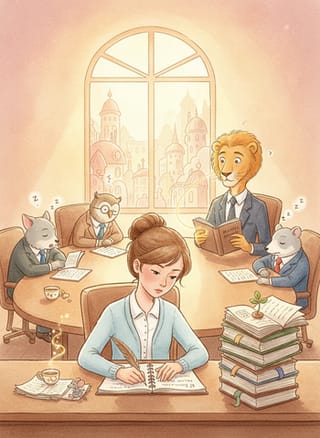
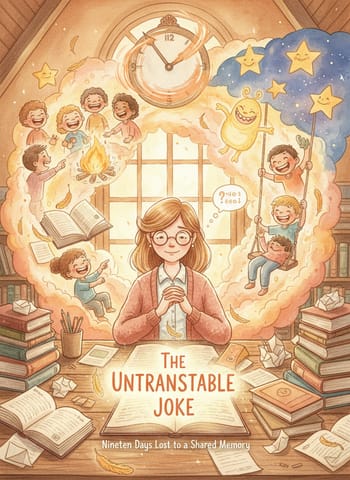
For nineteen days Maia has been stuck on a single line. It is not a long line: a character in the novel she is translating says three words to a bank clerk, and every reader of the original laughs. But the laugh depends on something her language does not contain. The three words are the opening of a children's radio programme that every child in that country heard at the same hour for forty years. The clerk, a stern woman, answers by humming the next phrase without noticing that she has done it.
Há dezenove dias Maia está presa a uma única frase. Não é uma frase longa: um personagem do romance que ela traduz diz três palavras a uma atendente de banco, e todo leitor do original ri. Mas o riso depende de algo que a língua dela não contém. As três palavras são a abertura de um programa de rádio infantil que todas as crianças daquele país ouviram na mesma hora durante quarenta anos. A atendente, uma mulher severa, responde cantarolando a frase seguinte sem perceber que o fez.
Maia has tried the obvious things. A footnote explaining the programme kills the joke, which is rather like explaining an echo. A local equivalent, a jingle or a catchphrase or a nursery rhyme, feels false, because her readers' own childhoods would have to be moved into a foreign bank. She has tried leaving the line out, and the whole scene, which hangs from it, sags like a tent with one pole missing.
Maia tentou o óbvio. Uma nota de rodapé explicando o programa mata a piada, o que é mais ou menos como explicar um eco. Um equivalente local, um jingle ou um bordão ou uma cantiga de roda, soa falso, porque as infâncias dos próprios leitores teriam de ser transplantadas para dentro de um banco estrangeiro. Tentou deixar a frase de fora, e a cena inteira, que pende dela, afunda como uma barraca com um mastro a menos.
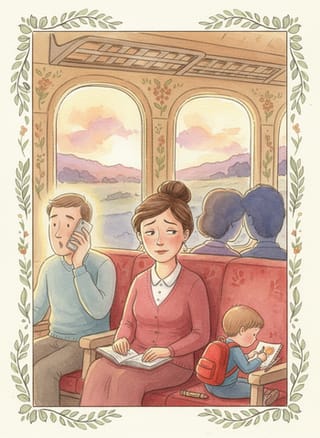
The obsession has begun to leak. She hums the theme tune, learned from a scratchy recording, in the supermarket queue, and watches the people around her with the odd hope that one of them will answer. On the bus she asks the driver whether any sentence makes him finish it automatically. After some thought he offers, "Please move down inside the vehicle," and looks startled by how quickly it came out. Rarely has a bus driver been thanked so warmly. Maia goes home to a page that has not changed.
A obsessão começou a vazar. Ela cantarola a música-tema, aprendida numa gravação chiada, na fila do supermercado, e observa as pessoas ao redor com a estranha esperança de que uma delas responda. No ônibus, pergunta ao motorista se há alguma frase que ele complete automaticamente. Depois de pensar um pouco, ele oferece: "Avance pelo corredor, por favor", e parece assustado com a rapidez com que saiu. Raramente um motorista de ônibus foi agradecido com tanto calor. Maia volta para casa e para uma página que não mudou.
Her editor, on the phone, is kind and no help at all.
O editor, ao telefone, é gentil e não ajuda em nada.
"It's one joke, Maia. Readers will survive."
"É uma piada só, Maia. Os leitores sobrevivem."
"I know they will," Maia says. "It's not the readers I'm worried about."
"Eu sei que sobrevivem", diz Maia. "Não são os leitores que me preocupam."
What finally moves her is, absurdly, the memory of the supermarket. Standing in the queue on the twentieth morning, she understands that what made the original funny was never the programme itself. It was the instant of recognition passing through a room, the sudden proof that these strangers had once been the same child. Her readers will never have that proof, but they can watch it happen to somebody else. Had she been less tired, she might have seen it on the second day.
O que finalmente a move é, absurdamente, a lembrança do supermercado. De pé na fila, na vigésima manhã, ela entende que o que tornava o original engraçado nunca foi o programa em si. Foi o instante de reconhecimento atravessando uma sala, a prova súbita de que aqueles desconhecidos já tinham sido a mesma criança. Os leitores dela jamais terão essa prova, mas podem ver acontecer com outra pessoa. Se estivesse menos cansada, talvez tivesse visto isso no segundo dia.
So she leaves the three words exactly as they are, unexplained, and adds only what the room does next. The clerk hums. A man behind the speaker sets down his pen. A woman stops in the middle of a sentence, and for a moment the whole bank is perfectly silent, like a congregation that has been reminded of something. The English reader will not know why. The English reader will know only that a thing has passed between strangers that they were not invited to share. That, she suspects, is the joke's real mechanism; the laughing was only one way of showing it.
Então ela deixa as três palavras exatamente como estão, sem explicação, e acrescenta apenas o que a sala faz em seguida. A atendente cantarola. Um homem atrás do interlocutor larga a caneta. Uma mulher para no meio de uma frase, e por um instante o banco inteiro fica em perfeito silêncio, como uma congregação a quem lembraram de alguma coisa. O leitor em português não saberá por quê. Saberá apenas que algo passou entre desconhecidos sem que ele fosse convidado a partilhar. Esse, suspeita ela, é o verdadeiro mecanismo da piada; o riso era apenas uma das maneiras de mostrá-lo.
It takes forty minutes to type. Having lost nineteen days to the problem, she is faintly insulted that the solution takes less time than a kettle. She sends the page to her editor with a single line beneath it: "It is not as funny as the original. It is, I think, as accurate, and I'm beginning to suspect that comes to the same thing."
Leva quarenta minutos para digitar. Depois de perder dezenove dias com o problema, ela se sente levemente insultada por a solução levar menos tempo do que ferver uma chaleira. Envia a página ao editor com uma única linha embaixo: "Não é tão engraçado quanto o original. É, creio eu, tão exato, e começo a suspeitar que dá no mesmo."