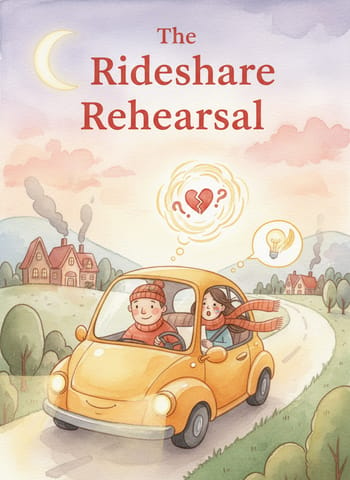
The Rideshare Rehearsal
Uma história gratuita em inglês de nível B2 para estudantes, para ler online em 4 idiomas, com opção de ouvir no app gratuito Storyteller.
A rideshare driver overhears a passenger practicing a breakup speech and offers a piece of advice that changes what she says.
Essa foi a prévia! Ouça a história completa no app gratuito Storyteller. Baixar o app
O áudio não está disponível no momento.
Fadi has been driving since six, and the evening's first fare is the first one to talk to herself. The woman in the back seat, a green scarf pulled up to her chin, is whispering at the window. Then she clears her throat and says, quite loudly, "Dear friend, this is very hard for me."
Fadi dirige desde as seis, e a primeira corrida da noite é a primeira a falar sozinha. A mulher no banco de trás, com um cachecol verde puxado até o queixo, sussurra para a janela. Depois limpa a garganta e diz, bem alto: "Querido amigo, isso é muito difícil para mim."
Fadi glances at the mirror. She does not look up. He understands that he is not being addressed; he is simply the audience.
Fadi olha de relance para o retrovisor. Ela não levanta os olhos. Ele entende que não é com ele que ela fala; é apenas a plateia.
"I have thought about this for weeks," she goes on. "It's not you, it's me. We want different things. I will always remember the good times." She stops. "No. Too much like a greeting card."
"Pensei nisso por semanas", continua ela. "Não é você, sou eu. Queremos coisas diferentes. Vou me lembrar para sempre dos bons momentos." Ela para. "Não. Parece cartão de felicitações."
By the second traffic light, she has started again four times. The opening changes. The ending changes. The sentence "I'm not angry, just disappointed" survives every version. Fadi counts it quietly and decides that if he had to grade the speech, he would give it four out of ten. He keeps his eyes on the road and a bag of mints in the door pocket. At the next red light he holds the bag over his shoulder without a word. She takes one.
No segundo semáforo, ela já recomeçou quatro vezes. A abertura muda. O final muda. A frase "Não estou com raiva, só decepcionada" sobrevive a todas as versões. Fadi a conta em silêncio e decide que, se tivesse de dar nota ao discurso, daria quatro de dez. Mantém os olhos na rua e um saquinho de balas no bolso da porta. No próximo sinal vermelho, estende o saquinho por cima do ombro sem uma palavra. Ela pega uma.
"Sorry," she says. "I'm practicing. I'm ending something tonight."
"Desculpe", diz. "Estou ensaiando. Vou terminar uma coisa hoje à noite."
"I noticed," Fadi says. "It was hard to miss. May I say one thing? You don't have to answer."
"Percebi", diz Fadi. "Era difícil não perceber. Posso dizer uma coisa? Não precisa responder."
"Go ahead. You've heard all of it by now anyway."
"Pode falar. Você já ouviu tudo mesmo."
"When my wife and I nearly split up, I wrote a speech too. It was perfect. Every sentence had a lock on it, so she couldn't argue." He signals and turns into a narrow street. "She listened to the whole thing. Then she asked me one question: what do you actually want?"
"Quando minha esposa e eu quase nos separamos, eu também escrevi um discurso. Era perfeito. Cada frase tinha um cadeado, para ela não poder rebater." Ele dá seta e entra numa rua estreita. "Ela ouviu tudo. Depois me fez uma pergunta: o que você realmente quer?"
"What did you say?"
"O que você respondeu?"
"Nothing. I had no line for that. I had only prepared the part where I was right."
"Nada. Eu não tinha fala para isso. Só tinha preparado a parte em que eu estava certo."
The woman laughs, then stops. She holds up her phone, and the notes screen glows with a long block of text. "Eleven paragraphs. I've been polishing them since Sunday."
A mulher ri, depois para. Levanta o celular, e a tela de notas brilha com um longo bloco de texto. "Onze parágrafos. Venho lapidando desde domingo."
"A speech is a good way to avoid a conversation," Fadi says. "But I'm only a driver. What do I know?"
"Um discurso é uma boa maneira de evitar uma conversa", diz Fadi. "Mas sou só um motorista. O que eu sei?"
"More than my friends. They all said, 'Just be firm.'" She holds her thumb over the screen, hesitates and deletes the whole note.
"Mais do que meus amigos. Todos disseram: 'Seja firme.'" Ela paira o polegar sobre a tela, hesita e apaga a nota inteira.
"What will you say instead?" he asks.
"O que vai dizer no lugar?", pergunta ele.
"That I'm unhappy. That I think he is too. That I want to talk about it properly, and that I'm scared." She says it quickly, as if testing the sentences. "That's all I've got."
"Que estou infeliz. Que acho que ele também está. Que quero conversar direito sobre isso, e que estou com medo." Ela diz depressa, como quem testa as frases. "Isso é tudo o que eu tenho."
"That's nine out of ten," says Fadi.
"Isso é nove de dez", diz Fadi.
They stop in front of a narrow house with a lamp in the window. She sits still for a moment, one hand on the door handle. "Could you wait?" she asks. "Ten minutes. If it goes badly, I'd rather not stand alone on the street."
Param diante de uma casa estreita com um abajur na janela. Ela fica imóvel por um momento, uma mão na maçaneta. "Poderia esperar?", pergunta. "Dez minutos. Se der errado, prefiro não ficar sozinha na rua."
Fadi presses the button on the meter, and the numbers stop. "Take your time," he says, and he turns off the engine.
Fadi aperta o botão do taxímetro, e os números param. "Fique à vontade", diz, e desliga o motor.