The Other Mother
Uma história gratuita em inglês de nível C1 para estudantes, para ler online em 4 idiomas, com opção de ouvir no app gratuito Storyteller.
With her father away and a fever rising, a teenager who has kept her stepmother at arm's length for two years is forced to see her differently.
Essa foi a prévia! Ouça a história completa no app gratuito Storyteller. Baixar o app
O áudio não está disponível no momento.
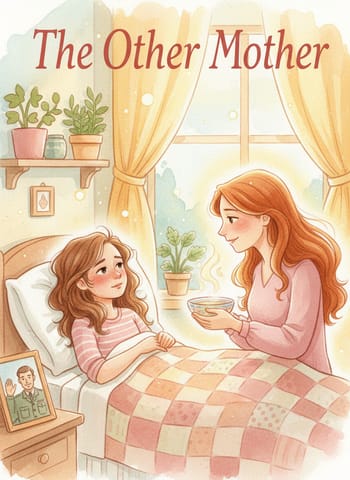
Theodora wakes at two in the afternoon, which is the first sign that something is wrong, since she has never in her life slept through a school day. Her head feels packed with wet wool. The room tilts when she turns it. On the bedside table, where nothing stood last night, there is a glass of water with a straw in it, two small tablets on a folded napkin and a thermometer. They are laid out in a row as neatly as instruments on a tray.
Theodora acorda às duas da tarde, o que é o primeiro sinal de que algo está errado, já que nunca na vida dormiu durante um dia de aula. A cabeça parece cheia de lã molhada. O quarto inclina quando ela a vira. Na mesa de cabeceira, onde ontem à noite não havia nada, há um copo d'água com um canudo, dois comprimidos pequenos sobre um guardanapo dobrado e um termômetro. Estão dispostos em fila, tão arrumados quanto instrumentos numa bandeja.
Her father is three time zones away at a conference he could not move. He rang yesterday, sounding guilty, and Theodora said she was fine, which in retrospect was her second mistake. The first was assuming that being fine and being alone were the same thing. For two years, ever since Tabitha moved in with her careful boxes and her mild, level voice, Theodora has run a campaign of cool, polished politeness. "Thanks," she says to the dinners. "Sure," she says to the questions. She has never once said anything that could be quoted back to her.
O pai está a três fusos horários de distância, num congresso que não pôde adiar. Ligou ontem, soando culpado, e Theodora disse que estava bem, o que, em retrospecto, foi o segundo erro dela. O primeiro foi presumir que estar bem e estar sozinha fossem a mesma coisa. Há dois anos, desde que Tabitha se mudou com suas caixas cuidadosas e sua voz suave e nivelada, Theodora conduz uma campanha de polidez fria e lustrosa. "Obrigada", diz aos jantares. "Claro", diz às perguntas. Nunca disse uma única coisa que pudesse ser citada de volta contra ela.
Tabitha appears in the doorway without being called, as though she had been measuring the silence from the hall. She works on a hospital ward, a fact Theodora has always filed under reasons she is boring. She does the next ten minutes the way Theodora imagines she does them there: a hand on the forehead, two fingers on the wrist, a few quiet questions that are not really questions. When did it start. Any pain here. Can you swallow. "Thirty-nine point one," she reads at last, and her face does absolutely nothing. It is that nothing, more than any alarm, that makes Theodora's stomach drop.
Tabitha aparece à porta sem ser chamada, como se estivesse medindo o silêncio do corredor. Trabalha numa ala de hospital, fato que Theodora sempre arquivou entre os motivos de ela ser chata. Faz os dez minutos seguintes como Theodora imagina que os faz lá: uma mão na testa, dois dedos no pulso, algumas perguntas quietas que não são bem perguntas. Quando começou. Dói aqui. Consegue engolir. "Trinta e nove vírgula um", lê por fim, e o rosto dela não faz absolutamente nada. É esse nada, mais do que qualquer alarme, que faz o estômago de Theodora despencar.
"It's probably the flu that's going round," Tabitha says. "But I've rung the doctor's line, and a nurse will call back within the hour. If it climbs, we go in. If it doesn't, we wait." She says we. Theodora hears it and tries to file it under the usual heading, and the heading no longer fits.
"Provavelmente é a gripe que está circulando", diz Tabitha. "Mas liguei para a linha do médico, e uma enfermeira vai retornar em menos de uma hora. Se a febre subir, vamos ao pronto-socorro. Se não, esperamos." Ela diz vamos. Theodora ouve e tenta arquivar sob o título de sempre, e o título já não serve.
The afternoon passes in small, precise efficiencies. Tabitha changes the pillowcase without making her sit up. She appears with a soup that is almost entirely broth, because, she explains, "the first rule is to keep it down, not to enjoy it." An hour later she appears with a second thermometer, as if she does not trust the first. Only when the glass is set down does Theodora notice the thing itself: it is on the left, the side her hand always reaches for. Tabitha has been paying attention for two years to a person who has spent that time looking straight past her.
A tarde passa em pequenas eficiências precisas. Tabitha troca a fronha sem fazê-la sentar. Aparece com uma sopa que é quase só caldo, porque, explica, "a primeira regra é manter no estômago, não saborear". Uma hora depois, aparece com um segundo termômetro, como se não confiasse no primeiro. Só quando o copo é posto na mesa Theodora percebe a coisa em si: está à esquerda, o lado para onde a mão dela sempre vai. Tabitha esteve prestando atenção, por dois anos, numa pessoa que passou esse tempo todo olhando através dela.
Towards evening the fever breaks. Propped against two pillows in the damp, rinsed-out quiet that follows, Theodora listens to Tabitha moving in the corridor outside, folding something, pausing, folding again. Had it been the other way round, she knows exactly what she would have done, and the knowledge sits in her chest like a swallowed stone. She would have knocked once, said "Do you need anything?" and gone back to her room.
Ao anoitecer, a febre cede. Recostada em dois travesseiros, na quietude úmida e lavada que se segue, Theodora escuta Tabitha se movendo no corredor, dobrando algo, parando, dobrando de novo. Se fosse o contrário, sabe exatamente o que teria feito, e o saber se aloja no peito dela como uma pedra engolida. Teria batido uma vez, perguntado "Precisa de alguma coisa?" e voltado para o quarto.
"You don't have to stay," she says, when Tabitha comes in for the tray. It is meant to be the old voice, the cool one, but it comes out cracked.
"Você não precisa ficar", diz ela, quando Tabitha entra para pegar a bandeja. Era para ser a voz antiga, a fria, mas sai rachada.
"I know I don't," says Tabitha.
"Eu sei que não preciso", diz Tabitha.
For a while neither of them speaks. The streetlight comes on outside, orange against the curtain. Then Theodora, who has not asked this woman for anything in two years, turns her face to the wall and says, "Could you stay until I'm asleep?"
Por um tempo nenhuma das duas fala. O poste de rua acende lá fora, laranja contra a cortina. Então Theodora, que não pediu nada a essa mulher em dois anos, vira o rosto para a parede e diz: "Você poderia ficar até eu dormir?"
Tabitha pulls the desk chair over to the bed and sits down. She does not say a word.
Tabitha puxa a cadeira da escrivaninha até a cama e se senta. Não diz uma palavra.