The First Decision
Uma história gratuita em inglês de nível C1 para estudantes, para ler online em 4 idiomas, com opção de ouvir no app gratuito Storyteller.
Offered a scholarship across the country, a teenager who has always let her older brother make the family's hard decisions has to figure out which of her own instincts are truly hers.
Essa foi a prévia! Ouça a história completa no app gratuito Storyteller. Baixar o app
O áudio não está disponível no momento.
Since their parents' divorce, Billie had let her older brother Cas make most of the real decisions. These included which parent to spend holidays with, how to split summers fairly, and when to simply stop asking their father to show up.
Desde o divórcio dos pais, Billie deixava o irmão mais velho, Cas, tomar a maioria das decisões de verdade. Isso incluía com qual dos pais passar os feriados, como dividir os verões de forma justa e quando simplesmente parar de pedir para o pai aparecer.
Cas was good at it, decisive in a way Billie had never had to be. Without quite noticing, she had built an entire personality around being the one who deferred and adapted rather than chose.
Cas era bom nisso, decidido de um jeito que Billie nunca precisara ser. Sem perceber muito bem, ela tinha construído toda uma personalidade em torno de ser aquela que cedia e se adaptava, em vez de escolher.
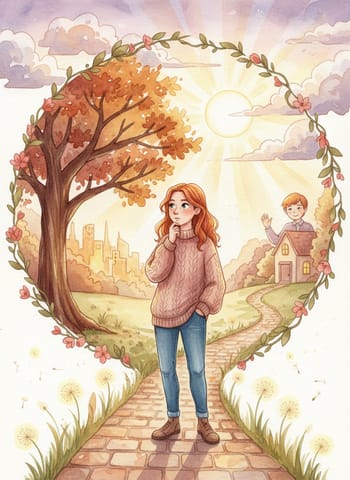
So when the scholarship letter arrived, offering a full ride to a university on the opposite coast, Billie found herself facing the first genuinely major decision of her life. For the first time, no older sibling was positioned to make it for her.
Então, quando a carta da bolsa de estudos chegou, oferecendo uma bolsa integral para uma universidade do outro lado do país, Billie se viu diante da primeira decisão realmente importante da vida dela. Pela primeira vez, nenhum irmão mais velho estava ali para tomá-la em seu lugar.
"You should take it," Cas said immediately, the way he said most things, with a certainty Billie envied and slightly resented in equal measure. "It's the obvious choice."
"Você devia aceitar", Cas disse na hora, do jeito que dizia a maioria das coisas, com uma certeza que Billie invejava e, em partes iguais, um pouco ressentia. "É a escolha óbvia."
"Is it, though?" Billie asked. "Or is it just the choice that sounds most like something a responsible person would make?"
"Será mesmo?", Billie perguntou. "Ou é só a escolha que mais parece algo que uma pessoa responsável faria?"
Cas didn't have an answer for that, which surprised them both. Turning the letter over in her hands, Billie realized she genuinely could not tell why she wanted to go. Was it because the opportunity excited her, or because refusing it would have felt, to some deeply reflexive part of her, like letting the family down again?
Cas não teve resposta para isso, o que surpreendeu os dois. Virando a carta nas mãos, Billie percebeu que realmente não sabia dizer por que queria ir. Era porque a oportunidade a empolgava, ou porque recusá-la faria, para alguma parte profundamente automática dela, parecer que estava decepcionando a família de novo?
She spent the following weeks asking herself a question she had never had reason to ask before. Which of her preferences were actually hers, chosen freely, and which had simply hardened into habit during four years of being the steady one so nobody else had to be?
Nas semanas seguintes, ela passou a se fazer uma pergunta que nunca tivera motivo para fazer antes. Quais das suas preferências eram realmente dela, escolhidas livremente, e quais tinham simplesmente se tornado hábito durante quatro anos sendo a pessoa firme para que mais ninguém precisasse ser?
Had their parents' marriage never ended, she suspected, she might have grown into someone far less careful, someone who chose things for the plain, uncomplicated reason of wanting them. She would never know for certain, and some part of her had made an uneasy peace with never knowing.
Se o casamento dos pais nunca tivesse acabado, ela suspeitava, talvez tivesse se tornado alguém bem menos cautelosa, alguém que escolhia as coisas pelo simples e descomplicado motivo de querê-las. Ela nunca saberia ao certo, e uma parte dela tinha feito as pazes, ainda que de forma incômoda, com nunca saber.
What finally tipped the decision was not ambition, and not guilt either, but something quieter. It was a growing suspicion that staying close to home, out of old habit, would only postpone a version of this same reckoning to some later, less forgiving year.
O que finalmente decidiu a questão não foi ambição, nem culpa também, mas algo mais silencioso. Foi uma suspeita crescente de que ficar perto de casa, por puro hábito antigo, só adiaria uma versão desse mesmo acerto de contas para algum ano futuro e menos generoso.
She accepted the scholarship. Packing for the flight three months later, she caught herself waiting for Cas to double-check her bag, her documents, her plan, the way he always had, and had to stop herself, consciously, from asking.
Ela aceitou a bolsa. Fazendo as malas para o voo três meses depois, ela se pegou esperando que Cas conferisse de novo a mala dela, os documentos, o plano, do jeito que sempre fazia, e teve que se conter, conscientemente, de pedir isso a ele.
"You've got this," he said instead, at the airport, and for the first time in years, Billie believed the responsible-sounding thing she was doing might actually, underneath it, be one she had chosen for herself.
"Você vai se sair bem", ele disse em vez disso, no aeroporto, e, pela primeira vez em anos, Billie acreditou que aquela coisa de aparência tão responsável que estava fazendo podia, no fundo, ser algo que ela mesma tinha escolhido.
She still wasn't entirely sure. That uncertainty, she was beginning to accept, might simply be what an actual choice, made freely for the first time, was supposed to feel like.
Ela ainda não tinha total certeza. Essa incerteza, ela estava começando a aceitar, talvez fosse simplesmente a sensação que uma escolha de verdade, feita livremente pela primeira vez, deveria mesmo causar.