The Man and His Image
A free B2-level English story for language learners, readable online in 7 languages, with an option to listen via the free Storyteller app.
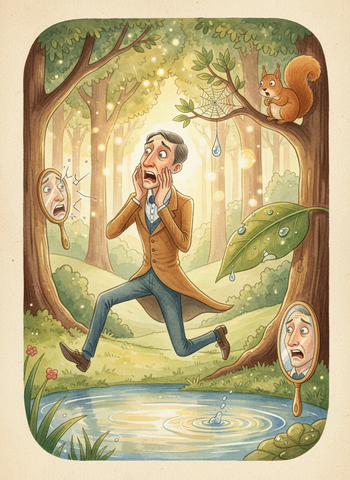
A man too vain to bear his own reflection flees every mirror he owns, only to discover that nature has just as many ways of showing him the truth.
Once there was a man who loved himself very much, and who permitted himself no rivals in that love. He thought his face and figure the handsomest in all the world. Anything in the shape of a mirror that could show him his own likeness he took care to avoid; for he did not want to be reminded that perhaps he was over-rating his beauty. For this reason he hated looking-glasses and accused them of being false. He made a very great mistake in this respect; but that he did not mind, being quite content to live in the happiness the mistake afforded him.
Era uma vez um homem que amava a si mesmo profundamente, e que não permitia a si próprio nenhum rival nesse amor. Ele achava seu rosto e sua figura os mais belos do mundo inteiro. Qualquer coisa em forma de espelho que pudesse mostrar-lhe sua própria imagem, ele cuidava de evitar; pois não queria ser lembrado de que talvez estivesse superestimando sua beleza. Por essa razão ele odiava espelhos e os acusava de serem enganosos. Cometia, nesse aspecto, um grande erro; mas isso não o incomodava, contente que estava em viver na felicidade que o erro lhe proporcionava.
To cure him of so grievous an error, officious Fate managed matters in such a way that wherever he turned his eyes they would fall on one of those mute little counsellors that ladies carry and appeal to when they are anxious about their appearance. He found mirrors in the houses; mirrors in the shops; mirrors in the pockets of gallants; mirrors even as ornaments on waist-belts of ladies.
Para curá-lo de erro tão grave, o Destino intrometido arranjou as coisas de tal maneira que, para onde quer que ele voltasse os olhos, eles recaíssem sobre um daqueles mudos pequenos conselheiros que as damas carregam e consultam quando estão ansiosas com sua aparência. Ele encontrava espelhos nas casas; espelhos nas lojas; espelhos nos bolsos dos galanteadores; espelhos até como enfeites nos cintos das damas.
What was he to do—this poor Narcissus? He thought to avoid all such things by going far away from haunts of mankind, where he should never have to face a mirror again. But in the woods to which he retreated a clear rivulet ran. Into this he happened to look and—saw himself again. Angrily he told himself that his eyes had been deluded by an idle fancy. Henceforth he would keep away from the water! This he tried his utmost to do; but who can resist the beauty of a woodland stream? There he was and remained, always with that which he had determined to shun.
O que faria ele—esse pobre Narciso? Pensou em evitar todas essas coisas afastando-se para longe dos lugares frequentados pela humanidade, onde nunca mais tivesse que encarar um espelho. Mas no bosque para onde se retirou corria um riacho límpido. Nele, por acaso, olhou e—viu-se novamente. Zangado, disse a si mesmo que seus olhos haviam sido enganados por uma fantasia ociosa. Doravante ele ficaria longe da água! Isso ele tentou fazer com todo o seu esforço; mas quem pode resistir à beleza de um riacho na floresta? Ali ficou ele, e ali permaneceu, sempre com aquilo que havia decidido evitar.
My meaning is easily seen. It applies to everybody; for everybody takes some joy in harbouring this very error. The man in love with himself stands for the soul of each one of us. All the mirrors wherein he saw himself reflected stand for the faults of other people, in which we really see our own faults though we hate to recognise them as such. As for the brook, that, as every one knows, stands for the book of maxims which the Duke de la Rochefoucauld wrote.
Meu significado é fácil de perceber. Aplica-se a todos; pois todos sentem certo prazer em abrigar esse mesmo erro. O homem apaixonado por si mesmo representa a alma de cada um de nós. Todos os espelhos nos quais ele se viu refletido representam os defeitos das outras pessoas, nos quais na verdade vemos nossas próprias falhas, embora odiemos reconhecê-las como tal. Quanto ao riacho, esse, como todos sabem, representa o livro de máximas que o Duque de La Rochefoucauld escreveu.
