The Foundling Prince
Uma história gratuita em inglês de nível B1 para estudantes, para ler online em 7 idiomas, com opção de ouvir no app gratuito Storyteller.
A Tsar's long-lost son is found after fifteen years — but to prove he is truly the prince, the boy must arrive at the palace neither naked nor dressed, neither on foot nor on horseback, by an impossible riddle of his own devising.
Essa foi a prévia! Ouça a história completa no app gratuito Storyteller. Baixar o app
O áudio não está disponível no momento.
Once upon a time there was a Tsar and Tsarítsa who had only one son. The Tsar one day had to leave home, and in his absence a disaster befell them; the Tsarévich disappeared. They searched and searched for the Tsarévich, dragging the ponds. Not a breath nor a sound could be heard of him. So fifteen years went by, until at last the Tsar received news that in a certain village a peasant had found a child who was a wonder for his beauty and his cleverness.
Era uma vez um Czar e uma Czarina que tinham apenas um filho. Certo dia o Czar teve de sair de casa, e em sua ausência uma desgraça os atingiu: o Czarévitch desapareceu. Procuraram e procuraram pelo Czarévitch, dragando os lagos. Nem um sopro nem um som se ouviu dele. Assim se passaram quinze anos, até que por fim o Czar recebeu notícias de que, em certa aldeia, um camponês havia encontrado uma criança que era um prodígio de beleza e esperteza.
So the Tsar ordered the peasant to be brought to him as soon as possible: he was brought, and the Tsar began asking him where he had found the boy. The peasant explained that he had found him fifteen years ago in a corn-kiln, with strange and rich clothing on him; and by every sign he was the Tsar’s own son.
Então o Czar mandou trazer o camponês diante dele o quanto antes: ele foi trazido, e o Czar começou a perguntar onde havia encontrado o menino. O camponês explicou que o encontrara quinze anos antes numa estufa de secar milho, com roupas estranhas e ricas sobre o corpo; e, por todos os sinais, era o próprio filho do Czar.
So the Tsar told the peasant, “Tell your foundling that he is to come to me neither naked nor dressed, nor on foot nor on horseback, neither by day nor by night, neither in the courtyard nor in the street.”
Então o Czar disse ao camponês: "Diga ao seu enjeitado que venha até mim nem nu nem vestido, nem a pé nem a cavalo, nem de dia nem de noite, nem no pátio nem na rua."
So the peasant went back home, wept and told the boy. How on earth was it to be done!
Então o camponês voltou para casa, chorou e contou tudo ao menino. Como diabos isso poderia ser feito!
But the boy replied, “That is easy enough: I can guess this riddle.”
Mas o menino respondeu: "Isso é fácil: eu consigo adivinhar esse enigma."
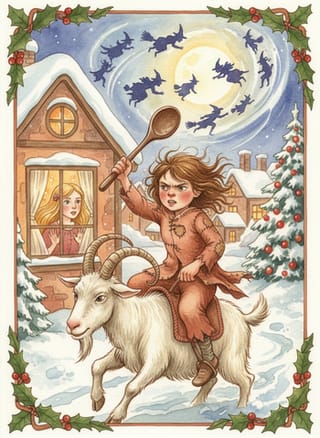
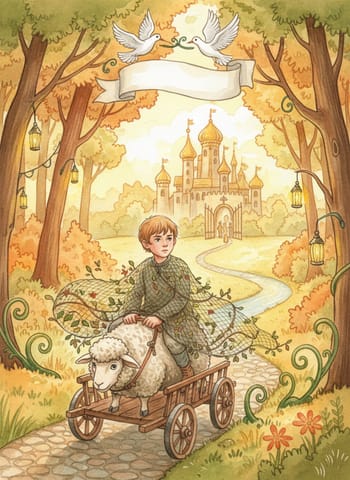
So he took and undressed himself from head to foot, put a net on himself, came on a goat, came up to the Tsar at twilight, and mounted the goat at the gate, leaving the fore-feet of the goat on the courtyard and the hind feet in the street.
Então ele se despiu da cabeça aos pés, colocou uma rede sobre o corpo, montou num bode, chegou diante do Czar ao entardecer, e parou o bode junto ao portão, deixando as patas dianteiras do bode no pátio e as traseiras na rua.
When the Tsar saw this, he became convinced and said, “This must be my son!”
Quando o Czar viu aquilo, ficou convencido e disse: "Este deve ser o meu filho!"