The Foundling Prince
Una historia gratuita en inglés de nivel B1 para estudiantes, para leer en línea en 7 idiomas, con opción de escucharla en la app gratuita Storyteller.
A Tsar's long-lost son is found after fifteen years — but to prove he is truly the prince, the boy must arrive at the palace neither naked nor dressed, neither on foot nor on horseback, by an impossible riddle of his own devising.
¡Ese fue el avance! Escucha la historia completa en la app gratuita Storyteller. Descargar la app
El audio no está disponible en este momento.
Once upon a time there was a Tsar and Tsarítsa who had only one son. The Tsar one day had to leave home, and in his absence a disaster befell them; the Tsarévich disappeared. They searched and searched for the Tsarévich, dragging the ponds. Not a breath nor a sound could be heard of him. So fifteen years went by, until at last the Tsar received news that in a certain village a peasant had found a child who was a wonder for his beauty and his cleverness.
Había una vez un Zar y una Zarina que tenían un solo hijo. El Zar un día tuvo que salir de viaje, y en su ausencia les sobrevino un desastre: el Zarévich desapareció. Lo buscaron y lo buscaron, dragando los estanques. No se pudo oír ni un aliento ni un sonido de él. Así pasaron quince años, hasta que por fin el Zar recibió noticias de que en cierta aldea un campesino había encontrado a un niño que era una maravilla por su belleza y su inteligencia.
So the Tsar ordered the peasant to be brought to him as soon as possible: he was brought, and the Tsar began asking him where he had found the boy. The peasant explained that he had found him fifteen years ago in a corn-kiln, with strange and rich clothing on him; and by every sign he was the Tsar’s own son.
Así que el Zar ordenó que le trajeran al campesino tan pronto como fuera posible: lo trajeron, y el Zar comenzó a preguntarle dónde había encontrado al niño. El campesino explicó que lo había encontrado quince años atrás en un horno de secar maíz, con ropas extrañas y ricas puestas; y por todas las señas era el propio hijo del Zar.
So the Tsar told the peasant, “Tell your foundling that he is to come to me neither naked nor dressed, nor on foot nor on horseback, neither by day nor by night, neither in the courtyard nor in the street.”
Así que el Zar le dijo al campesino: «Dile a tu expósito que venga a mí ni desnudo ni vestido, ni a pie ni a caballo, ni de día ni de noche, ni en el patio ni en la calle.»
So the peasant went back home, wept and told the boy. How on earth was it to be done!
Así que el campesino volvió a casa, lloró y se lo contó al muchacho. ¡Cómo diablos se podría hacer eso!
But the boy replied, “That is easy enough: I can guess this riddle.”
Pero el muchacho respondió: «Eso es bastante fácil: puedo adivinar este acertijo.»
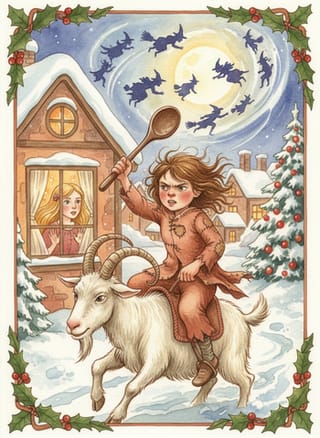
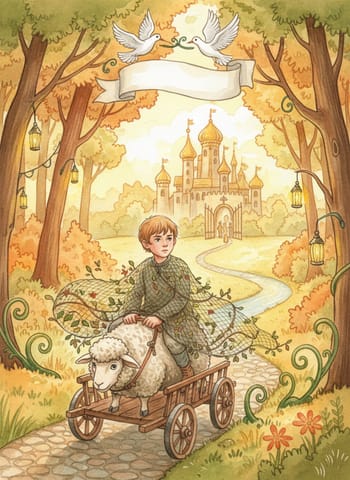
So he took and undressed himself from head to foot, put a net on himself, came on a goat, came up to the Tsar at twilight, and mounted the goat at the gate, leaving the fore-feet of the goat on the courtyard and the hind feet in the street.
Así que se desnudó por completo de pies a cabeza, se puso una red encima, montó en una cabra, se presentó ante el Zar al anochecer, y detuvo la cabra en la puerta, dejando las patas delanteras de la cabra en el patio y las traseras en la calle.
When the Tsar saw this, he became convinced and said, “This must be my son!”
Cuando el Zar vio esto, quedó convencido y dijo: «¡Este debe ser mi hijo!»