The Choir for Forgetting
Uma história gratuita em inglês de nível C1 para estudantes, para ler online em 4 idiomas, com opção de ouvir no app gratuito Storyteller.
A volunteer at a choir for people with memory loss watches her father forget her name but remember every word of the songs.
Essa foi a prévia! Ouça a história completa no app gratuito Storyteller. Baixar o app
O áudio não está disponível no momento.
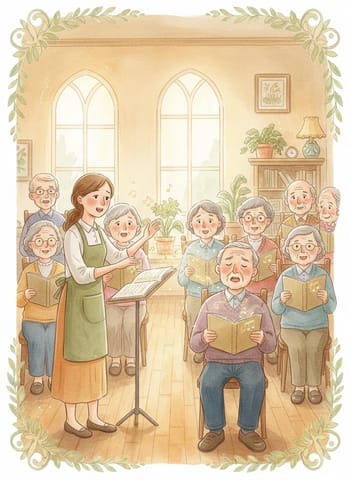
The choir meets on Thursday afternoons in a church hall with a leaking skylight and a tea urn that takes forty minutes to boil. Rosamund arrives early, as she has for five months, to set out the folders and the plastic cups and to arrange the chairs in a curve. The singers do better when they can see one another's faces. There are twenty-two of them, most with some form of memory loss, and eleven carers, who sing quietly and pretend not to. Her father, Halvard, is third from the left in the front row, in the cardigan she ironed that morning.
O coral se reúne nas tardes de quinta-feira num salão de igreja com uma claraboia que pinga e uma chaleira de chá que leva quarenta minutos para ferver. Rosamund chega cedo, como faz há cinco meses, para arrumar as pastas e os copos de plástico e dispor as cadeiras em curva. Os cantores se saem melhor quando conseguem ver o rosto uns dos outros. São vinte e dois, a maioria com alguma forma de perda de memória, e onze cuidadores, que cantam baixinho e fingem que não. O pai dela, Halvard, está em terceiro lugar da esquerda para a direita na primeira fila, com o cardigã que ela passou a ferro naquela manhã.
He does not always know her. Some weeks he greets her with the polished warmth he used to keep for the neighbours; some weeks he calls her "the nice lady with the folders" and asks whether she lives nearby. She has stopped correcting him, less out of resignation than out of a practical sort of mercy, since correction costs him something and the cost is visible. Today he calls her "madam" and thanks her for the tea.
Ele nem sempre a reconhece. Em algumas semanas a cumprimenta com a calorosa polidez que antes reservava aos vizinhos; em outras a chama de "a moça simpática das pastas" e pergunta se ela mora perto. Ela parou de corrigi-lo, menos por resignação do que por uma espécie prática de misericórdia, já que a correção lhe custa alguma coisa e o custo é visível. Hoje ele a chama de "senhora" e agradece pelo chá.
Then the pianist plays four bars, and something in the room changes. What Rosamund has still not got used to is the speed of it. A woman who cannot remember the name of her own street sings the first verse without a hitch, perfectly in tune. The man beside her, who has not spoken a full sentence since Easter, comes in on the second line with the exact tremor he must have had at twenty. Her father does not look at the sheet. Rarely does he look at anything except the pianist's hands. He sings the words in order, every one, including the old-fashioned verse that nobody else remembers.
Então o pianista toca quatro compassos, e algo na sala muda. O que Rosamund ainda não se acostumou a ver é a rapidez disso. Uma mulher que não lembra o nome da própria rua canta a primeira estrofe sem tropeço, perfeitamente afinada. O homem ao lado dela, que não diz uma frase completa desde a Páscoa, entra no segundo verso com o exato tremor que devia ter aos vinte anos. O pai dela não olha para a partitura. Raramente olha para algo além das mãos do pianista. Canta as palavras em ordem, todas elas, inclusive a estrofe antiquada de que mais ninguém se lembra.
She has read the explanations, and two doctors have kindly given them to her: that melody and memory are stored in different places, that rhythm acts as a kind of scaffolding. None of it helps. The words are all there, perfectly kept, in a man who cannot say what he had for breakfast. She, who has every day of her life at her disposal, cannot finish the second verse without the page. If someone had told her a year ago that she would envy her father's memory, she would have laughed.
Ela leu as explicações, e dois médicos já as deram a ela com gentileza: que melodia e memória ficam guardadas em lugares diferentes, que o ritmo funciona como uma espécie de andaime. Nada disso ajuda. As palavras estão todas lá, perfeitamente conservadas, num homem que não sabe dizer o que comeu no café da manhã. Ela, que tem à disposição todos os dias da própria vida, não consegue terminar a segunda estrofe sem a página. Se alguém lhe dissesse um ano atrás que ela invejaria a memória do pai, ela teria rido.
At the break she carries the tea around on a tray, the cups rattling in their saucers. Her father takes one with both hands and studies her over the rim.
No intervalo, ela leva o chá em uma bandeja, as xícaras tilintando nos pires. O pai pega uma com as duas mãos e a estuda por cima da borda.
"You sing very quietly," he says. It is the most direct remark he has made to her in a month.
"Você canta bem baixinho", diz ele. É a observação mais direta que lhe faz em um mês.
"I'm following the others," she says.
"Estou acompanhando os outros", diz ela.
"No," he says, with perfect courtesy. "You're listening. It's different."
"Não", diz ele, com perfeita cortesia. "Você está ouvindo. É diferente."
After the break, the last song is the long one, the one he used to sing in the car, the one with seven verses. The pianist begins. Rosamund opens her folder, finds the page, and joins in half a beat late, as always. Carrying on through the fifth verse with her eyes on the words, she is aware of a hand reaching across her without any break in the singing. The page turns, one beat before she needs it. Her father, his eyes on the pianist, is still singing.
Depois do intervalo, a última canção é a longa, a que ele cantava no carro, a de sete estrofes. O pianista começa. Rosamund abre a pasta, encontra a página e entra meio tempo atrasada, como sempre. Seguindo pela quinta estrofe com os olhos na letra, percebe uma mão que se estende por cima dela sem interromper o canto. A página vira, um tempo antes de ela precisar. O pai, com os olhos no pianista, continua cantando.
She lets one line go by without her, and then she finds her place.
Ela deixa passar um verso sem acompanhar, e então encontra o seu lugar.