The Choir for Forgetting
Cerita bahasa Inggris gratis level C1 untuk pelajar, bisa dibaca online dalam 5 bahasa, dengan pilihan untuk mendengarkannya di aplikasi Storyteller gratis.
A volunteer at a choir for people with memory loss watches her father forget her name but remember every word of the songs.
Itu cuplikannya! Dengarkan cerita lengkapnya di aplikasi Storyteller gratis. Unduh aplikasi
Audio belum tersedia saat ini.
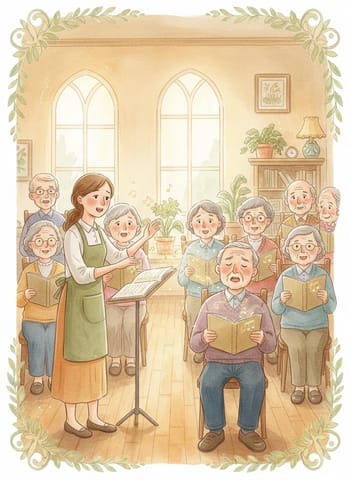
The choir meets on Thursday afternoons in a church hall with a leaking skylight and a tea urn that takes forty minutes to boil. Rosamund arrives early, as she has for five months, to set out the folders and the plastic cups and to arrange the chairs in a curve. The singers do better when they can see one another's faces. There are twenty-two of them, most with some form of memory loss, and eleven carers, who sing quietly and pretend not to. Her father, Halvard, is third from the left in the front row, in the cardigan she ironed that morning.
Paduan suara itu berkumpul pada Kamis sore di aula gereja dengan jendela atap yang bocor dan dispenser teh yang butuh empat puluh menit untuk mendidih. Rosamund tiba lebih awal, seperti yang ia lakukan selama lima bulan, untuk menyiapkan map-map dan gelas plastik dan menata kursi melengkung. Para penyanyi bernyanyi lebih baik bila bisa saling melihat wajah. Ada dua puluh dua penyanyi, kebanyakan dengan semacam gangguan ingatan, dan sebelas pendamping, yang bernyanyi pelan dan berpura-pura tidak. Ayahnya, Halvard, duduk ketiga dari kiri di barisan depan, dengan kardigan yang pagi tadi ia setrika.
He does not always know her. Some weeks he greets her with the polished warmth he used to keep for the neighbours; some weeks he calls her "the nice lady with the folders" and asks whether she lives nearby. She has stopped correcting him, less out of resignation than out of a practical sort of mercy, since correction costs him something and the cost is visible. Today he calls her "madam" and thanks her for the tea.
Ayahnya tak selalu mengenalinya. Beberapa minggu ia menyapanya dengan kehangatan halus yang dulu ia simpan untuk para tetangga; beberapa minggu ia menyebutnya "ibu baik yang membawa map" dan bertanya apakah ia tinggal di dekat sini. Rosamund sudah berhenti mengoreksinya, kurang karena pasrah dan lebih karena semacam belas kasih yang praktis, sebab koreksi membuat ayahnya kehilangan sesuatu dan kehilangan itu tampak jelas. Hari ini ayahnya memanggilnya "Nyonya" dan berterima kasih atas tehnya.
Then the pianist plays four bars, and something in the room changes. What Rosamund has still not got used to is the speed of it. A woman who cannot remember the name of her own street sings the first verse without a hitch, perfectly in tune. The man beside her, who has not spoken a full sentence since Easter, comes in on the second line with the exact tremor he must have had at twenty. Her father does not look at the sheet. Rarely does he look at anything except the pianist's hands. He sings the words in order, every one, including the old-fashioned verse that nobody else remembers.
Lalu pianis memainkan empat birama, dan sesuatu di ruangan itu berubah. Yang belum juga terbiasa bagi Rosamund adalah kecepatannya. Seorang perempuan yang tak ingat nama jalannya sendiri menyanyikan bait pertama tanpa tersendat, sempurna dalam nada. Pria di sampingnya, yang belum mengucapkan satu kalimat utuh sejak Paskah, masuk pada baris kedua dengan getaran persis seperti yang pasti ia miliki pada usia dua puluh. Ayahnya tak memandang lembar lagu. Jarang ia memandang apa pun selain tangan sang pianis. Ia menyanyikan kata-katanya berurutan, setiap kata, termasuk bait kuno yang tak diingat siapa pun lagi.
She has read the explanations, and two doctors have kindly given them to her: that melody and memory are stored in different places, that rhythm acts as a kind of scaffolding. None of it helps. The words are all there, perfectly kept, in a man who cannot say what he had for breakfast. She, who has every day of her life at her disposal, cannot finish the second verse without the page. If someone had told her a year ago that she would envy her father's memory, she would have laughed.
Ia sudah membaca penjelasannya, dan dua dokter dengan baik hati telah menyampaikannya: bahwa melodi dan ingatan disimpan di tempat berbeda, bahwa ritme bekerja semacam perancah. Semua itu tak membantu. Kata-katanya ada semua, terjaga sempurna, pada seorang pria yang tak bisa mengatakan apa yang ia sarapankan. Ia sendiri, yang memiliki setiap hari hidupnya, tak sanggup menyelesaikan bait kedua tanpa lembar itu. Kalau setahun lalu ada yang mengatakan bahwa ia akan iri pada ingatan ayahnya, ia akan tertawa.
At the break she carries the tea around on a tray, the cups rattling in their saucers. Her father takes one with both hands and studies her over the rim.
Saat istirahat ia membawa teh berkeliling dengan nampan, gelas-gelas bergemerincing di lepeknya. Ayahnya mengambil satu dengan kedua tangan dan mengamatinya dari atas bibir gelas.
"You sing very quietly," he says. It is the most direct remark he has made to her in a month.
"Kamu bernyanyi sangat pelan," katanya. Itu ucapan paling langsung yang ia sampaikan kepadanya dalam sebulan.
"I'm following the others," she says.
"Aku mengikuti yang lain," katanya.
"No," he says, with perfect courtesy. "You're listening. It's different."
"Bukan," kata ayahnya, dengan kesantunan sempurna. "Kamu mendengarkan. Itu berbeda."
After the break, the last song is the long one, the one he used to sing in the car, the one with seven verses. The pianist begins. Rosamund opens her folder, finds the page, and joins in half a beat late, as always. Carrying on through the fifth verse with her eyes on the words, she is aware of a hand reaching across her without any break in the singing. The page turns, one beat before she needs it. Her father, his eyes on the pianist, is still singing.
Setelah istirahat, lagu terakhir adalah yang panjang, yang dulu ia nyanyikan di mobil, yang berbait tujuh. Sang pianis mulai. Rosamund membuka mapnya, menemukan halamannya, dan ikut bernyanyi setengah ketukan terlambat, seperti biasa. Sambil terus bernyanyi sampai bait kelima dengan mata pada kata-kata, ia sadar ada sebuah tangan menjangkau melintasinya tanpa jeda dalam nyanyian. Halaman itu dibalik, satu ketukan sebelum ia membutuhkannya. Ayahnya, dengan mata pada sang pianis, masih bernyanyi.
She lets one line go by without her, and then she finds her place.
Ia membiarkan satu baris berlalu tanpa dirinya, lalu ia menemukan tempatnya.