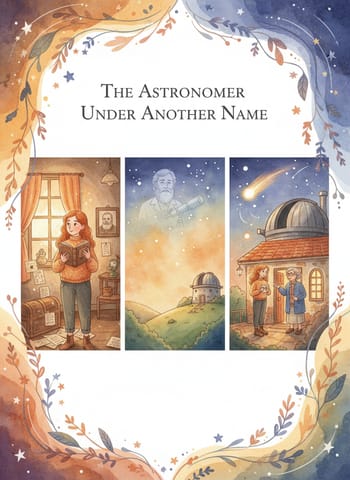
The Astronomer Under Another Name
Uma história gratuita em inglês de nível C1 para estudantes, para ler online em 4 idiomas, com opção de ouvir no app gratuito Storyteller.
After her silent father's death, Lorna discovers that he spent forty years publishing astronomy observations under a pen name, and goes to meet one of his correspondents.
Essa foi a prévia! Ouça a história completa no app gratuito Storyteller. Baixar o app
O áudio não está disponível no momento.
Her father had spoken, by Lorna's rough estimate, about four hundred words a month, and rarely had any of them been about himself. Clearing his loft a fortnight after the funeral, she expected tax papers, spare radiator parts, the plain residue of a plain man. What she found instead, behind the water tank, were forty years of notebooks in a tidy slanting hand, each page ruled into columns of dates, times and numbers. Beneath them lay a shoebox of printed bulletins from a society of amateur astronomers.
O pai de Lorna falava, pelos cálculos dela, umas quatrocentas palavras por mês, e raramente alguma delas era sobre si mesmo. Ao esvaziar o sótão dele, duas semanas depois do funeral, ela esperava encontrar papéis de imposto de renda, peças sobressalentes de radiador, o resíduo simples de um homem simples. O que encontrou, atrás da caixa-d'água, foram quarenta anos de cadernos escritos numa letra caprichada e inclinada, cada página dividida em colunas de datas, horários e números. Embaixo deles havia uma caixa de sapatos cheia de boletins impressos de uma sociedade de astrônomos amadores.
The bulletins carried a regular column of observations on variable stars, signed with the pen name Meridian. It took her an evening, comparing the handwriting in the margins, to be certain that Meridian was her father. He had stood in a cold garden on some thousand nights, she calculated, timing the dimming and brightening of lights she had never once seen him look at. He had told nobody: not her, and not her mother while she was alive. "Why would a man hide that?" she asked the empty loft, and found it had no more to say than he had.
Os boletins traziam uma coluna regular de observações de estrelas variáveis, assinada com o pseudônimo Meridian. Ela levou uma noite inteira, comparando a caligrafia das margens, para ter certeza de que Meridian era seu pai. Ele havia ficado num jardim frio durante umas mil noites, calculou ela, cronometrando o esmaecer e o brilhar de luzes para as quais ela jamais o vira olhar. Não contara a ninguém: nem a ela, nem à mãe dela enquanto estava viva. "Por que um homem esconderia isso?", perguntou ela ao sótão vazio, e descobriu que ele não tinha mais a dizer do que o pai.
One bulletin mentioned a reader who wrote to Meridian so often that the editor had started printing the replies. His name was Vidar, and he lived two hours up the coast. Lorna wrote to him without any real plan, and he answered by return, in a note that began, "I have wondered for years what he looked like."
Um dos boletins mencionava um leitor que escrevia tanto a Meridian que o editor passara a publicar as respostas. Chamava-se Vidar e morava a duas horas dali, subindo a costa. Lorna lhe escreveu sem plano nenhum, e ele respondeu na mesma hora, num bilhete que começava assim: "Há anos me pergunto como ele era."
Vidar turned out to be a small, careful man in his seventies who kept a telescope under a tarpaulin in his orchard, and he received her as though she were a rumour finally confirmed. He had a drawer of letters, he said, and brought them out. Reading them at his kitchen table, Lorna met someone she did not know. The Meridian of these pages teased and complained about the weather. Once he gave an entire page to a feud with a neighbour's floodlight, and he closed each letter with some version of "Clear skies, and say hello to the family."
Vidar se revelou um homem pequeno e cuidadoso, na casa dos setenta, que guardava um telescópio sob uma lona em seu pomar, e a recebeu como se ela fosse um boato finalmente confirmado. Tinha uma gaveta de cartas, disse, e as trouxe. Lendo-as à mesa da cozinha, Lorna conheceu alguém que não conhecia. O Meridian daquelas páginas provocava e reclamava do tempo. Certa vez dedicou uma página inteira a uma briga com o holofote de um vizinho, e encerrava cada carta com alguma versão de "Céu limpo, e lembranças à família".
What unsettled her was not that her father had been different on paper. It was that she recognised the jokes. Had anyone told her, as a girl, that the long silences at the dinner table were his way of saving the words for later, she would have taken it for an excuse. Now, with the letters in front of her, she thought it might simply have been true. He had spent his talk in a place where nobody could answer back, and she could not decide whether that was a kind of generosity or a kind of absence.
O que a perturbou não foi o fato de o pai ter sido diferente no papel. Foi reconhecer as piadas. Se alguém lhe tivesse dito, quando menina, que os longos silêncios à mesa do jantar eram o jeito dele de guardar as palavras para depois, ela teria tomado aquilo por desculpa. Agora, com as cartas diante de si, pensava que talvez fosse simplesmente verdade. Ele gastara sua conversa num lugar onde ninguém podia retrucar, e ela não conseguia decidir se isso era uma forma de generosidade ou uma forma de ausência.
Vidar asked whether she would like to look through the telescope. It was not yet dark, but a few stars had come out above the apple trees, and he aimed at one of them with the patience of a man who had done it many times. "Your father measured this one every clear night since before you were born," he said. "It fades for a day or so, then recovers. He never missed a minimum."
Vidar perguntou se ela gostaria de olhar pelo telescópio. Ainda não estava escuro, mas algumas estrelas já tinham surgido acima das macieiras, e ele apontou para uma delas com a paciência de quem já fez isso muitas vezes. "Seu pai media esta aqui todas as noites claras, desde antes de você nascer", disse ele. "Ela enfraquece por um dia mais ou menos e depois se recupera. Ele nunca perdeu um mínimo."
Lorna bent to the eyepiece. The star was small, steady and entirely ordinary, and she realised, looking at it, that she was holding her breath. It was not reverence. It was the particular stillness she had watched from the kitchen window as a child, on nights when he would not come in for supper. She did not breathe out until Vidar cleared his throat behind her and asked, very gently, whether she could see it.
Lorna se curvou sobre a ocular. A estrela era pequena, firme e inteiramente comum, e ela percebeu, ao olhar para ela, que estava prendendo a respiração. Não era reverência. Era a quietude particular que ela observara da janela da cozinha, quando criança, nas noites em que ele não vinha jantar. Só voltou a respirar quando Vidar pigarreou atrás dela e perguntou, com muita delicadeza, se ela conseguia ver.
"Yes," she said, and stayed where she was.
"Sim", disse ela, e continuou onde estava.