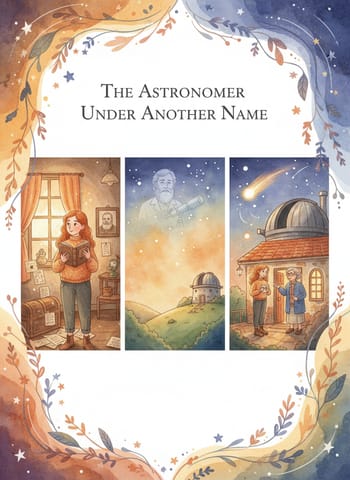
The Astronomer Under Another Name
Una historia gratuita en inglés de nivel C1 para estudiantes, para leer en línea en 4 idiomas, con opción de escucharla en la app gratuita Storyteller.
After her silent father's death, Lorna discovers that he spent forty years publishing astronomy observations under a pen name, and goes to meet one of his correspondents.
¡Ese fue el avance! Escucha la historia completa en la app gratuita Storyteller. Descargar la app
El audio no está disponible en este momento.
Her father had spoken, by Lorna's rough estimate, about four hundred words a month, and rarely had any of them been about himself. Clearing his loft a fortnight after the funeral, she expected tax papers, spare radiator parts, the plain residue of a plain man. What she found instead, behind the water tank, were forty years of notebooks in a tidy slanting hand, each page ruled into columns of dates, times and numbers. Beneath them lay a shoebox of printed bulletins from a society of amateur astronomers.
Su padre había hablado, según el cálculo aproximado de Lorna, unas cuatrocientas palabras al mes, y rara vez alguna había sido sobre sí mismo. Al vaciar su desván dos semanas después del funeral, ella esperaba papeles de impuestos, repuestos de radiador, el residuo sencillo de un hombre sencillo. Lo que encontró, detrás del tanque de agua, fueron cuarenta años de cuadernos escritos con una letra inclinada y pulcra, cada página dividida en columnas de fechas, horas y cifras. Debajo había una caja de zapatos con boletines impresos de una sociedad de astrónomos aficionados.
The bulletins carried a regular column of observations on variable stars, signed with the pen name Meridian. It took her an evening, comparing the handwriting in the margins, to be certain that Meridian was her father. He had stood in a cold garden on some thousand nights, she calculated, timing the dimming and brightening of lights she had never once seen him look at. He had told nobody: not her, and not her mother while she was alive. "Why would a man hide that?" she asked the empty loft, and found it had no more to say than he had.
Los boletines traían una columna regular de observaciones de estrellas variables, firmada con el seudónimo Meridian. Le tomó una noche, comparando la letra de los márgenes, estar segura de que Meridian era su padre. Había estado en un jardín helado unas mil noches, calculó, cronometrando el apagarse y el avivarse de unas luces que ella jamás lo había visto mirar. No se lo había dicho a nadie: ni a ella, ni a su madre mientras vivió. «¿Por qué escondería algo así un hombre?», preguntó al desván vacío, y descubrió que tenía tan poco que decir como él.
One bulletin mentioned a reader who wrote to Meridian so often that the editor had started printing the replies. His name was Vidar, and he lived two hours up the coast. Lorna wrote to him without any real plan, and he answered by return, in a note that began, "I have wondered for years what he looked like."
Un boletín mencionaba a un lector que escribía a Meridian tan a menudo que el editor había empezado a publicar las respuestas. Se llamaba Vidar y vivía a dos horas por la costa. Lorna le escribió sin ningún plan real, y él contestó de inmediato, en una nota que comenzaba: «Llevo años preguntándome cómo era».
Vidar turned out to be a small, careful man in his seventies who kept a telescope under a tarpaulin in his orchard, and he received her as though she were a rumour finally confirmed. He had a drawer of letters, he said, and brought them out. Reading them at his kitchen table, Lorna met someone she did not know. The Meridian of these pages teased and complained about the weather. Once he gave an entire page to a feud with a neighbour's floodlight, and he closed each letter with some version of "Clear skies, and say hello to the family."
Vidar resultó ser un hombre pequeño y meticuloso de unos setenta años que guardaba un telescopio bajo una lona en su huerto, y la recibió como a un rumor por fin confirmado. Tenía un cajón de cartas, dijo, y las sacó. Leyéndolas en su mesa de cocina, Lorna conoció a alguien a quien no conocía. El Meridian de esas páginas bromeaba y se quejaba del clima. Una vez dedicó una página entera a su disputa con el reflector de un vecino, y cerraba cada carta con alguna variante de «Cielos despejados, y saluda a la familia de mi parte».
What unsettled her was not that her father had been different on paper. It was that she recognised the jokes. Had anyone told her, as a girl, that the long silences at the dinner table were his way of saving the words for later, she would have taken it for an excuse. Now, with the letters in front of her, she thought it might simply have been true. He had spent his talk in a place where nobody could answer back, and she could not decide whether that was a kind of generosity or a kind of absence.
Lo que la inquietó no fue que su padre hubiera sido distinto en el papel. Fue que reconoció los chistes. Si alguien le hubiera dicho, de niña, que los largos silencios en la mesa eran su manera de guardar las palabras para después, lo habría tomado por una excusa. Ahora, con las cartas delante, pensó que tal vez simplemente era verdad. Había gastado su charla en un lugar donde nadie podía contestarle, y ella no lograba decidir si eso era una forma de generosidad o una forma de ausencia.
Vidar asked whether she would like to look through the telescope. It was not yet dark, but a few stars had come out above the apple trees, and he aimed at one of them with the patience of a man who had done it many times. "Your father measured this one every clear night since before you were born," he said. "It fades for a day or so, then recovers. He never missed a minimum."
Vidar le preguntó si quería mirar por el telescopio. Aún no anochecía, pero algunas estrellas habían salido sobre los manzanos, y él apuntó a una de ellas con la paciencia de quien lo ha hecho muchas veces. «Su padre midió esta todas las noches despejadas desde antes de que usted naciera», dijo. «Se apaga durante un día más o menos y luego se recupera. Nunca se perdió un mínimo».
Lorna bent to the eyepiece. The star was small, steady and entirely ordinary, and she realised, looking at it, that she was holding her breath. It was not reverence. It was the particular stillness she had watched from the kitchen window as a child, on nights when he would not come in for supper. She did not breathe out until Vidar cleared his throat behind her and asked, very gently, whether she could see it.
Lorna se inclinó hacia el ocular. La estrella era pequeña, firme y por completo corriente, y al mirarla comprendió que contenía la respiración. No era reverencia. Era la quietud particular que había observado desde la ventana de la cocina de niña, en las noches en que él no entraba a cenar. No soltó el aire hasta que Vidar se aclaró la garganta a su espalda y le preguntó, con mucha suavidad, si la veía.
"Yes," she said, and stayed where she was.
«Sí», dijo, y se quedó donde estaba.