The Bell in the Light Parcel
Cerita bahasa Inggris gratis level B2 untuk pelajar, bisa dibaca online dalam 7 bahasa, dengan pilihan untuk mendengarkannya di aplikasi Storyteller gratis.
A parcel that weighs far more than its label says gives a shop manager and a delivery driver a reason to ask each other a question they have avoided for a year.
Itu cuplikannya! Dengarkan cerita lengkapnya di aplikasi Storyteller gratis. Unduh aplikasi
Audio belum tersedia saat ini.
The gift shop at the foot of the lighthouse was the smallest shop on the coast. It sold postcards, dish towels printed with maps, and tiny glass lanterns that nobody needed and everybody bought. Ife had managed it for two years, and she knew every squeaking floorboard by heart.
Toko suvenir di kaki mercusuar itu adalah toko terkecil di pesisir. Toko itu menjual kartu pos, lap piring bercetak peta, dan lentera kaca mungil yang tidak dibutuhkan siapa pun tetapi dibeli semua orang. Ife sudah mengelolanya selama dua tahun, dan ia hafal setiap papan lantai yang berderit.
The shop also served as the village parcel point, because the nearest post office was forty minutes away by road. Once a week the delivery van climbed the hill. Then Abena climbed out of it with a scanner in one hand and a box under each arm.
Toko itu juga berfungsi sebagai titik pengambilan paket desa, karena kantor pos terdekat berjarak empat puluh menit lewat jalan darat. Seminggu sekali mobil pengantar mendaki bukit. Lalu Abena turun dari mobil itu dengan pemindai di satu tangan dan sebuah kardus di bawah tiap lengan.
Their routine never changed. Abena put the parcels on the counter, Ife weighed them on the old brass scale, and they argued cheerfully about whether the scale was honest. Then Abena drank a glass of water, said something about the road, and left. It had gone on like that for a year.
Rutinitas mereka tidak pernah berubah. Abena menaruh paket-paket di meja kasir, Ife menimbangnya di timbangan kuningan tua, dan mereka berdebat riang tentang apakah timbangan itu jujur. Lalu Abena minum segelas air, mengatakan sesuatu tentang jalanan, dan pergi. Begitulah selama setahun.
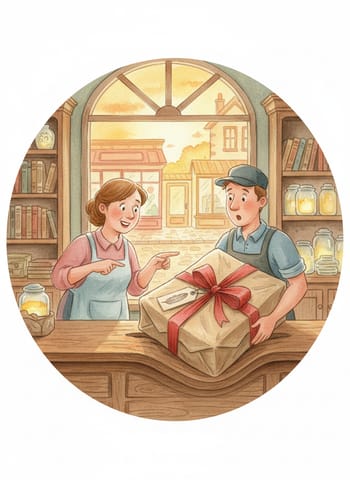
On a quiet afternoon in early autumn, Abena arrived later than usual and carried a single parcel. It was wrapped in brown paper and tied with blue string, and it had Ife's name on the label.
Pada suatu sore yang sepi di awal musim gugur, Abena tiba lebih lambat dari biasanya dan hanya membawa satu paket. Paket itu terbungkus kertas cokelat dan diikat tali biru, dan di labelnya tertulis nama Ife.
"Strange one," Abena said. "The label says four hundred grams. A scarf, maybe. But it nearly pulled my arm off on the stairs."
"Yang aneh," kata Abena. "Di labelnya tertulis empat ratus gram. Mungkin sehelai syal. Tapi paket ini hampir mencabut lenganku di tangga."
Ife lifted the parcel. Abena was right. It felt like a bag of wet sand. She put it on the scale, and the needle swung past one kilo, then past two, and finally settled at three.
Ife mengangkat paket itu. Abena benar. Rasanya seperti sekantong pasir basah. Ia menaruhnya di timbangan, dan jarumnya bergerak melewati satu kilo, lalu dua kilo, dan akhirnya berhenti di tiga.
"Three kilos," Ife said. "It should not weigh that much."
"Tiga kilo," kata Ife. "Seharusnya tidak seberat itu."
"The sender has made a mistake on the label." Abena frowned at her scanner. "I should correct the weight, and you should pay the extra fee. That is the rule."
"Pengirimnya salah menulis berat di label." Abena mengerutkan kening menatap pemindainya. "Aku harus mengoreksi beratnya, dan kamu harus membayar biaya tambahan. Itu aturannya."
"How much extra?"
"Tambahannya berapa?"
"About nine euros."
"Sekitar sembilan euro."
Ife laughed. She had expected a worse number. But she did not reach for her purse, because something else had caught her attention. The handwriting on the label was her sister's, and her sister never made mistakes with numbers. She was an accountant.
Ife tertawa. Ia sudah menduga angka yang lebih buruk. Tetapi ia tidak meraih dompetnya, karena ada hal lain yang menarik perhatiannya. Tulisan tangan di label itu milik kakaknya, dan kakaknya tidak pernah salah soal angka. Ia seorang akuntan.
"I would like to open it," Ife said. "Before I pay anything."
"Aku ingin membukanya," kata Ife. "Sebelum membayar apa pun."
"You may," said Abena. "I will wait."
"Silakan," kata Abena. "Aku akan menunggu."
Neither of them mentioned that Abena had already finished her round. Nobody was waiting for her at the depot, and the van stood in the shade with its engine switched off. Ife cut the blue string with the scissors from the till and folded back the brown paper.
Tak satu pun dari mereka menyebut bahwa Abena sudah menyelesaikan rutenya. Tidak ada yang menunggunya di depo, dan mobilnya berdiri di tempat teduh dengan mesin mati. Ife memotong tali biru dengan gunting dari laci kasir dan melipat kertas cokelat itu ke belakang.
Inside, wrapped in a woollen scarf that explained the label, was a brass bell. It was the size of a small melon, heavy and bright, with a small ring of leather for hanging. A card was tucked under the clapper. Ife read it silently first, and then, because Abena was standing there, she read it aloud.
Di dalamnya, terbungkus syal wol yang menjelaskan soal label itu, ada sebuah lonceng kuningan. Ukurannya sebesar melon kecil, berat dan mengilap, dengan cincin kulit kecil untuk menggantungnya. Sebuah kartu terselip di bawah pemukulnya. Ife membacanya dalam hati lebih dulu, lalu, karena Abena berdiri di situ, ia membacanya dengan suara keras.
"For your door. You said you never hear anyone coming until they are already inside. Now you will."
"Untuk pintumu. Kamu bilang kamu tidak pernah mendengar siapa pun datang sampai mereka sudah di dalam. Sekarang kamu akan mendengarnya."
For a moment neither of them spoke. Ife remembered the telephone call, a month earlier, when she had complained about the silence of the shop. She had said it half as a joke. Her sister had listened and apparently done something about it.
Sejenak tak satu pun dari mereka bicara. Ife teringat percakapan telepon sebulan lalu, ketika ia mengeluh tentang sunyinya toko itu. Ia mengatakannya setengah bercanda. Kakaknya mendengarkan dan rupanya melakukan sesuatu tentang itu.
"That is a good sister," Abena said.
"Kakak yang baik," kata Abena.
"She is an accountant," Ife said, "so the weight on the label is the only mistake she has made in twenty years. I think she wanted to hide the surprise."
"Dia seorang akuntan," kata Ife, "jadi berat di label itu satu-satunya kesalahan yang pernah ia buat dalam dua puluh tahun. Kurasa dia ingin menyembunyikan kejutannya."
Abena smiled. She asked whether there was a hook by the door. Ife said no, and Abena said she had a screwdriver in the van. She also had a habit of doing small useful things when she was nervous. This was the first time Ife had seen her nervous in all the year they had known each other.
Abena tersenyum. Ia bertanya apakah ada pengait di dekat pintu. Ife bilang tidak, dan Abena bilang ia punya obeng di mobil. Ia juga punya kebiasaan melakukan hal-hal kecil yang berguna saat gugup. Ini pertama kalinya Ife melihatnya gugup selama setahun mereka saling mengenal.
Together they hung the bell above the door. Abena held the ladder while Ife worked, and they argued, as they always did, about whether the hook was straight. When Ife finally stepped down, Abena opened the door and closed it again, and a deep, clear note filled the little shop.
Bersama-sama mereka menggantung lonceng itu di atas pintu. Abena memegangi tangga sementara Ife bekerja, dan mereka berdebat, seperti biasa, tentang apakah pengaitnya lurus. Ketika Ife akhirnya turun, Abena membuka pintu dan menutupnya lagi, dan sebuah nada dalam dan jernih memenuhi toko kecil itu.
It was a beautiful sound. It was also a very loud one, and a pair of walkers outside looked up at the lighthouse as though it had spoken.
Suaranya indah. Suaranya juga sangat keras, dan dua pejalan kaki di luar mendongak ke mercusuar seakan-akan mercusuar itulah yang bicara.
"I think the whole village will hear it," Ife said, laughing.
"Kurasa seluruh desa akan mendengarnya," kata Ife sambil tertawa.
"Good," said Abena. "Nobody will be able to sneak into your shop."
"Bagus," kata Abena. "Tidak akan ada yang bisa menyelinap ke tokomu."
They stood together for a moment beside the counter. The shop had gone quiet again, though not in the old way. The afternoon light came through the glass lanterns and made little coloured patches on the floor. Ife noticed that Abena still held the screwdriver, and that neither of them seemed to know what to do next.
Mereka berdiri bersama sejenak di samping meja kasir. Toko itu kembali hening, tetapi tidak seperti dulu. Cahaya sore menembus lentera-lentera kaca dan membuat bercak-bercak warna kecil di lantai. Ife memperhatikan bahwa Abena masih memegang obeng, dan keduanya tampak tidak tahu harus berbuat apa selanjutnya.
There was a question that had been waiting for a year. Ife had carried it around the way a person carries a stone in a pocket, never taking it out, always aware of its weight. She had asked herself why a woman who could finish her round by three always arrived at five. She had wondered why Abena stayed for water she never seemed to want. She had never asked, because the answer might spoil something that already worked.
Ada sebuah pertanyaan yang sudah menunggu selama setahun. Ife membawanya ke mana-mana seperti orang membawa batu di saku, tidak pernah mengeluarkannya, selalu sadar akan beratnya. Ia pernah bertanya pada dirinya sendiri mengapa seorang perempuan yang bisa menyelesaikan rutenya pukul tiga selalu tiba pukul lima. Ia pernah bertanya-tanya mengapa Abena tinggal demi air yang tampaknya tidak pernah ia inginkan. Ia tidak pernah bertanya, karena jawabannya mungkin merusak sesuatu yang sudah berjalan baik.
But the bell had changed the room. Her sister had sent a small, heavy reminder that silence could be broken on purpose, and Ife decided to take her at her word.
Tetapi lonceng itu telah mengubah ruangan. Kakaknya telah mengirim pengingat kecil yang berat bahwa keheningan bisa dipecahkan dengan sengaja, dan Ife memutuskan mengikuti nasihat itu.
"Abena," she said. "May I ask you something I should have asked a long time ago?"
"Abena," katanya. "Boleh aku menanyakan sesuatu yang seharusnya sudah kutanyakan sejak lama?"
"Of course."
"Tentu."
"Why do you come to my shop last, every week? Your other stops are much closer to the depot. You could be home two hours earlier."
"Kenapa kamu datang ke tokoku paling akhir setiap minggu? Pemberhentianmu yang lain jauh lebih dekat ke depo. Kamu bisa sampai di rumah dua jam lebih awal."
Abena put the screwdriver down on the counter very carefully, as though it might break. She looked at the scale, then at the brass bell, then at the door, and last of all at Ife.
Abena meletakkan obeng itu di meja kasir dengan sangat hati-hati, seolah benda itu bisa patah. Ia menatap timbangan, lalu lonceng kuningan, lalu pintu, dan terakhir Ife.
"Because it is the only stop on my route where nobody is in a hurry," she said. "And because you always argue with the scale as if it were a person." She stopped, and for the first time since Ife had known her she looked unsure. "That is the short answer. There is a longer one. Would you like to hear it, or would you rather pay the nine euros and let me go?"
"Karena ini satu-satunya pemberhentian di rutenya yang tidak ada orang terburu-buru," katanya. "Dan karena kamu selalu berdebat dengan timbangan seolah-olah dia manusia." Ia berhenti, dan untuk pertama kalinya sejak Ife mengenalnya ia tampak ragu. "Itu jawaban singkatnya. Ada yang lebih panjang. Mau mendengarnya, atau lebih suka membayar sembilan euro dan membiarkan aku pergi?"
Ife thought about the shop, the bell, and the long quiet afternoons that were no longer so long. She picked up her purse and put it back down again.
Ife memikirkan toko itu, lonceng itu, dan sore-sore sunyi yang panjang yang kini tidak lagi sepanjang itu. Ia mengambil dompetnya dan meletakkannya kembali.
"How long is the longer answer?" she asked.
"Seberapa panjang jawaban yang lebih panjang itu?" tanyanya.