Row C Is Always Empty
Cerita bahasa Inggris gratis level C1 untuk pelajar, bisa dibaca online dalam 5 bahasa, dengan pilihan untuk mendengarkannya di aplikasi Storyteller gratis.
A young violinist finally asks the house manager why the same concert seat is bought every season yet never filled.
Itu cuplikannya! Dengarkan cerita lengkapnya di aplikasi Storyteller gratis. Unduh aplikasi
Audio belum tersedia saat ini.
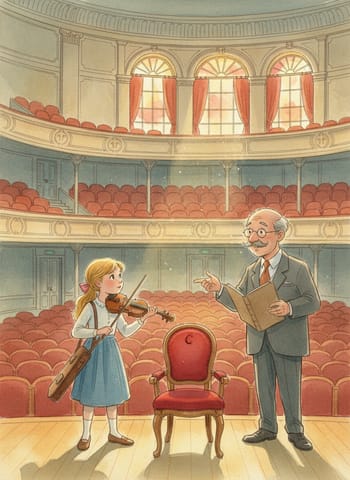
By her third concert with the youth orchestra, Noor had stopped expecting seat C7 to be occupied.
Pada konsernya yang ketiga bersama orkestra remaja, Noor sudah berhenti berharap kursi C7 akan terisi.
Someone bought it every single time. The box office confirmed as much whenever she asked, waving a printout of the seating chart at her like proof of something she hadn't quite accused them of. And yet, whenever the house lights dimmed and Noor found the seat with her eyes from the second violin section, C7 sat empty, coat-less, program-less, under a small reserved sign nobody seemed willing to explain.
Ada saja yang membelinya setiap kali. Loket tiket membenarkannya setiap kali ia bertanya, sambil mengacungkan cetakan denah tempat duduk kepadanya seperti bukti atas sesuatu yang belum benar-benar ia tuduhkan. Namun, setiap kali lampu aula meredup dan Noor mencari kursi itu dengan matanya dari barisan biola kedua, C7 selalu kosong, tanpa mantel, tanpa buklet acara, di bawah sebuah tanda kecil bertuliskan dipesan yang tak ada seorang pun mau menjelaskannya.
"Maybe it's superstition," her stand partner, Callum, offered after a rehearsal. "Some old patron who died in that seat and everyone's too polite to sell it."
"Mungkin itu takhayul," kata teman sebangku partiturnya, Callum, setelah latihan. "Mungkin ada pelanggan tua yang meninggal di kursi itu dan semua orang terlalu sungkan untuk menjualnya."
Noor doubted that. What struck her as far stranger than an empty seat was how precisely it stayed the same seat, concert after concert, season after season. It was as though someone had made a decision once, and nobody since had thought to question it. She started watching the house manager, Desmond Ochoa, a quiet man who arrived early and checked every row himself before doors opened, C7 included. Pausing at that one row a beat longer than any other, he would run his hand once along the seatback before moving on, a habit Noor doubted he knew he had.
Noor meragukannya. Yang menurutnya jauh lebih aneh daripada sebuah kursi kosong adalah betapa persis kursi itu tetap menjadi kursi yang sama, konser demi konser, musim demi musim. Seakan-akan seseorang pernah membuat keputusan sekali, dan sejak itu tak ada yang terpikir untuk mempertanyakannya. Ia mulai memperhatikan manajer gedung, Desmond Ochoa, pria pendiam yang datang lebih awal dan memeriksa setiap baris sendiri sebelum pintu dibuka, termasuk C7. Ia berhenti di baris itu sedikit lebih lama daripada baris lainnya, lalu mengusapkan tangannya sekali di sandaran kursi sebelum berlalu, kebiasaan yang Noor yakin tak disadarinya.
Not until her fourth concert did she work up the nerve to ask him directly. She caught him in the lobby folding programs, and he didn't look surprised by the question, only tired in a way that suggested he had answered some version of it before.
Baru pada konser keempat ia memberanikan diri bertanya langsung kepadanya. Ia mencegat Desmond di lobi saat sedang melipat buklet acara, dan Desmond tak tampak terkejut oleh pertanyaan itu, hanya lelah dengan cara yang menunjukkan bahwa ia pernah menjawab versi lain dari pertanyaan yang sama.
"That seat belonged to a teacher of mine," he said. "Mrs. Alvear. She taught cello here for thirty years, right up until she couldn't hold the bow steady anymore. Told me once that C7 had the best sightline to the cello section in the whole hall. She meant to sit there every year for the rest of her life, whether she was well enough to play or not."
"Kursi itu milik guruku," katanya. "Bu Alvear. Beliau mengajar cello di sini selama tiga puluh tahun, sampai beliau tak lagi bisa memegang busur dengan mantap. Beliau pernah bilang bahwa C7 punya pandangan terbaik ke barisan cello di seluruh aula. Beliau bermaksud duduk di sana setiap tahun selama sisa hidupnya, entah sehat cukup untuk bermain atau tidak."
"Is she—" Noor started, unsure how to finish the question politely.
"Apakah beliau…" Noor memulai, bingung bagaimana menyelesaikan pertanyaan itu dengan sopan.
"She's alive. Ninety-one, in a care home two towns over. She hasn't made it to a concert in six years." Desmond folded another program before he went on. "I buy the seat every season out of my own pocket. Not because she'll ever sit in it again. Because somebody has to keep the promise she made to herself, now that she can't."
"Beliau masih hidup. Sembilan puluh satu tahun, di panti perawatan dua kota dari sini. Sudah enam tahun beliau tak sanggup datang ke konser." Desmond melipat satu buklet lagi sebelum melanjutkan. "Aku membeli kursi itu setiap musim dengan uangku sendiri. Bukan karena beliau akan duduk di sana lagi. Tapi karena seseorang harus menjaga janji yang dibuat beliau untuk dirinya sendiri, sekarang saat beliau tak bisa."
Noor didn't know what to say to that, so for once she didn't try. It was only later, tuning her violin before the next concert, that she understood what had actually bothered her about the empty seat all along. It was not the mystery of who had reserved it, but her own quiet assumption that an empty chair must mean nobody was watching.
Noor tak tahu harus berkata apa, jadi untuk sekali ini ia tak mencoba. Baru belakangan, saat menyetem biolanya sebelum konser berikutnya, ia mengerti apa yang sebenarnya selama ini mengusiknya dari kursi kosong itu. Bukan misteri siapa yang memesannya, melainkan anggapan diam-diamnya sendiri bahwa kursi kosong pasti berarti tak ada yang menonton.
She played the second half looking toward C7 more than once that night, not because she expected it to fill, but because it no longer felt empty in the way it once had.
Ia memainkan babak kedua malam itu dengan beberapa kali menoleh ke arah C7, bukan karena mengharapkan kursi itu terisi, tetapi karena kursi itu tak lagi terasa kosong seperti dulu.