Row C Is Always Empty
Una historia gratuita en inglés de nivel C1 para estudiantes, para leer en línea en 3 idiomas, con opción de escucharla en la app gratuita Storyteller.
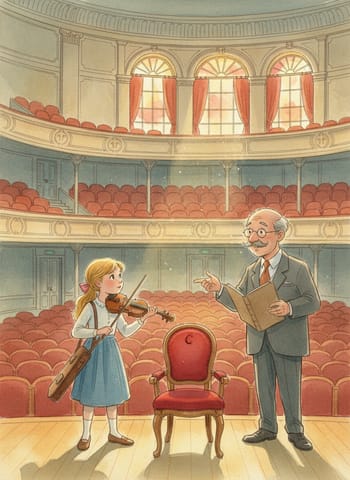
A young violinist finally asks the house manager why the same concert seat is bought every season yet never filled.
¡Ese fue el avance! Escucha la historia completa en la app gratuita Storyteller. Descargar la app
El audio no está disponible en este momento.
By her third concert with the youth orchestra, Noor had stopped expecting seat C7 to be occupied.
Para su tercer concierto con la orquesta juvenil, Noor ya había dejado de esperar que el asiento C7 estuviera ocupado.
Someone bought it every single time. The box office confirmed as much whenever she asked, waving a printout of the seating chart at her like proof of something she hadn't quite accused them of. And yet, whenever the house lights dimmed and Noor found the seat with her eyes from the second violin section, C7 sat empty, coat-less, program-less, under a small reserved sign nobody seemed willing to explain.
Alguien lo compraba cada vez, sin excepción. La boletería lo confirmaba cada vez que preguntaba, agitando ante ella una copia del plano de asientos como prueba de algo que ella no había llegado a acusarlos de nada. Y sin embargo, cada vez que se apagaban las luces de la sala y Noor buscaba el asiento con la vista desde la sección de segundos violines, el C7 estaba vacío, sin abrigo, sin programa, bajo un pequeño letrero de reservado que nadie parecía dispuesto a explicar.
"Maybe it's superstition," her stand partner, Callum, offered after a rehearsal. "Some old patron who died in that seat and everyone's too polite to sell it."
«Tal vez sea superstición», sugirió su compañero de fila, Callum, después de un ensayo. «Algún viejo mecenas que murió en ese asiento y todos son demasiado educados para venderlo».
Noor doubted that. What struck her as far stranger than an empty seat was how precisely it stayed the same seat, concert after concert, season after season. It was as though someone had made a decision once, and nobody since had thought to question it. She started watching the house manager, Desmond Ochoa, a quiet man who arrived early and checked every row himself before doors opened, C7 included. Pausing at that one row a beat longer than any other, he would run his hand once along the seatback before moving on, a habit Noor doubted he knew he had.
Noor lo dudaba. Lo que le parecía mucho más extraño que un asiento vacío era lo exactamente igual que seguía siendo ese mismo asiento, concierto tras concierto, temporada tras temporada. Era como si alguien hubiera tomado una decisión una vez, y nadie desde entonces se hubiera detenido a cuestionarla. Empezó a observar al gerente de la sala, Desmond Ochoa, un hombre callado que llegaba temprano y revisaba cada fila él mismo antes de abrir las puertas, incluido el C7. Se detenía en esa fila un momento más que en cualquier otra, pasaba la mano una vez sobre el respaldo antes de seguir, un hábito que Noor dudaba que él supiera que tenía.
Not until her fourth concert did she work up the nerve to ask him directly. She caught him in the lobby folding programs, and he didn't look surprised by the question, only tired in a way that suggested he had answered some version of it before.
No fue hasta su cuarto concierto que ella se armó de valor para preguntarle directamente. Lo encontró en el vestíbulo doblando programas, y él no pareció sorprendido por la pregunta, solo cansado, de una forma que sugería que ya había respondido alguna versión de ella antes.
"That seat belonged to a teacher of mine," he said. "Mrs. Alvear. She taught cello here for thirty years, right up until she couldn't hold the bow steady anymore. Told me once that C7 had the best sightline to the cello section in the whole hall. She meant to sit there every year for the rest of her life, whether she was well enough to play or not."
«Ese asiento fue de una maestra mía», dijo él. «La señora Alvear. Dio clases de violonchelo aquí durante treinta años, hasta que ya no pudo sostener el arco con firmeza. Me dijo una vez que el C7 tenía la mejor vista hacia la sección de violonchelos de toda la sala. Pensaba sentarse ahí cada año por el resto de su vida, estuviera lo bastante bien para tocar o no».
"Is she—" Noor started, unsure how to finish the question politely.
«¿Ella está…?», empezó Noor, sin saber cómo terminar la pregunta con delicadeza.
"She's alive. Ninety-one, in a care home two towns over. She hasn't made it to a concert in six years." Desmond folded another program before he went on. "I buy the seat every season out of my own pocket. Not because she'll ever sit in it again. Because somebody has to keep the promise she made to herself, now that she can't."
«Está viva. Noventa y un años, en un hogar de cuidados dos pueblos más allá. No ha podido venir a un concierto en seis años». Desmond dobló otro programa antes de continuar. «Compro el asiento cada temporada con mi propio dinero. No porque ella vaya a sentarse ahí de nuevo alguna vez. Porque alguien tiene que cumplir la promesa que ella se hizo a sí misma, ahora que ella no puede».
Noor didn't know what to say to that, so for once she didn't try. It was only later, tuning her violin before the next concert, that she understood what had actually bothered her about the empty seat all along. It was not the mystery of who had reserved it, but her own quiet assumption that an empty chair must mean nobody was watching.
Noor no supo qué decir a eso, así que por una vez no lo intentó. Fue solo después, afinando su violín antes del siguiente concierto, que entendió lo que en realidad la había molestado del asiento vacío todo este tiempo. No era el misterio de quién lo había reservado, sino su propia suposición silenciosa de que una silla vacía debía significar que nadie estaba mirando.
She played the second half looking toward C7 more than once that night, not because she expected it to fill, but because it no longer felt empty in the way it once had.
Esa noche tocó la segunda mitad mirando hacia el C7 más de una vez, no porque esperara que se llenara, sino porque ya no se sentía vacío de la forma en que antes se sentía.