The Little Door in the Garden Wall
Una historia gratuita en inglés de nivel B2 para estudiantes, para leer en línea en 7 idiomas, con opción de escucharla en la app gratuita Storyteller.
A volunteer on a shopping-centre roof tidies a wall so well that she hides the one thing the garden cannot live without.
¡Ese fue el avance! Escucha la historia completa en la app gratuita Storyteller. Descargar la app
El audio no está disponible en este momento.
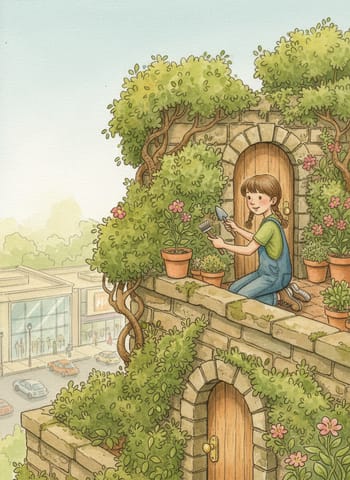
The roof garden sits above the shopping centre like a green island that nobody has bothered to name. Down below, people queue for shoes and argue about parking. Up here, there are four long beds of herbs, a row of apple trees in barrels and a view of the car park.
El jardín de la azotea se extiende sobre el centro comercial como una isla verde a la que nadie se ha molestado en ponerle nombre. Abajo, la gente hace fila para comprar zapatos y discute por el estacionamiento. Aquí arriba hay cuatro largos canteros de hierbas, una hilera de manzanos en barriles y una vista del estacionamiento.
Sunniva has volunteered here every Saturday since January. She is sixteen, and she is the youngest person on the team by about thirty years. Most weeks she waters the beds, pulls weeds and listens to the older volunteers disagree about compost.
Sunniva es voluntaria aquí todos los sábados desde enero. Tiene dieciséis años y es la persona más joven del equipo por unos treinta años. La mayoría de las semanas riega los canteros, arranca malezas y escucha a los voluntarios mayores discutir sobre el compost.
This Saturday, though, she has a real job. Damir, who is nineteen and keeps the whole garden running, hands her a tin of cream paint and a wide brush.
Este sábado, sin embargo, tiene un trabajo de verdad. Damir, que tiene diecinueve años y mantiene en marcha todo el jardín, le entrega una lata de pintura color crema y una brocha ancha.
"The back wall looks tired," he says. "Give it two coats, from the corner to the stairwell door. I have to fix the gutters on the other side, so you are on your own."
«La pared del fondo se ve cansada», dice. «Dale dos manos, desde la esquina hasta la puerta de la escalera. Tengo que arreglar las canaletas del otro lado, así que estás por tu cuenta».
"On my own?" Sunniva says. "What if I do it wrong?"
«¿Por mi cuenta?», dice Sunniva. «¿Y si lo hago mal?»
"It is a wall," Damir says. "The worst thing you can do is leave a drip."
«Es una pared», dice Damir. «Lo peor que puedes hacer es dejar un chorreón».
He leaves, and the roof falls quiet except for the hum of the air vents. Sunniva lays newspaper along the bottom of the wall and begins.
Se va, y la azotea queda en silencio, salvo por el zumbido de las salidas de aire. Sunniva extiende papel de periódico al pie de la pared y empieza.
Painting turns out to be more peaceful than she expected. The brush moves in long strokes, and the old grey disappears a metre at a time. She likes the way a flaw vanishes the moment she covers it. A crack, a stain, a patch where someone once taped up a poster: all of it becomes smooth and cream.
Pintar resulta ser más tranquilo de lo que esperaba. La brocha se mueve en trazos largos, y el viejo gris desaparece un metro tras otro. Le gusta cómo un defecto se esfuma en el momento en que lo cubre. Una grieta, una mancha, un parche donde alguien pegó un afiche: todo se vuelve liso y color crema.
Halfway along the wall, at the height of her knee, she finds a very small door. It is made of metal and is about the size of a large book. Its hinges are clogged with so many old coats of paint that the edges have nearly melted into the brick.
A la mitad de la pared, a la altura de su rodilla, encuentra una puertita muy pequeña. Es de metal y tiene más o menos el tamaño de un libro grande. Sus bisagras están tan tapadas por capas viejas de pintura que los bordes casi se han fundido con el ladrillo.
Sunniva crouches and studies it. There is no handle, only a little dent where a handle used to be. Nobody has mentioned this door in five months of Saturdays. She decides it must be a leftover from some old plan, a decoration that never found its purpose.
Sunniva se agacha y la estudia. No tiene manija, solo una pequeña hendidura donde antes hubo una. Nadie ha mencionado esta puerta en cinco meses de sábados. Decide que debe de ser un sobrante de algún plan antiguo, un adorno que nunca encontró su propósito.
A thin gap runs around the frame, dark and untidy against the new cream. It bothers her more than it should. She finds a tube of filler in the toolbox, presses a neat line of it into the gap and smooths it with her thumb. Then she paints over the door itself, twice, until the whole wall is one clean surface.
Una rendija delgada rodea el marco, oscura y desprolija contra el crema nuevo. Le molesta más de lo que debería. Encuentra un tubo de masilla en la caja de herramientas, aplica una línea pareja en la rendija y la alisa con el pulgar. Luego pinta sobre la puerta misma, dos veces, hasta que toda la pared es una sola superficie limpia.
When she steps back, she can hardly tell where the door begins. She feels the small, private pride of someone who has made a problem disappear.
Cuando se aleja, apenas puede distinguir dónde empieza la puerta. Siente el pequeño orgullo privado de quien ha hecho desaparecer un problema.
Damir returns at four o'clock, wiping his hands on his trousers. He stops in front of the wall and whistles.
Damir regresa a las cuatro, limpiándose las manos en los pantalones. Se detiene frente a la pared y silba.
"That looks like a different building," he says. "Honestly, Sunniva, I thought you would leave stripes."
«Parece otro edificio», dice. «De verdad, Sunniva, pensé que dejarías rayas».
"I was careful," she says, and she smiles for the first time all day.
«Fui cuidadosa», dice ella, y sonríe por primera vez en todo el día.
They spend the next hour tying up the tomato plants, and Damir talks while they work. He explains that the sprinklers come on at five, because the beds dry out fastest on Saturday evenings. A pump in the basement sends water up through a long pipe, and a single valve controls the whole system.
Pasan la hora siguiente atando las plantas de tomate, y Damir habla mientras trabajan. Explica que los aspersores se encienden a las cinco, porque los canteros se secan más rápido los sábados por la tarde. Una bomba en el sótano manda el agua hacia arriba por una tubería larga, y una sola válvula controla todo el sistema.
"That valve is the only thing that really matters up here," he says. "If it stays shut, the garden is just a field of expensive sticks. I open it by hand every Saturday before the timer starts. The hatch is in the back wall, about knee height. You cannot miss it."
«Esa válvula es lo único que de verdad importa aquí arriba», dice. «Si se queda cerrada, el jardín es solo un campo de palitos caros. La abro a mano todos los sábados antes de que arranque el temporizador. La compuerta está en la pared del fondo, a la altura de la rodilla. No tiene pérdida».
Sunniva stops with a tomato stem in her fingers. A cold feeling begins in her stomach and spreads outward.
Sunniva se detiene con un tallo de tomate entre los dedos. Un frío empieza en su estómago y se extiende hacia afuera.
"Is it a metal door?" she asks. "About this big?"
«¿Es una puerta de metal?», pregunta. «¿Más o menos de este tamaño?»
Damir looks at her. Then he looks at the wall, and his face changes slowly, the way a window changes when someone draws the curtains.
Damir la mira. Luego mira la pared, y su cara cambia despacio, como cambia una ventana cuando alguien corre las cortinas.
"Please tell me you did not paint the hatch," he says.
«Por favor, dime que no pintaste la compuerta», dice.
Sunniva has about two seconds to decide what kind of person she is going to be. The excuses are already lined up in her head, and every one of them is true. Nobody told her. There was no label. It looked like decoration. She notices that none of them will get the water moving.
Sunniva tiene unos dos segundos para decidir qué clase de persona va a ser. Las excusas ya están alineadas en su cabeza, y todas son verdad. Nadie se lo dijo. No había ninguna etiqueta. Parecía un adorno. Se da cuenta de que ninguna va a hacer que el agua corra.
"I did," she says. "I filled the gap around it, and I painted it twice. I thought it was decoration. I am sorry."
«Lo hice», dice. «Rellené la rendija de alrededor y la pinté dos veces. Pensé que era un adorno. Lo siento».
Damir closes his eyes for a moment. When he opens them, he checks his phone, and she sees him doing the arithmetic.
Damir cierra los ojos un momento. Cuando los abre, revisa su teléfono, y ella lo ve haciendo la cuenta.
"It is ten to five," he says. "If the pump starts against a closed valve, it could burn out. And the new seedlings will not last the night without water. Come on."
«Son las cinco menos diez», dice. «Si la bomba arranca contra una válvula cerrada, podría quemarse. Y las plántulas nuevas no aguantarán la noche sin agua. Vamos».
They kneel in front of the wall together. In the afternoon light the paint looks perfect, which is the worst part. The door has vanished so completely that Damir has to feel along the bricks with his fingers to find it.
Se arrodillan juntos frente a la pared. A la luz de la tarde la pintura se ve perfecta, y eso es lo peor. La puerta ha desaparecido tan por completo que Damir tiene que palpar los ladrillos con los dedos para encontrarla.
He hands her a craft knife. "Score the line first," he says. "Gently, as if you are drawing, not cutting. If you slip, you will tear the paint off the whole panel."
Le pasa un cúter. «Marca primero la línea», dice. «Con suavidad, como si dibujaras, no como si cortaras. Si te resbalas, arrancarás la pintura de todo el panel».
Her hand shakes at first. Then she remembers how steady the brush felt, and she lets the blade follow the same patient line. The paint cracks in a thin, dark outline. The filler crumbles in small white pieces, like old plaster. Damir slides a flat screwdriver into the corner and leans on it.
Al principio le tiembla la mano. Luego recuerda lo firme que se sentía la brocha, y deja que la hoja siga la misma línea paciente. La pintura se agrieta en un contorno fino y oscuro. La masilla se desmorona en trocitos blancos, como yeso viejo. Damir desliza un destornillador plano en la esquina y hace palanca.
For a moment nothing happens. Then the little door gives way with a squeal that echoes across the roof. A breath of cool, damp air comes out of the dark. Inside, she can see a pipe as thick as her arm and a valve with a yellow handle.
Por un momento no pasa nada. Luego la puertita cede con un chirrido que resuena por toda la azotea. Un soplo de aire fresco y húmedo sale de la oscuridad. Adentro ve una tubería tan gruesa como su brazo y una válvula con una manija amarilla.
"Your turn," Damir says. "It is stiff. Use both hands."
«Tu turno», dice Damir. «Está dura. Usa las dos manos».
She grips the handle and pulls with all her weight. It moves a quarter turn, then a half, and somewhere below her feet a pump wakes up with a long, low groan. Along the beds, the hoses swell like sleeping snakes. At exactly five o'clock, the sprinklers cough once and then throw a silver fan of water across the herbs.
Agarra la manija y tira con todo su peso. Se mueve un cuarto de vuelta, luego media, y en algún lugar bajo sus pies una bomba despierta con un largo y grave gemido. A lo largo de los canteros, las mangueras se hinchan como serpientes dormidas. A las cinco en punto, los aspersores tosen una vez y luego lanzan un abanico plateado de agua sobre las hierbas.
Neither of them speaks for a while. Damir sits down on an upturned bucket and laughs quietly, mostly with relief.
Ninguno de los dos habla por un rato. Damir se sienta en un balde boca abajo y se ríe en voz baja, sobre todo de alivio.
"For the record," he says, "I should have shown you the hatch this morning. I assumed you knew. Everyone who has ever worked here knows it, so I forgot that you had to learn it too."
«Para que conste», dice, «debí haberte mostrado la compuerta esta mañana. Supuse que la conocías. Todos los que han trabajado aquí la conocen, así que olvidé que tú también tenías que aprenderla».
"I should have asked," Sunniva says. "I saw a door that nobody had ever explained to me, and I decided it was not important."
«Yo debí preguntar», dice Sunniva. «Vi una puerta que nadie me había explicado, y decidí que no era importante».
"That is a very human mistake," Damir says. "Most people only learn what a thing is for after they have covered it up."
«Es un error muy humano», dice Damir. «La mayoría de la gente solo aprende para qué sirve una cosa después de taparla».
She looks at the wall. The cream paint is now scarred with a rough rectangle, and the cut lines run across her careful work like cracks in a mirror. A few hours ago she would have wanted to hide that damage as well. Now she finds that she does not mind it. The scar tells the truth about what the wall contains.
Mira la pared. La pintura crema ahora tiene la cicatriz de un rectángulo irregular, y las líneas del corte atraviesan su trabajo cuidadoso como grietas en un espejo. Hace unas horas habría querido esconder también ese daño. Ahora descubre que no le molesta. La cicatriz dice la verdad sobre lo que contiene la pared.
"Do I have to paint it again?" she asks.
«¿Tengo que pintarla otra vez?», pregunta.
"Yes, but not the same way," Damir says. He picks up the tin of blue paint that has been standing by the stairs since March. "Let us make the door impossible to forget."
«Sí, pero no de la misma manera», dice Damir. Toma la lata de pintura azul que está junto a la escalera desde marzo. «Hagamos que la puerta sea imposible de olvidar».
Sunniva takes the thin brush from the toolbox. She wipes a stray drip from the frame with her thumb, dips the bristles into the blue and starts with the hinges.
Sunniva toma el pincel fino de la caja de herramientas. Se limpia con el pulgar un chorrito perdido en el marco, moja las cerdas en el azul y empieza por las bisagras.