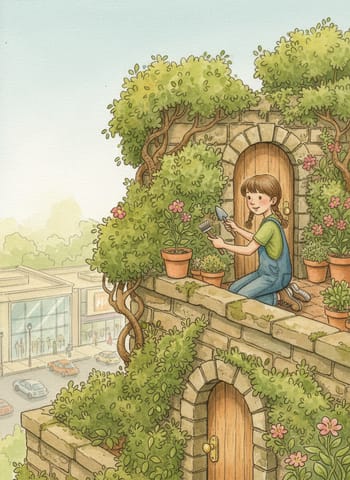
The Little Door in the Garden Wall
A free B2-level English story for language learners, readable online in 7 languages, with an option to listen via the free Storyteller app.
A volunteer on a shopping-centre roof tidies a wall so well that she hides the one thing the garden cannot live without.
That was the preview! Hear the full story in the free Storyteller app. Get the app
Audio isn't available right now.
The roof garden sits above the shopping centre like a green island that nobody has bothered to name. Down below, people queue for shoes and argue about parking. Up here, there are four long beds of herbs, a row of apple trees in barrels and a view of the car park.
Sunniva has volunteered here every Saturday since January. She is sixteen, and she is the youngest person on the team by about thirty years. Most weeks she waters the beds, pulls weeds and listens to the older volunteers disagree about compost.
This Saturday, though, she has a real job. Damir, who is nineteen and keeps the whole garden running, hands her a tin of cream paint and a wide brush.
"The back wall looks tired," he says. "Give it two coats, from the corner to the stairwell door. I have to fix the gutters on the other side, so you are on your own."
"On my own?" Sunniva says. "What if I do it wrong?"
"It is a wall," Damir says. "The worst thing you can do is leave a drip."
He leaves, and the roof falls quiet except for the hum of the air vents. Sunniva lays newspaper along the bottom of the wall and begins.
Painting turns out to be more peaceful than she expected. The brush moves in long strokes, and the old grey disappears a metre at a time. She likes the way a flaw vanishes the moment she covers it. A crack, a stain, a patch where someone once taped up a poster: all of it becomes smooth and cream.
Halfway along the wall, at the height of her knee, she finds a very small door. It is made of metal and is about the size of a large book. Its hinges are clogged with so many old coats of paint that the edges have nearly melted into the brick.
Sunniva crouches and studies it. There is no handle, only a little dent where a handle used to be. Nobody has mentioned this door in five months of Saturdays. She decides it must be a leftover from some old plan, a decoration that never found its purpose.
A thin gap runs around the frame, dark and untidy against the new cream. It bothers her more than it should. She finds a tube of filler in the toolbox, presses a neat line of it into the gap and smooths it with her thumb. Then she paints over the door itself, twice, until the whole wall is one clean surface.
When she steps back, she can hardly tell where the door begins. She feels the small, private pride of someone who has made a problem disappear.
Damir returns at four o'clock, wiping his hands on his trousers. He stops in front of the wall and whistles.
"That looks like a different building," he says. "Honestly, Sunniva, I thought you would leave stripes."
"I was careful," she says, and she smiles for the first time all day.
They spend the next hour tying up the tomato plants, and Damir talks while they work. He explains that the sprinklers come on at five, because the beds dry out fastest on Saturday evenings. A pump in the basement sends water up through a long pipe, and a single valve controls the whole system.
"That valve is the only thing that really matters up here," he says. "If it stays shut, the garden is just a field of expensive sticks. I open it by hand every Saturday before the timer starts. The hatch is in the back wall, about knee height. You cannot miss it."
Sunniva stops with a tomato stem in her fingers. A cold feeling begins in her stomach and spreads outward.
"Is it a metal door?" she asks. "About this big?"
Damir looks at her. Then he looks at the wall, and his face changes slowly, the way a window changes when someone draws the curtains.
"Please tell me you did not paint the hatch," he says.
Sunniva has about two seconds to decide what kind of person she is going to be. The excuses are already lined up in her head, and every one of them is true. Nobody told her. There was no label. It looked like decoration. She notices that none of them will get the water moving.
"I did," she says. "I filled the gap around it, and I painted it twice. I thought it was decoration. I am sorry."
Damir closes his eyes for a moment. When he opens them, he checks his phone, and she sees him doing the arithmetic.
"It is ten to five," he says. "If the pump starts against a closed valve, it could burn out. And the new seedlings will not last the night without water. Come on."
They kneel in front of the wall together. In the afternoon light the paint looks perfect, which is the worst part. The door has vanished so completely that Damir has to feel along the bricks with his fingers to find it.
He hands her a craft knife. "Score the line first," he says. "Gently, as if you are drawing, not cutting. If you slip, you will tear the paint off the whole panel."
Her hand shakes at first. Then she remembers how steady the brush felt, and she lets the blade follow the same patient line. The paint cracks in a thin, dark outline. The filler crumbles in small white pieces, like old plaster. Damir slides a flat screwdriver into the corner and leans on it.
For a moment nothing happens. Then the little door gives way with a squeal that echoes across the roof. A breath of cool, damp air comes out of the dark. Inside, she can see a pipe as thick as her arm and a valve with a yellow handle.
"Your turn," Damir says. "It is stiff. Use both hands."
She grips the handle and pulls with all her weight. It moves a quarter turn, then a half, and somewhere below her feet a pump wakes up with a long, low groan. Along the beds, the hoses swell like sleeping snakes. At exactly five o'clock, the sprinklers cough once and then throw a silver fan of water across the herbs.
Neither of them speaks for a while. Damir sits down on an upturned bucket and laughs quietly, mostly with relief.
"For the record," he says, "I should have shown you the hatch this morning. I assumed you knew. Everyone who has ever worked here knows it, so I forgot that you had to learn it too."
"I should have asked," Sunniva says. "I saw a door that nobody had ever explained to me, and I decided it was not important."
"That is a very human mistake," Damir says. "Most people only learn what a thing is for after they have covered it up."
She looks at the wall. The cream paint is now scarred with a rough rectangle, and the cut lines run across her careful work like cracks in a mirror. A few hours ago she would have wanted to hide that damage as well. Now she finds that she does not mind it. The scar tells the truth about what the wall contains.
"Do I have to paint it again?" she asks.
"Yes, but not the same way," Damir says. He picks up the tin of blue paint that has been standing by the stairs since March. "Let us make the door impossible to forget."
Sunniva takes the thin brush from the toolbox. She wipes a stray drip from the frame with her thumb, dips the bristles into the blue and starts with the hinges.