The Repair Café
A free B2-level English story for language learners, readable online in 4 languages, with an option to listen via the free Storyteller app.
At a monthly repair café, two competitive volunteers must cooperate to bring an old woman's silent radio back to life.
That was the preview! Hear the full story in the free Storyteller app. Get the app
Audio isn't available right now.
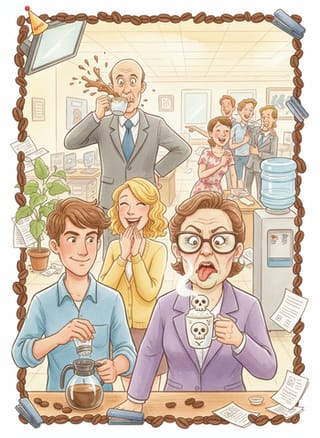
On the first Saturday of every month, the church hall smells of solder, coffee and warm dust. This is the repair café. Anyone can bring a broken lamp, a stuck zipper or a toaster that has given up. One of a dozen volunteers will try to bring it back to life for free.
Dominika, who coordinates the volunteers, has learned that the real work isn't fixing things. It is managing the two retired men at the corner table: a former electrician and a former watchmaker. Each is convinced that he is the fastest repairer in the building. A small chalkboard on the wall, which nobody admits to having started, keeps the score.
This morning the board reads: Toaster, 11 minutes (electrician). Wristwatch, 9 minutes (watchmaker). Both men glance at it whenever a new customer sits down, the way people glance at a mirror.
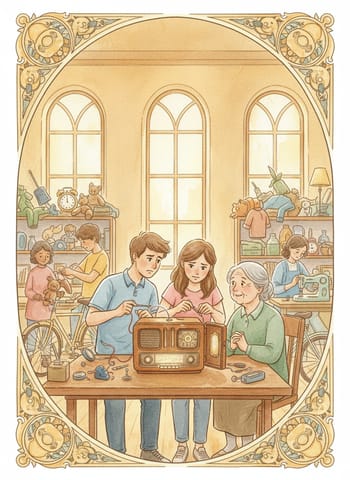
At ten o'clock, an old woman called Johanna comes in, holding a wooden radio against her chest as if it were a cat. It is the size of a bread box, with a cloth front and a dial that was once lit from behind. "It was my husband's," she says. "He listened to the evening concert on it for forty years. It has been silent since he died."
The electrician reaches for it first. "Dead capacitor," he announces after thirty seconds, with the confidence of a man who has already pressed his stopwatch. "Twenty minutes, maximum."
"The dial cord has snapped," the watchmaker says at the same moment, leaning over. "It wouldn't turn even if the power were on."
They look at each other. Johanna looks from one to the other, as though she has wandered into a sport she doesn't know.
Dominika has been watching from behind the tea urn. She knows exactly what will happen. The electrician will fix the sound, the watchmaker will fix the dial, and each will claim the radio as his own victory. Worse, it would be returned to its owner only half repaired.
"Gentlemen," she says, and sets a third chair at their table. "I am changing the rules. This repair gets one score on the board, and it is shared."
They grumble. Neither refuses.
For an hour, the corner table is almost silent. The electrician replaces a small capacitor, tests the wiring with a probe and mutters about the quality of old solder. The watchmaker threads a new cord around the pulley with tweezers, his tongue between his teeth, and loops it three times before it holds. Occasionally one of them says "Hold this," and the other holds it.
Johanna drinks her tea and says nothing. Once she reaches out and touches the wood of the radio, then takes her hand back.
At twenty to twelve, the electrician switches it on. A hum, then a crackle, then a thin strip of light behind the dial. The watchmaker turns the knob slowly, and the needle slides across the numbers like a swimmer. A voice appears, murmuring through the static, and then a few bars of piano, faint but clear.
The two men sit back at exactly the same moment. Neither says a word.
Johanna presses a hand to her mouth. "That's the one," she says. "That's his concert." She thanks them both and, after some thought, shakes hands with each of them in turn.
When she has gone, Dominika walks to the chalkboard, picks up the chalk and writes: Radio, 1 hour 40 minutes (both). Behind her, the electrician and the watchmaker pretend not to read it.