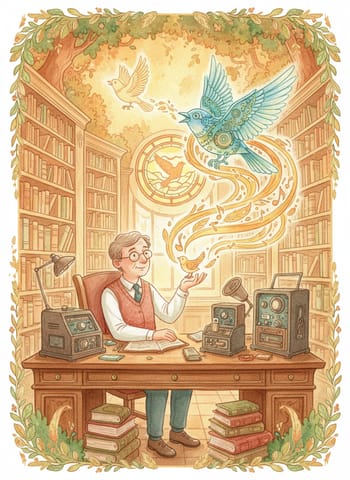
The Reconstructed Birdsong
A free C1-level English story for language learners, readable online in 4 languages, with an option to listen via the free Storyteller app.
An archivist must decide how to label an AI-built song for a bird that no one has heard for forty years.
That was the preview! Hear the full story in the free Storyteller app. Get the app
Audio isn't available right now.
Meike has eleven recordings of the glass-throated reedfinch and no way to make them into one. The longest runs four seconds. The shortest is a single note, caught by accident on a tape meant for frogs. The bird has been extinct for forty years. Meike's job at the sound archive is to give each fragment a number, a date and a microphone, and then to file it in a database that stands in for a shelf.
On Monday the lab upstairs sends her a file. Zuzana, the engineer who leads the project, has trained a model on the eleven fragments and on the songs of the bird's closest living relatives. The result, according to the cover note, is "a plausible full song." It lasts forty-one seconds. Meike listens through headphones with her eyes closed, and by the third phrase she has stopped breathing. It is exactly what she has imagined for twenty years: a rising run of notes, a pause like a held door, a falling answer.
What unsettles her is how little it unsettles her. Nothing in it sounds invented.
"Would it fool you?" Zuzana asks over the phone, hopeful and a little out of breath. "Be honest."
"It would fool anyone. That's not the same as being right."
"Every fragment we have is in there. The model only fills the gaps."
"Between what and what?" Meike says. "Four seconds is a fact. Forty-one seconds is a very elaborate opinion."
There is a short silence on the line. Then Zuzana, more gently than Meike expected, explains what the museum wants: a species page with a sound on it, something a schoolchild can press and hear. Nobody, she says, wants to press a button and get four seconds of hiss and a squeak. She does not say that the funding review is in March. She does not need to.
Meike takes off the headphones and sits for a while with the file open on the screen. Rarely has she cared this much about a single word on a form. The archive's record has a field called Type, and the menu beside it offers two choices, and the distance between them is the whole of her profession. Had anyone been listening properly in that marsh, with a good microphone and a little luck, the bird might have given them the entire song. Then she would not be having this conversation. But nobody was, and the song that exists now exists because someone upstairs was patient and clever and kind.
It would be easy to hate the file. She finds she cannot. It is an act of love, she thinks, performed by something that has never loved anything, and both halves of that sentence are true.
She selects Reconstruction. In the notes field she types the number of source fragments, their total length in seconds, the date of the training run, and the name of the model, which takes longer than the rest. Then she types, in a smaller line underneath, a sentence about what the file cannot tell us. She saves the record and sits back.
The evening cleaner has reached her door with his cart. He stops, one hand on the bin, head tilted toward the speakers she has forgotten to turn off.
"Is that the real one?" he asks.
"Part of it," Meike says, and turns the volume up for him.