The Locked Password Vault
Uma história gratuita em inglês de nível B2 para estudantes, para ler online em 4 idiomas, com opção de ouvir no app gratuito Storyteller.
After her uncle's death, Francesca works out the master password to the family's locked digital vault from his habits, his jokes and an unfinished crossword.
Essa foi a prévia! Ouça a história completa no app gratuito Storyteller. Baixar o app
O áudio não está disponível no momento.
Three weeks after the funeral, the family still could not open her uncle's password vault. It held everything: the bank accounts, the insurance papers, forty years of photographs and the code for the garden shed. And it sat behind a single master password, which nobody had.
Três semanas depois do funeral, a família ainda não conseguia abrir o cofre de senhas do tio. Ali havia tudo: as contas bancárias, os papéis do seguro, quarenta anos de fotografias e o código do galpão do jardim. E tudo ficava atrás de uma única senha mestra, que ninguém tinha.
They had tried the obvious things. His birthday, in every format. His street. The name of his old dog. Each attempt had been answered by the vault's built-in assistant, a small, patient voice that said only, "That was not correct." On Sunday it added: "Two attempts remain before a seven-day lock."
Tinham tentado o óbvio. O aniversário dele, em todos os formatos. A rua. O nome do velho cachorro. Cada tentativa fora respondida pelo assistente embutido do cofre, uma vozinha paciente que dizia apenas: "Isso não estava correto." No domingo, acrescentou: "Restam duas tentativas antes de um bloqueio de sete dias."
Francesca took the laptop home that night. She did not want to guess. Her uncle had been a careful man with a mischievous streak. He must have chosen something he could never forget and nobody else would think of.
Francesca levou o notebook para casa naquela noite. Não queria adivinhar. O tio fora um homem cuidadoso, com um toque travesso. Devia ter escolhido algo que jamais pudesse esquecer e que mais ninguém pensaria.
She started with his habits. He had ended every phone call with the same words, "Still upright, thank you," whatever he was asked. He had said it even when he had a cold. She wrote the phrase on a sticky note.
Começou pelos hábitos dele. Ele terminava todo telefonema com as mesmas palavras, "Ainda de pé, obrigado", fosse o que fosse que lhe perguntassem. Dizia até quando estava resfriado. Ela escreveu a frase num post-it.
Next came his jokes. Every year he had planted tomatoes, and every year he had claimed they were a gift for the neighbors' squirrels. He had also insisted that a good password needed a number, "so the computer feels respected."
Depois vieram as piadas. Todo ano ele plantava tomates, e todo ano alegava que eram um presente para os esquilos dos vizinhos. Também insistia que uma boa senha precisava de um número, "para o computador se sentir respeitado".
That still was not enough. A phrase and a vegetable could not make a lock. She needed the number.
Ainda não bastava. Uma frase e um legume não faziam uma fechadura. Ela precisava do número.
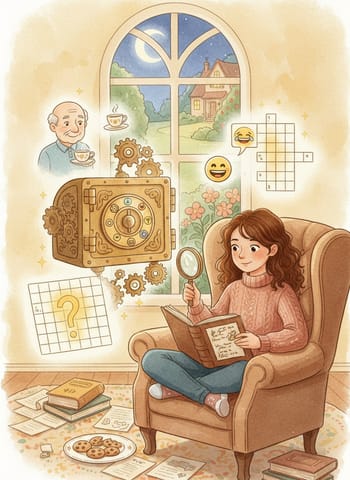
On the desk, under the reading lamp, she found the Sunday crossword. It was half finished, in ink. His handwriting was neat until the middle of the grid, where it grew smaller, as if he had been tired. One clue had been circled twice: 23-down, "Red fruit often eaten as a vegetable, eight letters." The squares were empty.
Na escrivaninha, sob a luminária de leitura, encontrou a cruzadinha de domingo. Estava pela metade, a caneta. A letra dele era caprichada até o meio da grade, onde ficava menor, como se estivesse cansado. Uma dica fora circulada duas vezes: 23 vertical, "Fruta vermelha muitas vezes comida como legume, oito letras". Os quadradinhos estavam vazios.
Why circle something so easy? He would never have left an easy clue blank by accident. Unless the circle was not about the answer at all, but about the number.
Por que circular algo tão fácil? Ele jamais deixaria uma dica fácil em branco por acidente. A não ser que o círculo não fosse sobre a resposta, e sim sobre o número.
She wrote out the three pieces: the phrase, the tomatoes, the 23. Then she tried to imagine him putting them together. Her aunt was watching from the sofa with a plate of cake.
Ela escreveu as três peças: a frase, os tomates, o 23. Depois tentou imaginá-lo juntando tudo. A tia a observava do sofá, com um prato de bolo.
"He always put the joke first and the number last," Francesca told her. "I'm nearly sure of it."
"Ele sempre punha a piada primeiro e o número por último", disse Francesca. "Tenho quase certeza."
Her aunt shrugged. "If it were my vault, I would have used something simple."
A tia deu de ombros. "Se fosse o meu cofre, eu teria usado algo simples."
"That's the difference. He would never use something simple. He would use something that belonged to us."
"Essa é a diferença. Ele nunca usaria algo simples. Usaria algo que pertencesse a nós."
The cursor blinked in the empty box. After this try, one attempt would remain. She typed "StillUpright-Tomatoes-23" and pressed enter before she could hesitate.
O cursor piscava na caixa vazia. Depois desta tentativa, restaria uma. Ela digitou "StillUpright-Tomatoes-23" e apertou enter antes que pudesse hesitar.
For a second, nothing happened. Then the screen brightened, and the small voice said, "That was correct. Welcome."
Por um segundo, nada aconteceu. Então a tela clareou, e a vozinha disse: "Isso estava correto. Bem-vinda."
The first folder was named "For whoever gets here." Inside was a single text file. Her aunt put down her cake and leaned over her shoulder. They read it together: "If you are reading this, it took you long enough. The tomatoes were for you, not the squirrels. The shed code is 1234, and I am not proud of it."
A primeira pasta se chamava "Para quem chegar até aqui". Dentro havia um único arquivo de texto. A tia pousou o bolo e se debruçou sobre o ombro dela. Leram juntas: "Se você está lendo isto, demorou bastante. Os tomates eram para vocês, não para os esquilos. O código do galpão é 1234, e não tenho orgulho disso."
Her aunt laughed so hard that she had to hold the arm of the sofa. "That is him," she said. "That is exactly him."
A tia riu tanto que precisou se segurar no braço do sofá. "É ele", disse. "É exatamente ele."