The Bell-Deep
A free C1-level English story for language learners, readable online in 7 languages, with an option to listen via the free Storyteller app.
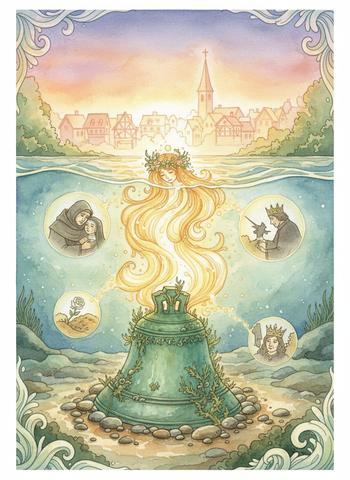
In the depths of the Odense-Au a sunken church bell talks each night with the river's water-spirit, retelling the town's darkest secrets — a monk's forbidden love, a buried nun, and the murder of a king.
"Ding-dong! ding-dong!" It sounds up from the "bell-deep" in the Odense-Au. Every child in the old town of Odense, on the island of Funen, knows the Au, which washes the gardens round about the town, and flows on under the wooden bridges from the dam to the water-mill.
"Blem-blem! blem-blem!" O som sobe do "poço do sino" no Odense-Au. Toda criança na velha cidade de Odense, na ilha de Funen, conhece o Au, que banha os jardins ao redor da cidade, e corre por baixo das pontes de madeira, desde a represa até o moinho d'água.
In the Au grow the yellow water-lilies and brown feathery reeds; the dark velvety flag grows there, high and thick; old and decayed willows, slanting and tottering, hang far out over the stream beside the monk's meadow and by the bleaching ground; but opposite there are gardens upon gardens, each different from the rest, some with pretty flowers and bowers like little dolls' pleasure grounds, often displaying cabbage and other kitchen plants; and here and there the gardens cannot be seen at all, for the great elder trees that spread themselves out by the bank, and hang far out over the streaming waters, which are deeper here and there than an oar can fathom.
No Au crescem os lírios-d'água amarelos e os juncos plumosos e castanhos; a taboa escura e aveludada cresce ali, alta e densa; velhos salgueiros apodrecidos, inclinados e cambaleantes, pendem bem para fora sobre o riacho, junto ao prado do monge e junto ao terreno de branqueamento; mas do outro lado há jardins e mais jardins, cada um diferente do outro, alguns com belas flores e caramanchões, feito pequenos jardins de recreio de bonecas, muitas vezes exibindo couves e outras hortaliças; e aqui e ali os jardins não podem ser vistos de jeito nenhum, por causa dos grandes sabugueiros que se espalham pela margem, e pendem bem para fora sobre as águas correntes, que aqui e ali são mais profundas do que um remo consegue alcançar o fundo.
Opposite the old nunnery is the deepest place, which is called the "bell-deep," and there dwells the old water spirit, the "Au-mann." This spirit sleeps through the day while the sun shines down upon the water; but in starry and moonlit nights he shows himself. He is very old.
Diante do antigo convento de freiras está o lugar mais profundo, chamado o "poço do sino," e ali vive o velho espírito das águas, o "Au-mann." Esse espírito dorme durante o dia, enquanto o sol brilha sobre a água; mas em noites estreladas e enluaradas ele se mostra. Ele é muito velho.
Grandmother says that she has heard her own grandmother tell of him; he is said to lead a solitary life, and to have nobody with whom he can converse save the great old church Bell. Once the Bell hung in the church tower; but now there is no trace left of the tower or of the church, which was called St. Alban's.
A avó diz que ouviu sua própria avó falar dele; dizem que ele leva uma vida solitária, e que não tem ninguém com quem possa conversar, a não ser o grande e antigo Sino da igreja. Antigamente o Sino ficava pendurado na torre da igreja; mas agora não resta nenhum vestígio da torre nem da igreja, que se chamava Santo Albano.
"Ding-dong! ding-dong!" sounded the Bell, when the tower still stood there; and one evening, while the sun was setting, and the Bell was swinging away bravely, it broke loose and came flying down through the air, the brilliant metal shining in the ruddy beam.
"Blem-blem! blem-blem!" soava o Sino, quando a torre ainda estava de pé; e certa noite, enquanto o sol se punha, e o Sino balançava bravamente, ele se soltou e veio voando pelos ares, o metal brilhante reluzindo no raio avermelhado.
"Ding-dong! ding-dong! Now I'll retire to rest!" sang the Bell, and flew down into the Odense-Au, where it is deepest; and that is why the place is called the "bell-deep."
"Blem-blem! blem-blem! Agora vou me recolher para descansar!" cantou o Sino, e voou para dentro do Odense-Au, no lugar mais profundo; e é por isso que o lugar se chama o "poço do sino."
But the Bell got neither rest nor sleep. Down in the Au-mann's haunt it sounds and rings, so that the tones sometimes pierce upward through the waters; and many people maintain that its strains forebode the death of some one; but that is not true, for the Bell is only talking with the Au-mann, who is now no longer alone.
Mas o Sino não teve descanso nem sono. Lá embaixo, no covil do Au-mann, ele soa e retine, de modo que às vezes seus tons atravessam para cima pelas águas; e muita gente afirma que seu som prenuncia a morte de alguém; mas isso não é verdade, pois o Sino apenas conversa com o Au-mann, que agora já não está mais sozinho.
And what is the Bell telling? It is old, very old, as we have already observed; it was there long before grandmother's grandmother was born; and yet it is but a child in comparison with the Au-mann, who is quite an old quiet personage, an oddity, with his hose of eel-skin, and his scaly Jacket with the yellow lilies for buttons, and a wreath of reed in his hair and seaweed in his beard; but he looks very pretty for all that.
E o que o Sino conta? Ele é velho, muito velho, como já observamos; ele já estava ali muito antes de a avó da avó ter nascido; e ainda assim é apenas uma criança em comparação com o Au-mann, que é um personagem bem velho e quieto, uma figura peculiar, com suas calças de pele de enguia, e sua jaqueta escamosa com lírios amarelos como botões, e uma coroa de junco no cabelo e alga na barba; mas, mesmo assim, ele parece bem bonito.
What the Bell tells? To repeat it all would require years and days; for year by year it is telling the old stories, sometimes short ones, sometimes long ones, according to its whim; it tells of old times, of the dark hard times, thus:
O que o Sino conta? Repetir tudo levaria anos e dias; pois ano após ano ele conta as velhas histórias, às vezes curtas, às vezes longas, conforme seu capricho; ele conta sobre os tempos antigos, os tempos sombrios e duros, assim:
"In the church of St. Alban, the monk had mounted up into the tower. He was young and handsome, but thoughtful exceedingly. He looked through the loophole out upon the Odense-Au, when the bed of the water was yet broad, and the monks' meadow was still a lake. He looked out over it, and over the rampart, and over the nuns' hill opposite, where the convent lay, and the light gleamed forth from the nun's cell. He had known the nun right well, and he thought of her, and his heart beat quicker as he thought. Ding-dong! ding-dong!"
"Na igreja de Santo Albano, o monge tinha subido até a torre. Ele era jovem e bonito, mas extremamente pensativo. Ele olhava pela fresta para o Odense-Au, quando o leito das águas ainda era largo, e o prado dos monges ainda era um lago. Ele olhava para ele, e para o muralha, e para a colina das freiras em frente, onde ficava o convento, e a luz brilhava vindo da cela da freira. Ele conhecia muito bem a freira, e pensava nela, e seu coração batia mais rápido enquanto pensava. Blem-blem! blem-blem!"
Yes, this was the story the Bell told.
Sim, essa era a história que o Sino contava.
"Into the tower came also the dapper man-servant of the bishop; and when I, the Bell, who am made of metal, rang hard and loud, and swung to and fro, I might have beaten out his brains. He sat down close under me, and played with two little sticks as if they had been a stringed instrument; and he sang to it.
"Também subiu à torre o elegante criado do bispo; e quando eu, o Sino, que sou feito de metal, tocava forte e alto, e balançava para lá e para cá, eu poderia ter estourado os miolos dele. Ele se sentava bem debaixo de mim, e brincava com dois pequenos gravetos como se fossem um instrumento de cordas; e cantava com eles.
"'Now I may sing it out aloud, though at other times I may not whisper it. I may sing of everything that is kept concealed behind lock and bars. Yonder it is cold and wet. The rats are eating her up alive! Nobody knows of it! Nobody hears of it! Not even now, for the bell is ringing and singing its loud Ding-dong, ding-dong!'
"'Agora posso cantar em voz alta, embora em outras ocasiões eu não possa nem sussurrar. Posso cantar sobre tudo o que fica escondido atrás de trancas e grades. Ali é frio e úmido. Os ratos estão comendo ela viva! Ninguém sabe disso! Ninguém ouve falar disso! Nem mesmo agora, pois o sino está tocando e cantando seu forte Blem-blem, blem-blem!'
"There was a King in those days. They called him Canute. He bowed himself before bishop and monk; but when he offended the free peasants with heavy taxes and hard words, they seized their weapons and put him to flight like a wild beast. He sought shelter in the church, and shut gate and door behind him. The violent band surrounded the church; I heard tell of it. The crows, ravens and magpies started up in terror at the yelling and shouting that sounded around. They flew into the tower and out again, they looked down upon the throng below, and they also looked into the windows of the church, and screamed out aloud what they saw there.
"Havia um Rei naqueles dias. Chamavam-no Canuto. Ele se curvava diante do bispo e do monge; mas quando ofendeu os camponeses livres com impostos pesados e palavras duras, eles pegaram suas armas e o puseram em fuga como um animal selvagem. Ele buscou abrigo na igreja, e fechou o portão e a porta atrás de si. A horda violenta cercou a igreja; eu ouvi falar disso. Os corvos, gralhas e pegas se assustaram com os gritos e berros que soavam ao redor. Voaram para dentro da torre e para fora de novo, olharam para baixo para a multidão embaixo, e também olharam pelas janelas da igreja, e gritaram alto o que viram ali.
"King Canute knelt before the altar in prayer; his brothers Eric and Benedict stood by him as a guard with drawn swords; but the King's servant, the treacherous Blake, betrayed his master. The throng in front of the church knew where they could hit the King, and one of them flung a stone through a pane of glass, and the King lay there dead! The cries and screams of the savage horde and of the birds sounded through the air, and I joined in it also; for I sang 'Ding-dong! ding-dong!'
"O Rei Canuto ajoelhou-se diante do altar em oração; seus irmãos Erico e Bento estavam junto dele como guarda, com espadas desembainhadas; mas o servo do Rei, o traiçoeiro Blake, traiu seu senhor. A multidão em frente da igreja sabia onde podia atingir o Rei, e um deles atirou uma pedra através de uma vidraça, e o Rei caiu ali morto! Os gritos e berros da horda selvagem e dos pássaros ecoaram pelo ar, e eu também me juntei a eles; pois cantei 'Blem-blem! blem-blem!'
"The church bell hangs high, and looks far around, and sees the birds around it, and understands their language. The wind roars in upon it through windows and loopholes; and the wind knows everything, for he gets it from the air, which encircles all things, and the church bell understands his tongue, and rings it out into the world, 'Ding-dong! ding-dong!'
"O sino da igreja fica pendurado bem alto, e enxerga bem longe ao redor, e vê os pássaros à sua volta, e entende a linguagem deles. O vento ruge sobre ele através de janelas e frestas; e o vento sabe tudo, pois ele o pega do ar, que envolve todas as coisas, e o sino da igreja entende a sua língua, e a espalha pelo mundo, 'Blem-blem! blem-blem!'
"But it was too much for me to hear and to know; I was not able any longer to ring it out. I became so tired, so heavy, that the beam broke, and I flew out into the gleaming Au, where the water is deepest, and where the Au-mann lives, solitary and alone; and year by year I tell him what I have heard and what I know. Ding-dong! ding-dong!"
"Mas era demais para mim ouvir e saber; eu não conseguia mais tocar. Fiquei tão cansado, tão pesado, que a viga se quebrou, e eu voei para dentro do Au brilhante, onde a água é mais funda, e onde vive o Au-mann, solitário e sozinho; e ano após ano eu conto a ele o que ouvi e o que sei. Blem-blem! blem-blem!"
Thus it sounds complainingly out of the bell-deep in the Odense-Au. That is what grandmother told us.
Assim soa, como um lamento, vindo do poço do sino no Odense-Au. Foi isso que a avó nos contou.
But the schoolmaster says that there was not any bell that rung down there, for that it could not do so; and that no Au-mann dwelt yonder, for there was no Au-mann at all! And when all the other church bells are sounding sweetly, he says that it is not really the bells that are sounding, but that it is the air itself which sends forth the notes; and grandmother said to us that the Bell itself said it was the air who told it to him, consequently they are agreed on that point, and this much is sure.
Mas o mestre-escola diz que não havia sino nenhum tocando lá embaixo, pois isso não seria possível; e que nenhum Au-mann morava ali, pois não existia Au-mann nenhum! E quando todos os outros sinos de igreja soam suavemente, ele diz que não são realmente os sinos que soam, mas sim o próprio ar que emite as notas; e a avó nos disse que o próprio Sino dizia que era o ar que lhe contava aquilo, portanto os dois concordam nesse ponto, e isso, ao menos, é certo.
"Be cautious, cautious, and take good heed to thyself," they both say.
"Sejam cautelosos, cautelosos, e cuidem bem de si mesmos," dizem os dois.
The air knows everything. It is around us, it is in us, it talks of our thoughts and of our deeds, and it speaks longer of them than does the Bell down in the depths of the Odense-Au where the Au-mann dwells. It rings it out in the vault of heaven, far, far out, forever and ever, till the heaven bells sound "Ding-dong! ding-dong!"
O ar sabe tudo. Ele está ao nosso redor, está dentro de nós, ele fala dos nossos pensamentos e dos nossos atos, e fala deles por mais tempo do que o Sino lá no fundo do Odense-Au, onde o Au-mann vive. Ele o espalha pela abóbada do céu, para bem, bem longe, para todo o sempre, até que os sinos do céu soem "Blem-blem! blem-blem!"
