The Back Booth
Uma história gratuita em inglês de nível C1 para estudantes, para ler online em 4 idiomas, com opção de ouvir no app gratuito Storyteller.
Taking over her late mother's diner, Odessa finds an old note revealing her mother nearly sold it the year she was born.
Essa foi a prévia! Ouça a história completa no app gratuito Storyteller. Baixar o app
O áudio não está disponível no momento.
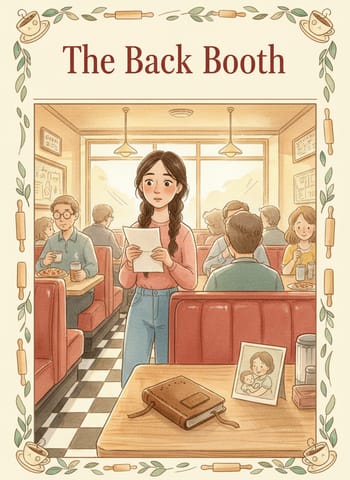
Odessa was thirty-four the week she finally agreed to take over the diner, a decision everyone in her family treated as inevitable, though nobody could say exactly when she had agreed to it.
Odessa tinha trinta e quatro anos na semana em que finalmente concordou em assumir a lanchonete, uma decisão que toda a família tratava como inevitável, embora ninguém soubesse dizer exatamente quando ela havia concordado com isso.
She had grown up in the back booth doing homework while her mother, Imogen, ran the register, the till, and every crisis the kitchen produced, seemingly without effort. The plan, as far as Odessa understood it, had always been quiet and unspoken: the diner would pass to her the way it had passed to Imogen, and to Imogen's mother before that.
Ela tinha crescido na cabine do fundo fazendo lição de casa enquanto sua mãe, Imogen, cuidava do caixa, do troco e de todas as crises que a cozinha produzia, aparentemente sem esforço. O plano, pelo que Odessa entendia, sempre tinha sido silencioso e não dito: a lanchonete passaria para ela do jeito que tinha passado para Imogen, e para a mãe de Imogen antes disso.
It was while clearing out the office, three months after the funeral, that Odessa found the note, folded small inside an old bank ledger from the year she was born.
Foi enquanto esvaziava o escritório, três meses depois do funeral, que Odessa encontrou o bilhete, dobrado pequeno dentro de um antigo livro-caixa do ano em que ela nasceu.
Considering selling. Baby due in six weeks. Can't keep doing both, it read, in her mother's unmistakable handwriting, dated a full year before Odessa had any memory of the place existing at all.
"Pensando em vender. Bebê nascendo em seis semanas. Não consigo fazer as duas coisas", dizia, na letra inconfundível de sua mãe, datado um ano inteiro antes de Odessa ter qualquer lembrança de o lugar sequer existir.
Standing in the office with the ledger open in her hands, Odessa realized something startling. Had that sale gone through, she would have grown up somewhere else entirely, doing something else entirely, with a mother who might have been less exhausted and, perhaps, considerably happier.
De pé no escritório com o livro-caixa aberto nas mãos, Odessa percebeu algo surpreendente. Se aquela venda tivesse acontecido, ela teria crescido em outro lugar completamente diferente, fazendo algo completamente diferente, com uma mãe que talvez estivesse menos exausta e, quem sabe, consideravelmente mais feliz.
She had spent her whole life assuming the diner was simply what her mother wanted, a calling rather than a burden quietly carried for thirty-four years past the point where it might reasonably have ended. The note complicated that story in a way Odessa was not prepared for.
Ela tinha passado a vida inteira presumindo que a lanchonete era simplesmente o que a mãe queria, uma vocação, e não um fardo carregado em silêncio por trinta e quatro anos além do ponto em que razoavelmente poderia ter terminado. O bilhete complicava essa história de um jeito para o qual Odessa não estava preparada.
She called her aunt that evening, hoping for context, and got instead a long pause before an honest answer. "She almost did sell it," her aunt confirmed. "Your father talked her out of it. I never knew if that was the right call or not, and I don't think your mother ever fully decided either."
Ela ligou para a tia naquela noite, esperando algum contexto, e recebeu em vez disso uma longa pausa antes de uma resposta honesta. "Ela quase vendeu mesmo", confirmou a tia. "Seu pai a convenceu a não vender. Nunca soube se aquela foi a decisão certa ou não, e acho que sua mãe também nunca decidiu isso de verdade."
What Odessa had to sit with, in the weeks that followed, was a question with no comfortable answer. Was keeping the diner running, all these years, her mother's devotion, or simply the shape her life had taken once the harder choice went unmade?
O que Odessa teve que enfrentar, nas semanas seguintes, foi uma pergunta sem resposta confortável. Manter a lanchonete funcionando, todos esses anos, era devoção da mãe, ou simplesmente a forma que a vida dela tinha assumido depois que a escolha mais difícil ficou sem ser feita?
She thought about closing it herself, more seriously than she had let anyone know. She thought, too, about her own daughter, not yet born, and whether she wanted to hand down a business or finally hand down the choice her mother never quite got to make.
Ela pensou em fechar a lanchonete, mais a sério do que deixou qualquer pessoa saber. Pensou também na própria filha, ainda não nascida, e se queria passar adiante um negócio ou finalmente passar adiante a escolha que a mãe nunca chegou a fazer de verdade.
In the end, Odessa kept the diner open, but not, she told herself carefully, out of the same quiet inevitability that had carried her mother through three decades of it. She kept it because she chose to, actively. The note from the ledger stayed taped inside a drawer only she ever opened, a small private reminder that devotion and habit can look, from the outside, exactly the same.
No fim, Odessa manteve a lanchonete aberta, mas não, ela dizia a si mesma com cuidado, pela mesma inevitabilidade silenciosa que tinha carregado a mãe por três décadas. Ela a manteve porque escolheu, ativamente. O bilhete do livro-caixa ficou colado dentro de uma gaveta que só ela abria, um pequeno lembrete particular de que devoção e hábito podem parecer, de fora, exatamente a mesma coisa.