Hudden and Dudden and Donald O'Neary
A free B1-level English story for language learners, readable online in 7 languages, with an option to listen via the free Storyteller app.
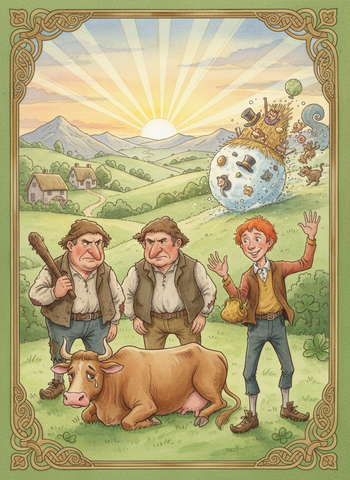
When two greedy farmers kill his only cow out of spite, poor Donald O'Neary turns the loss into a wild trick — one that keeps snowballing further than anyone expects.
There was once upon a time two farmers, and their names were Hudden and Dudden. They had poultry in their yards, sheep on the uplands, and scores of cattle in the meadow-land alongside the river. But for all that they weren't happy. For just between their two farms there lived a poor man by the name of Donald O'Neary. He had a hovel over his head and a strip of grass that was barely enough to keep his one cow, Daisy, from starving, and, though she did her best, it was but seldom that Donald got a drink of milk or a roll of butter from Daisy.
Era uma vez dois fazendeiros, e seus nomes eram Hudden e Dudden. Tinham aves em seus quintais, ovelhas nas terras altas, e dezenas de cabeças de gado no pasto ao longo do rio. Mas apesar de tudo isso não eram felizes. Pois bem entre as duas fazendas vivia um homem pobre chamado Donald O'Neary. Ele tinha um casebre sobre a cabeça e uma faixa de terra com grama mal suficiente para manter sua única vaca, Margarida, de morrer de fome, e, embora ela fizesse o possível, era raro que Donald conseguisse um copo de leite ou um pedaço de manteiga de Margarida.
You would think there was little here to make Hudden and Dudden jealous, but so it is, the more one has the more one wants, and Donald's neighbours lay awake of nights scheming how they might get hold of his little strip of grass-land. Daisy, poor thing, they never thought of; she was just a bag of bones.
Você pensaria que havia pouco aqui para deixar Hudden e Dudden com inveja, mas é assim mesmo, quanto mais se tem, mais se quer, e os vizinhos de Donald ficavam acordados à noite planejando como poderiam se apoderar de sua pequena faixa de terra de pasto. Em Margarida, coitada, eles nunca pensavam; ela era só um saco de ossos.
One day Hudden met Dudden, and they were soon grumbling as usual, and all to the tune of "If only we could get that vagabond Donald O'Neary out of the country."
Um dia Hudden encontrou Dudden, e logo estavam resmungando como sempre, e tudo na mesma toada de "Se ao menos pudéssemos tirar aquele vagabundo do Donald O'Neary daqui."
"Let's kill Daisy," said Hudden at last; "if that doesn't make him clear out, nothing will."
"Vamos matar a Margarida," disse Hudden por fim; "se isso não o fizer ir embora, nada vai fazer."
No sooner said than agreed, and it wasn't dark before Hudden and Dudden crept up to the little shed where lay poor Daisy trying her best to chew the cud, though she hadn't had as much grass in the day as would cover your hand. And when Donald came to see if Daisy was all snug for the night, the poor beast had only time to lick his hand once before she died.
Assim que foi dito, foi combinado, e não tinha escurecido ainda quando Hudden e Dudden se arrastaram até o pequeno galpão onde jazia a pobre Margarida, fazendo o possível para ruminar, embora não tivesse tido no dia grama suficiente para cobrir sua mão. E quando Donald foi ver se Margarida estava bem acomodada para a noite, o pobre animal só teve tempo de lamber sua mão uma vez antes de morrer.
Well, Donald was a shrewd fellow, and downhearted though he was, began to think if he could get any good out of Daisy's death. He thought and he thought, and the next day you could have seen him trudging off early to the fair, Daisy's hide over his shoulder, every penny he had jingling in his pockets. Just before he got to the fair, he made several slits in the hide, put a penny in each slit, walked into the best inn of the town as bold as if it belonged to him, and, hanging the hide up to a nail in the wall, sat down.
Bem, Donald era um sujeito astuto, e por mais desanimado que estivesse, começou a pensar se poderia tirar algum proveito da morte de Margarida. Ele pensou e pensou, e no dia seguinte você o teria visto seguindo cedo para a feira, o couro de Margarida sobre o ombro, cada moeda que tinha tilintando nos bolsos. Pouco antes de chegar à feira, ele fez vários cortes no couro, colocou uma moeda em cada corte, entrou na melhor estalagem da cidade tão confiante como se ela lhe pertencesse, e, pendurando o couro num prego na parede, sentou-se.
"Some of your best whisky," says he to the landlord.
"Do seu melhor uísque," disse ele ao estalajadeiro.
But the landlord didn't like his looks. "Is it fearing I won't pay you, you are?" says Donald; "why I have a hide here that gives me all the money I want." And with that he hit it a whack with his stick and out hopped a penny. The landlord opened his eyes, as you may fancy.
Mas o estalajadeiro não gostou da aparência dele. "É que teme que eu não vá pagar, não é?" disse Donald; "ora, tenho aqui um couro que me dá todo o dinheiro que quero." E com isso ele deu uma pancada nele com sua bengala e saltou uma moeda. O estalajadeiro arregalou os olhos, pode imaginar.
"What'll you take for that hide?"
"Quanto você quer por esse couro?"
"It's not for sale, my good man."
"Não está à venda, meu bom homem."
"Will you take a gold piece?"
"Aceita uma moeda de ouro?"
"It's not for sale, I tell you. Hasn't it kept me and mine for years?" and with that Donald hit the hide another whack and out jumped a second penny.
"Não está à venda, eu disse. Não tem me sustentado a mim e aos meus há anos?" e com isso Donald deu outra pancada no couro e saltou uma segunda moeda.
Well, the long and the short of it was that Donald let the hide go, and, that very evening, who but he should walk up to Hudden's door?
Bem, resumindo, Donald acabou deixando o couro ir, e, naquela mesma noite, quem foi que apareceu à porta de Hudden senão ele mesmo?
"Good-evening, Hudden. Will you lend me your best pair of scales?"
"Boa noite, Hudden. Você me empresta seu melhor par de balanças?"
Hudden stared and Hudden scratched his head, but he lent the scales.
Hudden ficou olhando e coçou a cabeça, mas emprestou as balanças.
When Donald was safe at home, he pulled out his pocketful of bright gold and began to weigh each piece in the scales. But Hudden had put a lump of butter at the bottom, and so the last piece of gold stuck fast to the scales when he took them back to Hudden.
Quando Donald estava seguro em casa, tirou o bolso cheio de ouro brilhante e começou a pesar cada peça nas balanças. Mas Hudden tinha colocado um pedaço de manteiga no fundo, e assim a última moeda de ouro ficou grudada nas balanças quando ele as devolveu a Hudden.
If Hudden had stared before, he stared ten times more now, and no sooner was Donald's back turned, than he was of as hard as he could pelt to Dudden's.
Se Hudden já tinha ficado olhando antes, agora ficou olhando dez vezes mais, e assim que Donald virou as costas, ele foi correndo o mais rápido que podia até a casa de Dudden.
"Good-evening, Dudden. That vagabond, bad luck to him—"
"Boa noite, Dudden. Aquele vagabundo, azar o dele—"
"You mean Donald O'Neary?"
"Você quer dizer Donald O'Neary?"
"And who else should I mean? He's back here weighing out sackfuls of gold."
"E quem mais eu poderia querer dizer? Ele está por lá pesando sacos e sacos de ouro."
"How do you know that?"
"Como você sabe disso?"
"Here are my scales that he borrowed, and here's a gold piece still sticking to them."
"Aqui estão minhas balanças que ele emprestou, e aqui está uma moeda de ouro ainda grudada nelas."
Off they went together, and they came to Donald's door. Donald had finished making the last pile of ten gold pieces. And he couldn't finish because a piece had stuck to the scales.
Foram juntos, e chegaram à porta de Donald. Donald tinha acabado de fazer a última pilha de dez moedas de ouro. E não conseguia terminar porque uma peça tinha grudado nas balanças.
In they walked without an "If you please" or "By your leave."
Entraram sem um "Com licença" ou "Se me permite."
"Well, I never!" that was all they could say.
"Bem, nunca vi tal coisa!" foi tudo o que conseguiram dizer.
"Good-evening, Hudden; good-evening, Dudden. Ah! you thought you had played me a fine trick, but you never did me a better turn in all your lives. When I found poor Daisy dead, I thought to myself, 'Well, her hide may fetch something;' and it did. Hides are worth their weight in gold in the market just now."
"Boa noite, Hudden; boa noite, Dudden. Ah! vocês pensaram que tinham me pregado uma bela peça, mas nunca me fizeram melhor favor em toda a vida de vocês. Quando encontrei a pobre Margarida morta, pensei comigo mesmo: 'Bem, o couro dela pode render alguma coisa;' e rendeu. Os couros valem seu peso em ouro no mercado nesta época."
Hudden nudged Dudden, and Dudden winked at Hudden.
Hudden cutucou Dudden, e Dudden piscou para Hudden.
"Good-evening, Donald O'Neary."
"Boa noite, Donald O'Neary."
"Good-evening, kind friends."
"Boa noite, bons amigos."
The next day there wasn't a cow or a calf that belonged to Hudden or Dudden but her hide was going to the fair in Hudden's biggest cart drawn by Dudden's strongest pair of horses.
No dia seguinte não havia vaca nem bezerro que pertencesse a Hudden ou Dudden cujo couro não estivesse indo para a feira na maior carroça de Hudden, puxada pelo par de cavalos mais fortes de Dudden.
When they came to the fair, each one took a hide over his arm, and there they were walking through the fair, bawling out at the top of their voices: "Hides to sell! hides to sell!"
Quando chegaram à feira, cada um pegou um couro no braço, e lá estavam eles caminhando pela feira, gritando no topo de suas vozes: "Couros à venda! couros à venda!"
Out came the tanner:
Saiu o curtidor:
"How much for your hides, my good men?"
"Quanto por seus couros, meus bons homens?"
"Their weight in gold."
"O peso deles em ouro."
"It's early in the day to come out of the tavern."
"É cedo demais para sair da taverna."
That was all the tanner said, and back he went to his yard.
Foi só isso que o curtidor disse, e voltou para seu quintal.
"Hides to sell! Fine fresh hides to sell!"
"Couros à venda! Belos couros frescos à venda!"
Out came the cobbler.
Saiu o sapateiro.
"How much for your hides, my men?"
"Quanto por seus couros, homens?"
"Their weight in gold."
"O peso deles em ouro."
"Is it making game of me you are! Take that for your pains," and the cobbler dealt Hudden a blow that made him stagger.
"Estão fazendo pouco de mim! Toma isso pelo incômodo," e o sapateiro deu em Hudden um soco que o fez cambalear.
Up the people came running from one end of the fair to the other. "What's the matter? What's the matter?" cried they.
As pessoas vieram correndo de uma ponta da feira à outra. "O que houve? O que houve?" gritavam elas.
"Here are a couple of vagabonds selling hides at their weight in gold," said the cobbler.
"Aqui estão dois vagabundos vendendo couros pelo peso em ouro," disse o sapateiro.
"Hold 'em fast; hold 'em fast!" bawled the innkeeper, who was the last to come up, he was so fat. "I'll wager it's one of the rogues who tricked me out of thirty gold pieces yesterday for a wretched hide."
"Segurem eles firme; segurem eles firme!" gritou o dono da estalagem, que foi o último a chegar, de tão gordo que era. "Aposto que é um daqueles velhacos que me enganaram em trinta moedas de ouro ontem por um couro miserável."
It was more kicks than halfpence that Hudden and Dudden got before they were well on their way home again, and they didn't run the slower because all the dogs of the town were at their heels.
Foram mais pontapés do que moedas o que Hudden e Dudden receberam antes de estarem bem no caminho de volta para casa, e não corriam mais devagar porque todos os cães da cidade estavam em seus calcanhares.
Well, as you may fancy, if they loved Donald little before, they loved him less now.
Bem, como você pode imaginar, se já gostavam pouco de Donald antes, gostavam menos ainda agora.
"What's the matter, friends?" said he, as he saw them tearing along, their hats knocked in, and their coats torn off, and their faces black and blue. "Is it fighting you've been? or mayhap you met the police, ill luck to them?"
"O que houve, amigos?" disse ele, ao vê-los correndo, os chapéus amassados, e os casacos rasgados, e os rostos roxos de tanto apanhar. "Andaram brigando? ou talvez encontraram a polícia, azar deles?"
"We'll police you, you vagabond. It's mighty smart you thought yourself, deluding us with your lying tales."
"Vamos te dar polícia, seu vagabundo. Você se achou muito esperto, nos enganando com suas histórias mentirosas."
"Who deluded you? Didn't you see the gold with your own two eyes?"
"Quem enganou vocês? Vocês não viram o ouro com seus próprios olhos?"
But it was no use talking. Pay for it he must, and should. There was a meal-sack handy, and into it Hudden and Dudden popped Donald O'Neary, tied him up tight, ran a pole through the knot, and off they started for the Brown Lake of the Bog, each with a pole-end on his shoulder, and Donald O'Neary between.
Mas não adiantava falar. Ele tinha que pagar por aquilo, e pagaria. Havia um saco de farinha à mão, e nele Hudden e Dudden enfiaram Donald O'Neary, amarraram-no bem apertado, passaram um mastro pelo nó, e partiram para o Lago Marrom do Pântano, cada um com uma ponta do mastro no ombro, e Donald O'Neary no meio.
But the Brown Lake was far, the road was dusty, Hudden and Dudden were sore and weary, and parched with thirst. There was an inn by the roadside.
Mas o Lago Marrom era longe, a estrada era empoeirada, Hudden e Dudden estavam doloridos e cansados, e ressecados de sede. Havia uma estalagem à beira da estrada.
"Let's go in," said Hudden; "I'm dead beat. It's heavy he is for the little he had to eat."
"Vamos entrar," disse Hudden; "estou exausto. Ele é pesado, para o pouco que comeu."
If Hudden was willing, so was Dudden. As for Donald, you may be sure his leave wasn't asked, but he was lumped down at the inn door for all the world as if he had been a sack of potatoes.
Se Hudden estava disposto, Dudden também estava. Quanto a Donald, você pode ter certeza de que sua permissão não foi pedida, mas ele foi largado na porta da estalagem como se fosse um saco de batatas.
"Sit still, you vagabond," said Dudden; "if we don't mind waiting, you needn't."
"Fique quieto, seu vagabundo," disse Dudden; "se nós não nos importamos de esperar, você também não precisa."
Donald held his peace, but after a while he heard the glasses clink, and Hudden singing away at the top of his voice.
Donald ficou calado, mas depois de um tempo ouviu os copos tilintando, e Hudden cantando no topo de sua voz.
"I won't have her, I tell you; I won't have her!" said Donald. But nobody heeded what he said.
"Não vou ficar com ela, eu digo; não vou ficar com ela!" disse Donald. Mas ninguém deu atenção ao que ele disse.
"I won't have her, I tell you; I won't have her!" said Donald, and this time he said it louder; but nobody heeded what he said.
"Não vou ficar com ela, eu digo; não vou ficar com ela!" disse Donald, e desta vez disse mais alto; mas ninguém deu atenção ao que ele disse.
"I won't have her, I tell you; I won't have her!" said Donald; and this time he said it as loud as he could.
"Não vou ficar com ela, eu digo; não vou ficar com ela!" disse Donald; e desta vez disse o mais alto que pôde.
"And who won't you have, may I be so bold as to ask?" said a farmer, who had just come up with a drove of cattle, and was turning in for a glass.
"E com quem você não vai ficar, posso ser tão ousado a ponto de perguntar?" disse um fazendeiro, que tinha acabado de chegar com um rebanho de gado, e estava entrando para tomar um copo.
"It's the king's daughter. They are bothering the life out of me to marry her."
"É a filha do rei. Estão me atormentando a vida toda para que eu me case com ela."
"You're the lucky fellow. I'd give something to be in your shoes."
"Você é um sujeito de sorte. Eu daria alguma coisa para estar no seu lugar."
"Do you see that now! Wouldn't it be a fine thing for a farmer to be marrying a princess, all dressed in gold and jewels?"
"Está vendo só! Não seria uma bela coisa para um fazendeiro se casar com uma princesa, toda vestida de ouro e joias?"
"Jewels, do you say? Ah, now, couldn't you take me with you?"
"Joias, você diz? Ah, então, você não poderia me levar com você?"
"Well, you're an honest fellow, and as I don't care for the king's daughter, though she's as beautiful as the day, and is covered with jewels from top to toe, you shall have her. Just undo the cord, and let me out; they tied me up tight, as they knew I'd run away from her."
"Bem, você é um sujeito honesto, e como não me importo com a filha do rei, embora ela seja tão bela quanto o dia, e esteja coberta de joias da cabeça aos pés, você pode ficar com ela. É só desamarrar a corda, e deixar eu sair; me amarraram bem apertado, pois sabiam que eu fugiria dela."
Out crawled Donald; in crept the farmer.
Saiu Donald se arrastando; entrou o fazendeiro se arrastando.
"Now lie still, and don't mind the shaking; it's only rumbling over the palace steps you'll be. And maybe they'll abuse you for a vagabond, who won't have the king's daughter; but you needn't mind that. Ah! it's a deal I'm giving up for you, sure as it is that I don't care for the princess."
"Agora fique quieto, e não se importe com o sacolejo; é só passando por cima dos degraus do palácio que você vai ficar. E talvez o xinguem de vagabundo, que não quer a filha do rei; mas você não precisa se importar com isso. Ah! é muita coisa que estou abrindo mão por você, garantido que é que não me importo com a princesa."
"Take my cattle in exchange," said the farmer; and you may guess it wasn't long before Donald was at their tails driving them homewards.
"Fique com meu gado em troca," disse o fazendeiro; e pode imaginar que não demorou muito para Donald estar atrás deles, conduzindo-os para casa.
Out came Hudden and Dudden, and the one took one end of the pole, and the other the other.
Saíram Hudden e Dudden, e um pegou uma ponta do mastro, e o outro a outra ponta.
"I'm thinking he's heavier," said Hudden.
"Acho que ele está mais pesado," disse Hudden.
"Ah, never mind," said Dudden; "it's only a step now to the Brown Lake."
"Ah, não importa," disse Dudden; "é só mais um passo agora até o Lago Marrom."
"I'll have her now! I'll have her now!" bawled the farmer, from inside the sack.
"Vou ficar com ela agora! Vou ficar com ela agora!" berrou o fazendeiro, de dentro do saco.
"By my faith, and you shall though," said Hudden, and he laid his stick across the sack.
"Por minha fé, você vai mesmo," disse Hudden, e deu uma pancada com o bastão no saco.
"I'll have her! I'll have her!" bawled the farmer, louder than ever.
"Vou ficar com ela! Vou ficar com ela!" berrou o fazendeiro, mais alto do que nunca.
"Well, here you are," said Dudden, for they were now come to the Brown Lake, and, unslinging the sack, they pitched it plump into the lake.
"Bem, aqui está você," disse Dudden, pois tinham chegado ao Lago Marrom, e, desamarrando o saco, jogaram-no direto no lago.
"You'll not be playing your tricks on us any longer," said Hudden.
"Você não vai mais nos pregar suas peças," disse Hudden.
"True for you," said Dudden. "Ah, Donald, my boy, it was an ill day when you borrowed my scales."
"Isso mesmo," disse Dudden. "Ah, Donald, meu rapaz, foi um dia funesto quando você pegou emprestadas minhas balanças."
Off they went, with a light step and an easy heart, but when they were near home, who should they see but Donald O'Neary, and all around him the cows were grazing, and the calves were kicking up their heels and butting their heads together.
Foram embora, com passo leve e coração tranquilo, mas quando estavam perto de casa, quem foram ver senão Donald O'Neary, e ao redor dele as vacas pastando, e os bezerros dando pulos e batendo as cabeças um contra o outro.
"Is it you, Donald?" said Dudden. "Faith, you've been quicker than we have."
"É você, Donald?" disse Dudden. "Nossa, você foi mais rápido do que nós."
"True for you, Dudden, and let me thank you kindly; the turn was good, if the will was ill. You'll have heard, like me, that the Brown Lake leads to the Land of Promise. I always put it down as lies, but it is just as true as my word. Look at the cattle."
"Isso mesmo, Dudden, e deixe-me agradecer gentilmente; a virada foi boa, mesmo que a intenção fosse má. Vocês devem ter ouvido, como eu, que o Lago Marrom leva à Terra da Promessa. Eu sempre achei que era mentira, mas é tão verdade quanto minha palavra. Olhem para o gado."
Hudden stared, and Dudden gaped; but they couldn't get over the cattle; fine fat cattle they were too.
Hudden ficou olhando, e Dudden ficou boquiaberto; mas não conseguiam se conformar com o gado; e eram gado gordo e bonito também.
"It's only the worst I could bring up with me," said Donald O'Neary; "the others were so fat, there was no driving them. Faith, too, it's little wonder they didn't care to leave, with grass as far as you could see, and as sweet and juicy as fresh butter."
"Só consegui trazer comigo os piores," disse Donald O'Neary; "os outros eram tão gordos, que não havia como conduzi-los. Nossa, também, não é de admirar que não quisessem sair de lá, com grama até onde a vista alcança, e tão doce e suculenta quanto manteiga fresca."
"Ah, now, Donald, we haven't always been friends," said Dudden, "but, as I was just saying, you were ever a decent lad, and you'll show us the way, won't you?"
"Ah, então, Donald, nem sempre fomos amigos," disse Dudden, "mas, como eu estava dizendo, você sempre foi um bom rapaz, e vai nos mostrar o caminho, não vai?"
"I don't see that I'm called upon to do that; there is a power more cattle down there. Why shouldn't I have them all to myself?"
"Não vejo por que eu deveria fazer isso; há uma porção a mais de gado lá embaixo. Por que eu não deveria ficar com tudo para mim?"
"Faith, they may well say, the richer you get, the harder the heart. You always were a neighbourly lad, Donald. You wouldn't wish to keep the luck all to yourself?"
"Nossa, bem que dizem, quanto mais rico você fica, mais duro o coração fica. Você sempre foi um rapaz bom vizinho, Donald. Você não gostaria de guardar toda a sorte só para você?"
"True for you, Hudden, though 'tis a bad example you set me. But I'll not be thinking of old times. There is plenty for all there, so come along with me."
"Isso mesmo, Hudden, embora seja um mau exemplo o que você me deu. Mas não vou ficar pensando em tempos antigos. Há bastante para todos lá, então venham comigo."
Off they trudged, with a light heart and an eager step. When they came to the Brown Lake, the sky was full of little white clouds, and, if the sky was full, the lake was as full.
Foram andando, com o coração leve e o passo ansioso. Quando chegaram ao Lago Marrom, o céu estava cheio de nuvenzinhas brancas, e, se o céu estava cheio, o lago estava tão cheio quanto.
"Ah! now, look, there they are," cried Donald, as he pointed to the clouds in the lake.
"Ah! agora, olhem, lá estão eles," gritou Donald, apontando para as nuvens no lago.
"Where? where?" cried Hudden, and "Don't be greedy!" cried Dudden, as he jumped his hardest to be up first with the fat cattle. But if he jumped first, Hudden wasn't long behind.
"Onde? onde?" gritou Hudden, e "Não seja ganancioso!" gritou Dudden, enquanto pulava com toda a força para chegar primeiro ao gado gordo. Mas se ele pulou primeiro, Hudden não ficou muito atrás.
They never came back. Maybe they got too fat, like the cattle. As for Donald O'Neary, he had cattle and sheep all his days to his heart's content.
Eles nunca mais voltaram. Talvez tenham ficado gordos demais, como o gado. Quanto a Donald O'Neary, ele teve gado e ovelhas por todos os seus dias, com o coração satisfeito.
