The Last Frame on the Roof
Cerita bahasa Inggris gratis level B2 untuk pelajar, bisa dibaca online dalam 7 bahasa, dengan pilihan untuk mendengarkannya di aplikasi Storyteller gratis.
During a city-wide power cut, two neighbours improvise a way to take one long-exposure photograph with a broken tripod.
Itu cuplikannya! Dengarkan cerita lengkapnya di aplikasi Storyteller gratis. Unduh aplikasi
Audio belum tersedia saat ini.
The power went out at nine minutes past eight, and the whole building seemed to take a breath. The refrigerators stopped humming. The lift groaned and went silent between two floors. Somewhere below, a baby began to cry, and a man's voice shouted that it was only a power cut, as though shouting would help.
Listrik padam pukul sembilan lewat delapan menit, dan seluruh gedung seolah menarik napas. Lemari es berhenti berdengung. Lift mengerang lalu diam di antara dua lantai. Di suatu tempat di bawah, seorang bayi mulai menangis, dan suara seorang pria berteriak bahwa ini hanya pemadaman listrik, seakan berteriak akan membantu.
Rui stood in the middle of the flat with his camera in his hands and grinned in the dark.
Rui berdiri di tengah apartemen dengan kameranya di tangan dan nyengir dalam gelap.
"This is it," he said. "This is exactly what I needed."
"Ini dia," katanya. "Ini persis yang kubutuhkan."
Safiya, who lived across the corridor, had known Rui since they were both small enough to share a paddling pool. She had warned him for years that a grin like that usually ended in trouble, and she had said it in many different ways. She came through his front door now, lit from below by her phone, and gave him a long look.
Safiya, yang tinggal di seberang koridor, sudah mengenal Rui sejak mereka masih sekecil itu hingga bisa berbagi kolam renang plastik. Selama bertahun-tahun ia memperingatkan Rui bahwa seringai seperti itu biasanya berakhir dengan masalah, dan ia mengatakannya dengan berbagai cara. Sekarang ia masuk lewat pintu depan Rui, disinari dari bawah oleh ponselnya, dan menatapnya lama.
"You have your photography face on," she said.
"Kamu pasang wajah fotografimu," katanya.
"The competition closes on Friday," Rui said. "The theme is The City at Rest. I have one photograph left on this roll, and I have been waiting a month for a night this dark."
"Lomba itu ditutup hari Jumat," kata Rui. "Temanya Kota yang Beristirahat. Aku punya satu foto tersisa di rol ini, dan sudah sebulan aku menunggu malam segelap ini."
The camera was old and heavy, a metal film camera he had bought at a market for the price of a pizza. It had no screen and no way to take back a mistake. He had used thirty-five of its thirty-six frames on a school trip and on the cat. The last one was the only one that mattered now.
Kameranya tua dan berat, kamera film dari logam yang ia beli di pasar seharga sebuah pizza. Kamera itu tidak punya layar dan tak ada cara untuk membatalkan kesalahan. Ia sudah memakai tiga puluh lima dari tiga puluh enam framenya untuk karyawisata sekolah dan untuk si kucing. Yang terakhir adalah satu-satunya yang penting sekarang.
"A whole city with its lights out," Safiya said slowly. "You could see the stars from the roof."
"Seluruh kota dengan lampu padam," kata Safiya pelan. "Kita bisa melihat bintang dari atap."
"That is the plan. A tripod, a long exposure, the skyline and the sky together. Twenty seconds should be enough."
"Itu rencananya. Tripod, eksposur panjang, cakrawala kota dan langit sekaligus. Dua puluh detik seharusnya cukup."
"Then I am coming with you," she said. "Somebody has to hold the torch."
"Kalau begitu aku ikut denganmu," katanya. "Harus ada yang memegang senter."
They climbed the stairs by phone light, nine flights, with the sound of other people's doors opening and closing above and below them. The roof door was stiff, and Rui had to lean his whole body on it. When it finally swung open, the night poured in, cool and enormous.
Mereka menaiki tangga dengan cahaya ponsel, sembilan lantai, diiringi bunyi pintu-pintu orang lain yang terbuka dan tertutup di atas dan di bawah mereka. Pintu atap itu macet, dan Rui harus menyandarkan seluruh tubuhnya padanya. Ketika akhirnya pintu itu terayun terbuka, malam mengalir masuk, sejuk dan luas.
Safiya gasped. Neither of them said anything for a while.
Safiya terkesiap. Untuk beberapa saat tak ada yang berkata apa-apa.
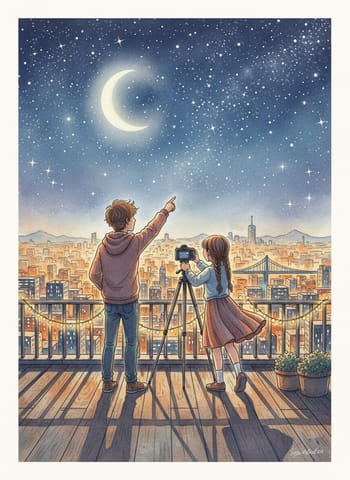
The city lay below them like a map that someone had forgotten to light. Where there were usually rivers of white and orange, there were only soft shapes. Here and there a candle moved behind a window. Above it all, wider than Rui had ever seen it, the sky was full of stars.
Kota terbentang di bawah mereka seperti peta yang lupa dinyalakan. Di tempat yang biasanya ada sungai-sungai cahaya putih dan jingga, kini hanya ada bentuk-bentuk lembut. Di sana-sini sebatang lilin bergerak di balik jendela. Di atas semuanya, lebih luas daripada yang pernah dilihat Rui, langit penuh bintang.
"Set it up," Safiya whispered.
"Pasang," bisik Safiya.
Rui unfolded the tripod, a thin aluminium one he had borrowed from the school photography club. He had checked it twice that afternoon. He screwed the camera onto the top, pointed it at the skyline, and reached into his jacket pocket for the cable release. It was a small plastic button that opened the shutter without touching the camera.
Rui membuka tripod, tripod aluminium tipis yang ia pinjam dari klub fotografi sekolah. Sore tadi ia sudah memeriksanya dua kali. Ia memasang kamera di bagian atasnya, mengarahkannya ke cakrawala kota, dan merogoh saku jaketnya untuk mengambil kabel rana. Itu tombol plastik kecil yang membuka rana tanpa menyentuh kamera.
His pocket was empty.
Sakunya kosong.
He checked the other pocket, and then his back pocket, and then every pocket again in a kind of slow panic. Safiya held the torch while he emptied his bag onto the roof.
Ia memeriksa saku yang lain, lalu saku belakangnya, lalu setiap saku sekali lagi dalam kepanikan yang lambat. Safiya memegang senter sementara ia menumpahkan isi tasnya ke atap.
"It was on my desk," he said at last. "I put it on my desk so I would not forget it."
"Ada di mejaku," katanya akhirnya. "Aku menaruhnya di mejaku supaya tidak lupa."
"Can you press the button on the camera yourself?"
"Bisakah kamu menekan tombol di kameranya sendiri?"
"Any shake at all blurs a twenty-second exposure. The stars would turn into little scratches."
"Goyangan sekecil apa pun mengaburkan eksposur dua puluh detik. Bintang-bintangnya akan jadi goresan kecil."
Safiya chewed her lip. "Then we use the self-timer."
Safiya menggigit bibir. "Kalau begitu kita pakai timer."
"The self-timer lasts ten seconds, and the shutter only stays open for a split second after that. It is the wrong kind of camera." He sat down heavily on the gravel. "I carried this thing up nine floors."
"Timer-nya sepuluh detik, dan rananya hanya terbuka sepersekian detik setelah itu. Ini jenis kamera yang salah." Ia duduk berat di atas kerikil. "Aku sudah membawa benda ini naik sembilan lantai."
For a minute they said nothing. Then Safiya stepped forward to straighten the tripod, because she could not bear to watch it stand there looking pointless. One of its legs folded in half with a small, sad crack.
Selama semenit mereka tidak berkata apa-apa. Lalu Safiya melangkah maju untuk meluruskan tripod, karena ia tak tahan melihatnya berdiri di sana tampak sia-sia. Salah satu kakinya terlipat menjadi dua dengan bunyi retak kecil yang menyedihkan.
The camera slid. Rui caught it a few centimetres above the roof, with both hands and a sound that was not quite a word. The tripod lay on the gravel like a broken umbrella.
Kameranya tergelincir. Rui menangkapnya beberapa sentimeter di atas atap, dengan kedua tangan dan suara yang bukan persis sebuah kata. Tripod itu tergeletak di atas kerikil seperti payung patah.
"I am so sorry," Safiya said.
"Aku sungguh minta maaf," kata Safiya.
"It was always going to break," said Rui, breathing hard. "It belongs to the club. It has been broken for three years. I think I knew."
"Dia memang ditakdirkan patah," kata Rui sambil terengah. "Itu milik klub. Sudah patah selama tiga tahun. Kurasa aku sebenarnya tahu."
He stood there holding the camera against his chest, the last frame still waiting inside it, and for a second he honestly considered going home. Then Safiya started walking along the edge of the roof, looking at things.
Ia berdiri di sana memeluk kamera di dadanya, frame terakhir masih menunggu di dalamnya, dan sesaat ia sungguh-sungguh mempertimbangkan untuk pulang. Lalu Safiya mulai berjalan menyusuri tepi atap, mengamati berbagai hal.
"What is the problem?" she said, mostly to herself. "You need the camera to stay still. You need the shutter to open and close without you touching it. Those are two different problems."
"Apa masalahnya?" katanya, sebagian besar kepada dirinya sendiri. "Kamu butuh kameranya tetap diam. Kamu butuh rananya terbuka dan tertutup tanpa kamu sentuh. Itu dua masalah yang berbeda."
"Thank you. That is a clear summary of my evening."
"Terima kasih. Itu ringkasan yang jelas tentang malamku."
"So we solve them one at a time." She tapped the low brick wall that ran around the edge of the roof. It was about knee height, flat on top, and covered in a thin layer of cold dust. "Here is a tripod that has never been broken in its life."
"Jadi kita selesaikan satu per satu." Ia mengetuk dinding bata rendah yang mengelilingi tepi atap. Tingginya sekitar setinggi lutut, rata di atasnya, dan tertutup selapis debu dingin yang tipis. "Ini tripod yang belum pernah patah seumur hidupnya."
Rui looked at the wall. He took off his jacket and folded it into a thick pad, and he laid the pad on the bricks. When he put the camera on top, it pointed too far at the ground. Safiya dug a coin out of her pocket and slid it under the front of the lens. The camera tilted up to meet the skyline as though it had been waiting for this all along.
Rui memandang dinding itu. Ia melepas jaketnya dan melipatnya menjadi bantalan tebal, lalu menaruh bantalan itu di atas bata. Ketika ia meletakkan kamera di atasnya, arahnya terlalu condong ke tanah. Safiya mengorek sebuah koin dari sakunya dan menyelipkannya di bawah bagian depan lensa. Kamera itu miring naik menyambut cakrawala seakan sudah menunggu ini sejak awal.
"One problem down," said Safiya. "Now the shutter."
"Satu masalah selesai," kata Safiya. "Sekarang rananya."
"This dial has a T setting: one press opens the shutter, and a second press closes it. But every press moves the camera."
"Dial ini punya pengaturan T: satu tekanan membuka rana, dan tekanan kedua menutupnya. Tapi setiap tekanan menggerakkan kamera."
"Then press it only twice, very gently, and keep the lens cap on for both. Press once now, while the cap is on." She held up the black plastic cap. "Then we take the cap off. We count to twenty. We put it back, and you press again. The cap is your shutter."
"Kalau begitu tekan hanya dua kali, dengan sangat lembut, dan biarkan tutup lensa terpasang untuk keduanya. Tekan sekali sekarang, selagi tutupnya terpasang." Ia mengangkat tutup plastik hitam itu. "Lalu kita lepas tutupnya. Kita hitung sampai dua puluh. Kita pasang lagi, dan kamu menekan sekali lagi. Tutup itu adalah ranamu."
"That is not how professionals do it."
"Profesional tidak melakukannya begitu."
"No," she said. "It is how two people on a roof do it."
"Memang tidak," katanya. "Begitulah caranya dua orang di atap."
It was ridiculous. It was also, he realised, exactly the kind of idea that people write down in books. Rui pressed the button with one finger as softly as he had ever done anything, and the camera clicked. The lens was still dark behind the cap. Safiya took her position with the cap in her fingers, and Rui crouched beside the wall and held his breath.
Itu konyol. Itu juga, ia sadar, persis jenis gagasan yang ditulis orang dalam buku. Rui menekan tombol dengan satu jari selembut yang pernah ia lakukan pada apa pun, dan kamera berbunyi klik. Lensanya masih gelap di balik tutup. Safiya mengambil posisi dengan tutup di jarinya, dan Rui berjongkok di samping dinding dan menahan napas.
"Ready?" she whispered.
"Siap?" bisiknya.
"Ready."
"Siap."
She lifted the cap away, and the lens drank in the night. Safiya began to count, quietly, in a voice made of nothing but air. "One. Two. Three."
Ia mengangkat tutup itu, dan lensa menyerap malam. Safiya mulai menghitung, pelan, dengan suara yang hanya terbuat dari udara. "Satu. Dua. Tiga."
At nine, something happened to the horizon.
Pada hitungan kesembilan, sesuatu terjadi pada cakrawala.
A line of light appeared in the far distance, thin as a hair, and began to spread. It ran along the river, jumped a bridge, and bloomed across an entire district in a single trembling wave. Streetlamps lit up in rows. The city was waking up, one neighbourhood at a time, and the wave was heading straight for them.
Sebaris cahaya muncul di kejauhan, setipis rambut, lalu mulai menyebar. Ia berlari menyusuri sungai, melompati sebuah jembatan, dan mekar di seluruh distrik dalam satu gelombang yang bergetar. Lampu-lampu jalan menyala berderet-deret. Kota itu terbangun, satu lingkungan demi satu, dan gelombang itu menuju lurus ke arah mereka.
"The power," Safiya breathed, still counting. "Rui, the lights will ruin it. Should I cover the lens?"
"Listriknya," kata Safiya terengah, masih menghitung. "Rui, lampu-lampu itu akan merusaknya. Perlu kututup lensanya?"
For a long moment Rui could not speak. He thought of the stars, which would fade as the glow rose. He thought of the empty, honest darkness he had waited a month for. Then he thought of a line of light running across a sleeping city like a spark along a fuse.
Untuk waktu yang lama Rui tak bisa bicara. Ia memikirkan bintang-bintang, yang akan memudar saat cahaya naik. Ia memikirkan kegelapan yang kosong dan jujur yang sudah ia tunggu sebulan. Lalu ia memikirkan sebaris cahaya yang berlari melintasi kota yang tertidur seperti percikan api di sepanjang sumbu.
"Do not cover it," he said. "Keep going."
"Jangan ditutup," katanya. "Teruskan."
"Ten," said Safiya. "Eleven. Twelve."
"Sepuluh," kata Safiya. "Sebelas. Dua belas."
The wave crashed into the streets below them. The building shuddered, and the lift, nine floors down, began to hum. The stars were still there, but fainter now, framed by a skyline that glowed.
Gelombang itu menghantam jalan-jalan di bawah mereka. Gedung bergetar, dan lift, sembilan lantai di bawah, mulai berdengung. Bintang-bintang masih di sana, tetapi kini lebih samar, dibingkai cakrawala kota yang berpendar.
"Eighteen," Safiya whispered. "Nineteen. Twenty."
"Delapan belas," bisik Safiya. "Sembilan belas. Dua puluh."
She slid the cap back over the lens. Rui pressed the button a second time, so gently that the camera did not tremble. The shutter closed. The last frame was finished, and somewhere in the dark of the metal box, the whole glowing city was waiting to be developed.
Ia menggeser tutup itu kembali menutupi lensa. Rui menekan tombol untuk kedua kalinya, selembut itu sampai kamera tidak bergetar. Rana menutup. Frame terakhir selesai, dan di suatu tempat dalam gelapnya kotak logam itu, seluruh kota yang berpendar menunggu untuk dicuci.
Rui let out a breath he seemed to have been holding for a month. Then he picked up the broken tripod, tucked it under one arm, and followed Safiya toward the stairs, where the lights were already coming on.
Rui mengembuskan napas yang rasanya sudah ia tahan selama sebulan. Lalu ia mengambil tripod yang patah itu, menyelipkannya di bawah satu lengan, dan mengikuti Safiya menuju tangga, tempat lampu-lampu sudah mulai menyala.